
AI in Lending: Underwriting Models, Fraud Detection & Model Risk
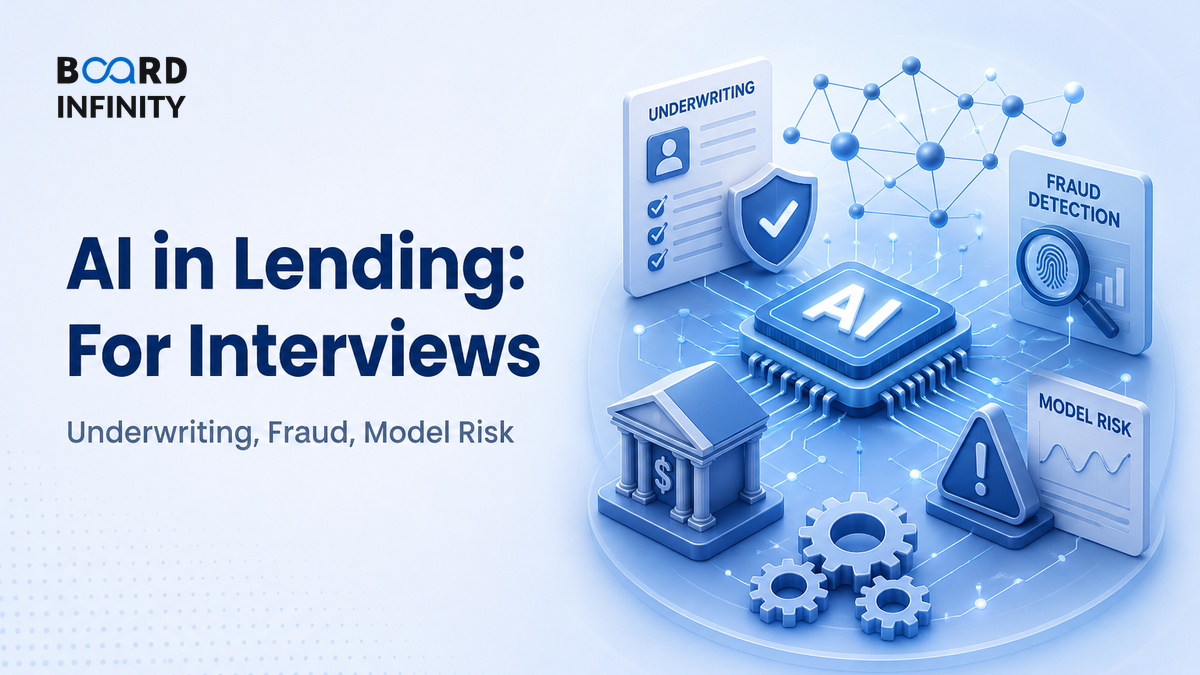
A ₹75,000 instant loan can be approved in minutes, but the lender is making a high-stakes bet on a stranger it may never meet. The AI model has to answer three questions at once: will this borrower repay, is this application genuine, and can we trust the model itself when the economy changes?
- AI in lending uses data and models to estimate credit risk, detect fraud, price loans, set limits and monitor portfolios.
- The lending model stack has three layers: underwriting for willingness and ability to repay, fraud detection for identity and intent, and model risk management for governance.
- Core credit identity: Expected Loss = PD × LGD × EAD, where PD is probability of default, LGD is loss if default occurs, and EAD is exposure at default.
- Good lending AI is not just high approval. It must improve risk-adjusted returns while staying explainable, fair, monitored and compliant.
- Key metrics to revise: AUC, KS, approval rate, 30+ DPD rate, expected loss, fraud precision and PSI.
- In India, useful signals include bureau data, bank statements, GST cash flows, device signals and Account Aggregator data, subject to consent and RBI digital lending norms.
- The biggest interview trap is praising a black-box model without explaining drift, bias, overrides and model validation.
Big Picture
Think of AI lending as a decision factory. Raw borrower signals enter the system, models convert them into risk scores, policy rules turn scores into actions, and monitoring checks whether the model still behaves safely after disbursal.
Core Explanation
The clean way to explain AI in lending is to separate credit risk, fraud risk and model risk. Credit risk asks, “Will a genuine borrower repay?” Fraud risk asks, “Is this borrower or transaction genuine?” Model risk asks, “Can we safely rely on this model?”
1. Underwriting Models: Predicting Repayment
Underwriting is the process of assessing a borrower’s ability and willingness to repay, then deciding approval, pricing and limits. Traditional underwriting relied heavily on income documents, bureau score, employment and collateral. AI underwriting can add richer signals such as bank statement cash flows, GST activity for MSMEs, transaction patterns, repayment behaviour, device consistency and application behaviour.
The output is usually a risk score or probability of default. A lender then applies policy rules: approve, reject, route to manual review, offer a smaller limit, charge a higher rate, or ask for additional verification.
2. Fraud Detection: Catching Intentional Deception
Fraud detection identifies intentionally deceptive applications or transactions before the lender loses money. In digital lending, fraud can include synthetic identities, stolen identities, forged salary documents, mule accounts, device farms, collusive merchants, repeat defaulters changing identifiers, or income manipulation.
Fraud models often work differently from credit models. Credit models learn from repayment over months. Fraud systems must act in seconds and often combine rules, anomaly detection, graph analytics and manual investigation.
3. Model Risk: Making AI Safe Enough to Use
Model risk becomes critical because lending models directly affect money, customers and regulatory exposure. A model trained on old data may fail during a job-market shock. A feature may unintentionally proxy for a protected or sensitive attribute. A highly accurate model may still be unusable if credit managers cannot explain its decisions to customers, auditors or regulators.
Good lenders therefore treat AI as a governed system, not a magic scoring machine. They validate the model before launch, monitor it after launch, document assumptions, define human override rules and keep a champion-challenger setup where a new model is tested against the current production model.
Key Metrics to Track
Interviewers like this topic because it tests whether you can connect analytics with lending economics. Do not stop at “accuracy.” Lending models are judged on discrimination, profitability, stability, fraud control and portfolio outcomes.
Worked Example: Expected Loss in a Digital Loan
Suppose a lender is evaluating a ₹1,00,000 personal loan. The model estimates PD = 4%. Based on recoveries and collection experience, the lender assumes LGD = 60%. Exposure at default is EAD = ₹1,00,000.
Expected Loss = 4% × 60% × ₹1,00,000 = ₹2,400.
If the expected interest and fee income is ₹18,000 and funding plus operating cost is ₹11,000, the pre-capital risk-adjusted contribution is ₹18,000 - ₹11,000 - ₹2,400 = ₹4,600. The model’s job is not to approve everyone. Its job is to approve customers where risk-adjusted economics remain attractive and compliant.
An Indian MSME lender may use bureau history, GST cash-flow patterns, bank statement inflows, cheque bounce behaviour and Account Aggregator data with customer consent. The strategic point is that AI expands underwriting beyond collateral, but the lender still needs KYC, consent, explainability, collections capability and RBI-aligned governance.
Definitions
U.S. Federal Reserve and OCC SR 11-7 define model risk as “the potential for adverse consequences from decisions based on incorrect or misused model outputs and reports.”
Expected Loss is the standard credit risk estimate: Probability of Default × Loss Given Default × Exposure at Default.
- PD: Probability that a borrower defaults within a defined time horizon.
- LGD: Percentage of exposure the lender expects to lose if default occurs.
- EAD: Amount outstanding when the borrower defaults.
- Scorecard: A model that converts borrower features into a risk score used for credit decisions.
- Drift: A change in data or model performance after deployment versus the development period.
U GRO Capital: AI-Led MSME Lending in India
U GRO Capital built a data-led MSME lending model to serve small businesses that often have weak collateral but usable digital cash-flow signals.

Situation: MSME lending in India is difficult because many small businesses are profitable but under-documented. Traditional secured lending can miss these borrowers because collateral, formal financials and standardized credit histories are often incomplete. At the same time, lenders cannot simply relax standards because MSME cash flows can be volatile and collections are operationally intensive.
The move: U GRO Capital positioned itself as a data-tech NBFC focused on MSMEs. Its approach uses sector understanding, bureau inputs, banking data, GST-linked business signals where available and internal scorecards to assess borrower cash flows. The primary driver is cash-flow based underwriting for specific MSME segments. Supporting drivers include co-lending partnerships, focused product design, digital acquisition and risk monitoring after disbursal.
Outcome or lesson: The important lesson is not “AI approves more loans.” The lesson is that AI can make MSME credit more scalable only when it is combined with segment expertise, risk-based pricing, collections discipline, partner governance and continuous model monitoring.
How AI Changes AI in Lending
By 2026, AI is changing lending in three concrete ways, but each one increases the need for governance.
- Cash-flow underwriting becomes richer: Models can read bank statement patterns, GST-linked activity, salary inflows, repayment behaviour and consented Account Aggregator data to assess borrowers with thin bureau files. This helps in India, especially for MSMEs and new-to-credit customers, but data consent and purpose limitation matter under privacy expectations and the Digital Personal Data Protection Act.
- Fraud detection becomes real time: ML models can flag device anomalies, velocity patterns, identity inconsistencies, mule account behaviour and suspicious network links before disbursal. The best systems combine rules, graph signals, anomaly detection and investigator feedback.
- Model risk becomes more complex: LLMs can summarize credit memos, extract document information and assist collections scripts, but lenders must guard against hallucination, unfair treatment, poor explainability and uncontrolled overrides. AI assistance is acceptable only when decision rights and audit trails are clear.
Load a lender annual report, RBI digital lending guidelines notes and this lesson into NotebookLM. Ask: “Generate 10 interview questions on this lender’s AI underwriting, fraud control, asset quality and model risk, with answer bullets using only uploaded sources.”
Interview Relevance
“A digital lender wants to use AI to approve personal loans faster. How would you design the underwriting model, fraud checks and model risk controls?”
A strong answer says, “I would not deploy the model only because AUC is high. I would check whether it improves risk-adjusted return after fraud losses, operational review cost, fairness checks and portfolio drift.”
Common Mistake
The common mistake is treating AI lending as a pure accuracy problem. That costs candidates because lending is a regulated balance-sheet business, not a Kaggle leaderboard. Fix: always connect the model to expected loss, fraud leakage, approval policy, customer fairness, monitoring and governance.
What to Revise Next
Next, move from concept to comparison: revise Case Study: Comparing Two Indian Lenders on a Single Metric Sheet. It will help you turn AI lending theory into a crisp, numbers-led discussion of asset quality, growth, profitability and risk discipline.