
Banking & Lending at a Glance: Size, Growth & Structure
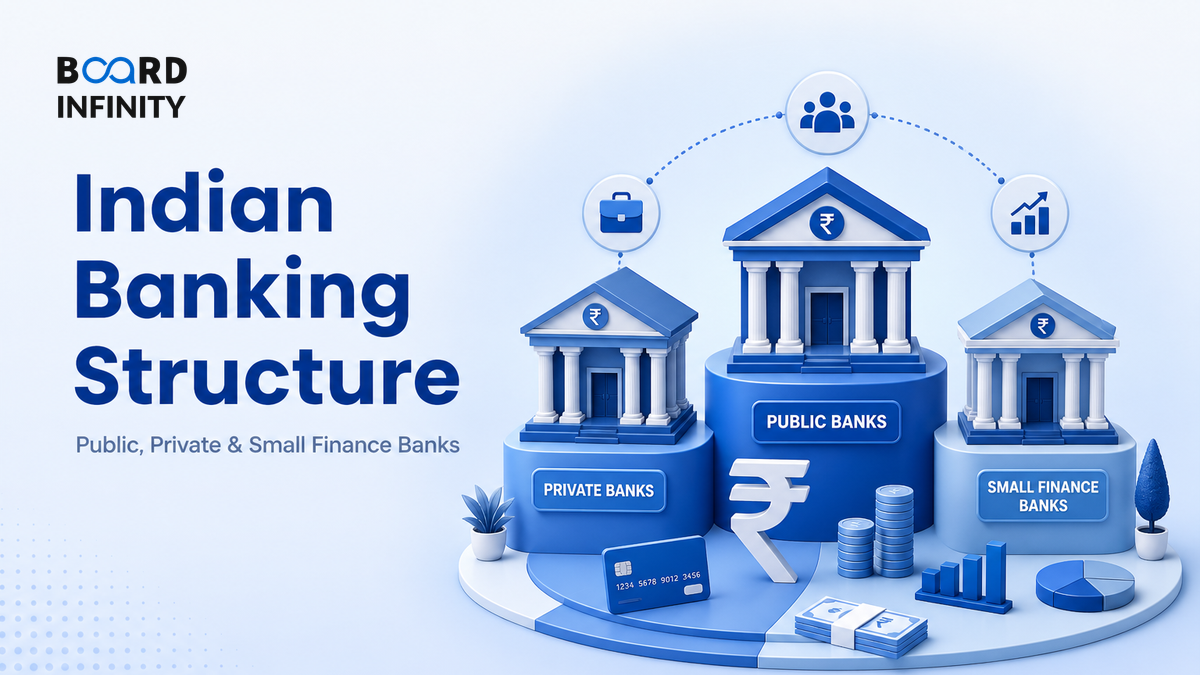
At 9:30 a.m., a kirana owner waits for yesterday’s UPI settlement, an MSME founder chases working-capital approval, and a pensioner checks whether her savings are safe. All three may be dealing with “a bank” - but the bank’s ownership, license and customer model decide its cost of funds, risk appetite and growth strategy.
- Public sector banks are majority government-owned commercial banks; their edge is trust, scale and low-cost deposits.
- Private sector banks are privately owned commercial banks; their edge is execution, digital distribution, risk analytics and fee income.
- Small finance banks are differentiated banks focused on financial inclusion - small borrowers, micro businesses, small farmers and underserved customers.
- All three are regulated by the Reserve Bank of India, but their business models differ in ownership, customer segment, distribution and asset risk.
- The interview answer should separate license, ownership, liability franchise, asset focus and risk metrics.
- Core metrics to compare banks: CASA ratio, cost of funds, NIM, gross NPA ratio, provision coverage ratio, credit-deposit ratio and CRAR.
- The trap: saying “public is safe, private is efficient, SFB is small” without explaining the economics behind each model.
Big Picture: The Indian Banking Map
Think of Indian banking as a regulated ladder. At the top sits the RBI, which licenses and supervises banks. Under it are scheduled commercial banks, and inside that family, public sector banks, private sector banks and small finance banks play different roles in the same financial system.
Core Explanation: How Public, Private and Small Finance Banks Differ
The cleanest way to understand Indian banking is to separate who owns the bank from what license it has and which customers it is built to serve.
Public sector banks are majority government-owned. They usually have deep branch networks, strong trust among depositors, large government and public-sector relationships, and a wide role in financial inclusion and priority-sector lending. Their strategic strength is often a large, stable, low-cost deposit base; their management challenge is operating productivity, legacy systems and asset-quality discipline.
Private sector banks are owned mainly by private shareholders and are listed or privately held institutions under RBI supervision. Their strength is sharper execution - better cross-sell, technology-led acquisition, stronger risk models and faster product innovation. Their challenge is maintaining deposit growth at a reasonable cost while expanding loans profitably.
Small finance banks are not “tiny banks” in a casual sense. They are differentiated banks created to serve underserved segments - micro and small enterprises, small farmers, informal workers and customers outside the prime banking mainstream. Their strength is last-mile credit knowledge and high-touch distribution; their challenge is building a low-cost deposit franchise and managing credit risk in granular borrower segments.
Comparison Table: Public vs Private vs Small Finance Banks
The Business Model Logic: Deposits, Loans, Spread and Risk
A bank is not just a lender. It is a balance-sheet business. It collects deposits, lends or invests that money, earns a spread, manages credit losses, and maintains regulatory capital. The type of bank changes each part of this chain.
Key Banking Metrics to Compare These Banks
Use these metrics to sound analytical instead of generic. The “good” number depends on bank type, economic cycle and loan mix, so treat the ranges below as interview heuristics, not absolute cut-offs.
Worked example: Suppose Bank A earns ₹1,000 crore interest, pays ₹600 crore interest, and has average earning assets of ₹10,000 crore. Its NIM is (₹1,000 - ₹600) / ₹10,000 = 4%. If its CASA ratio is also high and NPAs are low, that 4% is high-quality profitability. If NPAs are rising, the same NIM may be compensating for higher credit risk.
Definitions You Should Be Able to Say Clearly
- Banking: Accepting public deposits for lending or investment, repayable and withdrawable through payment instruments.
- Scheduled bank: A bank included in the Second Schedule to the Reserve Bank of India Act, 1934.
- Public sector bank: A commercial bank in which the Government of India owns a majority stake.
- Private sector bank: A commercial bank owned mainly by private shareholders and regulated by RBI.
- Universal bank: A bank offering broad deposit, credit, payment and fee-based services under one banking license.
- RBI on SFBs: SFBs further financial inclusion through savings and credit for small businesses, small farmers, micro industries and unorganised entities.
Case Study: AU Small Finance Bank and the SFB Transition
AU shows how an inclusion-led lender can use a small finance bank license to move from focused asset lending toward a fuller deposit-led banking model.

Situation: AU began as a vehicle-finance focused non-bank lender with strong knowledge of local borrowers and small-ticket credit. That gave it an asset-side advantage - it understood customers who were often not fully served by large universal banks.
The move: After receiving an RBI small finance bank license, AU converted into a bank and began building the liability side of the franchise - savings accounts, current accounts, term deposits, branches and digital banking. In 2024, AU completed its merger with Fincare Small Finance Bank, a move that broadened its customer base and strengthened its presence in microfinance-linked segments.
The lesson: The primary driver of AU’s strategy is not simply “being small.” It is the shift from asset-originator economics to deposit-funded bank economics. Supporting drivers include local credit knowledge, branch expansion, technology investment, cross-sell potential and the regulatory credibility of a bank license.
So what: AU proves that the structure of Indian banking is strategic, not administrative. The license decides what customer need the bank is designed to solve, while funding quality and risk control decide whether that model can scale profitably.
How AI Changes Indian Banking Structure
AI does not replace RBI licenses or ownership categories. It changes the economics inside each category - especially credit selection, fraud control, branch productivity and compliance cost.
- AI underwriting strengthens SFBs and private banks: With consent-based data, account aggregator rails and transaction histories, banks can assess thin-file MSME and informal borrowers better. The caveat is model bias, explainability and RBI digital-lending compliance.
- AI fraud and AML systems raise the hygiene bar: Public, private and small finance banks increasingly use machine learning to flag unusual transactions, mule-account patterns and early warning signals. This makes risk infrastructure a competitive advantage, not a back-office detail.
- AI changes distribution productivity: Multilingual chatbots, agent-assist tools and document automation can make branches and relationship managers more productive, especially outside metro markets where assisted banking remains important.
Use NotebookLM: upload the latest annual report of one public bank, one private bank and one SFB, plus RBI’s SFB guidelines. Ask: “Compare these banks on license, CASA, NIM, GNPA, CRAR, customer focus and strategic risk. Generate five placement interview questions.”
Interview Relevance
“Explain the structure of Indian banking. How is a public sector bank different from a private sector bank and a small finance bank?”
If the interviewer asks “Which model is better?”, do not choose blindly. Say: “It depends on the segment. Public banks have deposit trust and reach, private banks often lead in execution, and SFBs are built for underserved niches. The right comparison is risk-adjusted profitability.”
Common Mistake
The most common error is treating bank categories as stereotypes - “public equals safe, private equals efficient, SFB equals small.” That sounds shallow because it ignores license, funding cost, asset mix and credit risk. Fix: explain every bank through four lenses - ownership, license, liability franchise and asset-risk profile.