
Digital Banking, Unified Payments & India's Financial Infrastructure
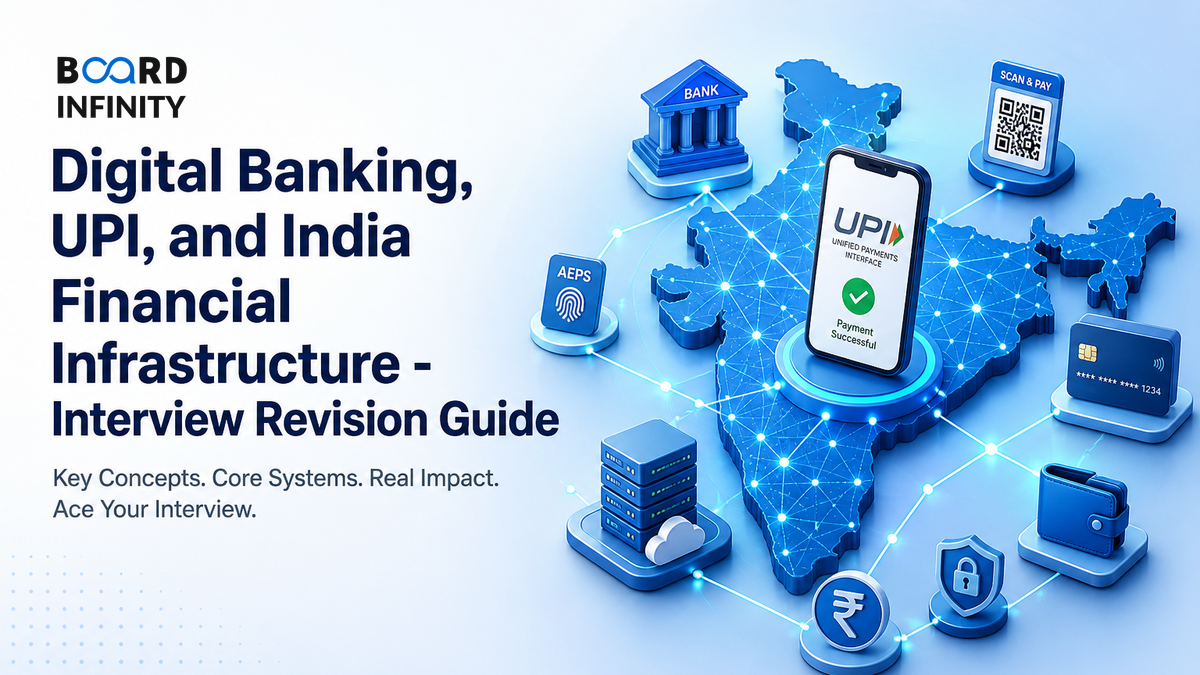
Most people think UPI is a payments app. It is not - it is the invisible rail underneath dozens of apps, banks, merchants and fraud controls that makes a street-side QR payment feel instant.
- Digital banking is banking delivered through digital channels, but deposits, lending and payment settlement still sit inside regulated financial institutions.
- UPI is an interoperable, real-time, account-to-account payment rail operated by NPCI and overseen by RBI.
- India’s financial infrastructure works in layers: identity and KYC, bank accounts, payment rails, consented data sharing, apps, risk controls and settlement.
- The magic of UPI is not only technology - it is interoperability, bank participation, low user friction, QR acceptance, regulatory trust and a common switching layer.
- Digital banking business models differ: a bank app owns the balance sheet, a neobank often owns the interface, and a payments bank has a restricted RBI licence.
- Track digital payment quality through success rate, technical decline rate, latency, availability, fraud loss rate and reconciliation lag.
- The safest interview answer separates front-end experience from back-end infrastructure; confusing the two is the most common error.
Big Picture: India’s Digital Banking Stack
Think of India’s digital finance system as a stack, not a single product. The customer sees a clean app screen; underneath it sit identity rails, bank ledgers, payment switches, regulatory rules, data consent frameworks and risk engines.
Core Explanation: What Actually Happens in Digital Banking
Digital banking means banking products and services delivered through electronic channels - mobile apps, web platforms, APIs, cards, QR codes, chat, kiosks and embedded finance journeys. But the key interview point is this: digital does not remove regulation. It changes the interface, speed, data flow and cost structure.
India’s system is powerful because it combines public digital infrastructure with competitive private innovation. Aadhaar and PAN help with identity, banks hold regulated accounts, NPCI operates important retail payment rails such as UPI and IMPS, RBI regulates payment systems, and fintechs compete on user experience, distribution and analytics.
The UPI Transaction Loop
A UPI payment feels like one tap, but operationally it is a loop across the payer app, payer bank, NPCI switch, beneficiary bank, merchant system and reconciliation layer. The loop matters because failures can happen at different points - app issue, bank downtime, switch latency, wrong credentials, fraud block or settlement mismatch.
The Main Building Blocks You Must Know
Use this map to avoid vague answers. The strongest candidates name the layer, the institution responsible, and the business implication.
Digital Banking Business Models: Do Not Mix Them Up
A banking app, a neobank, a wallet and a payments bank can all look similar on a phone. Their economics and regulation are different. In interviews, classify them by two questions: who controls the customer interface, and who controls the regulated balance sheet?
Payments banks in India can accept demand deposits up to ₹2 lakh per individual customer, but they cannot lend or issue credit cards. The strategic point: a payments bank competes on low-cost transaction banking and distribution, not on loan spreads like a universal bank.
Metrics That Prove a Digital Banking System Is Healthy
Do not say “good UX” or “secure platform” without measures. Digital banking quality is measured through reliability, speed, risk and reconciliation.
Worked Example: Reading a UPI Reliability Snapshot
Suppose a bank processes 10,00,000 UPI payment attempts in a day. 9,70,000 succeed, 18,000 fail due to customer mistakes such as wrong PIN or insufficient balance, and 12,000 fail due to technical reasons. Confirmed fraud loss is ₹2,00,000 on transaction value of ₹50 crore.
The interview lesson: a platform can have a good success rate and still hide a technical reliability problem or a fraud trend. Always decompose the metric.
Definitions You Can Say Clearly
- Digital banking: Delivery of banking products and services through electronic channels, backed by regulated accounts, controls and ledgers.
- NPCI on UPI: “UPI is a system that powers multiple bank accounts into a single mobile application.”
- NEFT, as described by RBI: “NEFT is a nation-wide centralised payment system owned and operated by the Reserve Bank of India.”
- Interoperability: The ability of different banks, apps and merchants to transact through common rules and technical standards.
- Settlement: Final transfer of funds between participating financial institutions after transaction authorization and clearing.
- Account Aggregator: A consent-based framework that lets customers share financial data securely between regulated entities.
Case Study: Airtel Payments Bank and the Distribution-Plus-Infrastructure Play
Airtel Payments Bank shows how digital banking in India is not just an app story - it is a regulated licence, telecom distribution, payment rails and trust infrastructure working together.

Situation. India had millions of customers who were comfortable with mobile usage but still needed simple, trusted ways to transact, pay bills and move money. A pure app-only model would struggle in segments where cash, assisted onboarding and local trust still matter.
The move. Airtel Payments Bank used a payments bank licence and Airtel’s distribution footprint to offer small-value transaction banking services. Its model leaned on India’s existing financial infrastructure - KYC, bank-grade accounts, UPI, bill payments and cash-in/cash-out touchpoints - instead of trying to build an isolated closed-loop wallet.
The result and lesson. The strategic lesson is not “telecom distribution wins.” The primary driver is the combination of regulated transaction banking with a large assisted distribution network. Supporting drivers include brand familiarity, merchant touchpoints, digital rails like UPI and BBPS, and RBI’s payments bank framework that clearly defines what such a bank can and cannot do.
A shallow answer says Airtel Payments Bank is “a digital wallet.” A complete answer says it is a restricted bank model using distribution and interoperable payment infrastructure to serve high-frequency transaction needs.
How AI Changes Digital Banking, UPI and India Financial Infrastructure
1. AI improves fraud and anomaly detection. Real-time payment systems create huge transaction velocity. Machine learning models can flag unusual device behaviour, mule-account patterns, impossible transaction sequences, beneficiary risk and social-engineering signals faster than rule-only systems. The caveat: false positives can block genuine customers, so model governance and appeal processes matter.
2. AI personalises digital banking journeys. Banks and fintechs can use behavioural data, consented financial data and transaction patterns to recommend savings nudges, bill reminders, cash-flow alerts and contextual credit offers. In India, this must be balanced with consent, privacy, RBI conduct expectations and DPDP Act compliance.
3. AI strengthens operations behind the screen. LLMs can summarise complaints, classify failed transactions, assist call-centre agents, generate reconciliation exception reports and monitor API incident logs. The biggest gain is not only customer-facing chat; it is faster issue resolution inside the payment operations room.
Use Perplexity or NotebookLM to compare one bank and one fintech app: load RBI FAQs, NPCI UPI documentation, the company annual report or investor presentation, and ask, “Which layers of the digital banking stack does this firm own, partner for, or depend on?” Then convert the answer into a 2-minute interview pitch.
Interview Relevance
“Explain how UPI changed Indian banking. Is it mainly a technology innovation, a regulatory innovation, or a business model innovation?”
If the interviewer pushes for examples, use one bank-led example and one non-bank front-end example. That proves you understand the difference between regulated balance sheet ownership and customer interface ownership.
Common Mistake
The mistake that costs candidates is saying “UPI is an app” or “fintechs move the money.” That collapses the entire infrastructure stack into the visible screen and makes your answer sound shallow. Fix it in one line: apps initiate the experience, banks hold the accounts, NPCI switches the transaction, and regulated settlement makes it final.
What to Revise Next
Once you can separate digital banking interfaces from payment infrastructure, move to the credit and risk layer that sits on top of this data-rich system.