
Deposits, Low-Cost Balances & the Cost of Funds Battle
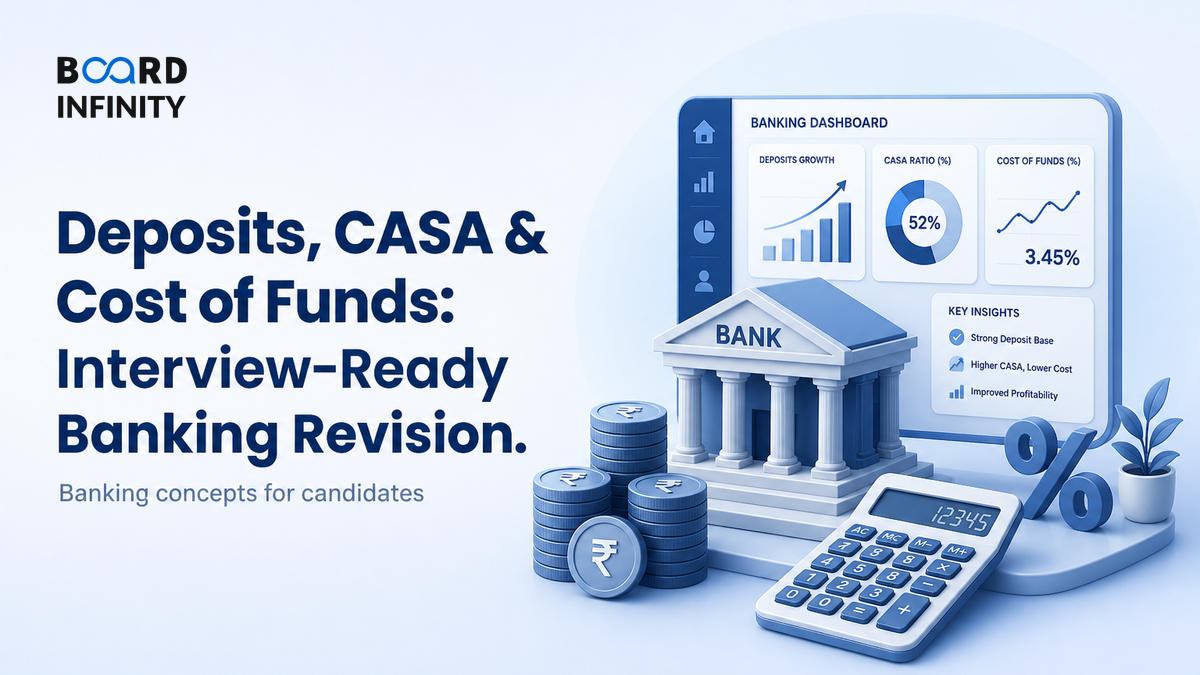
A bank can announce strong loan demand and still feel nervous if deposits are not arriving fast enough. That is the quiet battle in banking: the cheapest money is not raised in a bond market - it sits in customers' current and savings accounts, waiting to be won, retained and repriced carefully.
- Deposits are the raw material of lending: banks collect deposits, pay interest on them, and deploy them into loans and investments.
- CASA means Current Account Savings Account: these balances usually cost less than term deposits and improve a bank's funding advantage.
- Cost of funds is the blended cost of all interest-bearing funding, not just customer deposits.
- Low-cost balances matter twice: they reduce interest expense and give banks pricing flexibility on loans.
- But cheap is not enough: good deposits must also be stable, granular, diversified and compliant with liquidity rules.
- The core interview logic: deposit mix shapes cost of funds, cost of funds shapes loan pricing, and loan pricing shapes NIM and profitability.
Big Picture: Deposits Are the Bank's Raw Material
A bank does not simply “have money to lend.” It competes continuously to source funds, and the quality of those funds decides how aggressively it can price loans, absorb rate shocks and defend margins. The deposit franchise is therefore not a back-office liability item - it is a strategic moat.
Core Explanation: Why Low-Cost Balances Win the Funding Battle
Deposits are amounts placed by customers with a bank, repayable on demand or after a fixed period. For a bank, deposits are liabilities because the money belongs to customers, but they are also the main funding source for assets such as loans and investments.
The battle is about mix. A bank with a larger share of low-cost, stable deposits can earn the same loan yield as a rival but keep more of it as margin. That difference shows up in NIM - Net Interest Margin, the spread between what the bank earns on assets and what it pays on funding.
The Three Deposit Buckets You Must Know
CASA is the combined share of current account and savings account deposits. A high CASA ratio usually indicates a strong low-cost deposit franchise, but it is not automatically superior. A bank also needs these balances to be granular, recurring and relationship-linked, not just temporarily attracted through promotional rates.
How Deposit Mix Becomes Cost of Funds
Cost of deposits measures what a bank pays on customer deposits. Cost of funds is broader: it includes deposits plus other interest-bearing borrowings. When term deposit rates rise, the bank's funding cost rises unless CASA and other low-cost balances cushion the increase.
Key Banking Metrics: What to Track
When an interviewer asks about deposits, do not stop at CASA. Use a small dashboard that connects deposit quality to profitability and liquidity.
Worked Example: Why a 5% CASA Shift Matters
Assume a bank has ₹100,000 crore of deposits: ₹10,000 crore current account at 0%, ₹30,000 crore savings at 3%, and ₹60,000 crore term deposits at 6.5%.
The lesson is powerful: a small change in deposit mix can materially change funding cost. But in real banking, earning that shift requires branches, trust, digital convenience, transaction flows and relationship depth.
Definitions You Can Say in One Breath
- RBI - Demand liabilities: liabilities of a bank which are payable on demand.
- RBI - Time liabilities: liabilities of a bank which are payable otherwise than on demand.
- CASA ratio: current account and savings account deposits as a percentage of total deposits.
- Cost of deposits: interest paid on deposits divided by average deposits.
- Cost of funds: total interest expense divided by average interest-bearing liabilities.
- Net Interest Margin: net interest income divided by average earning assets.
Case Study: IDFC FIRST Bank and the Retail Deposit Franchise Build
IDFC FIRST Bank shows how a bank can move from a more wholesale-oriented funding profile toward a retail liability franchise to improve strategic control over funding.

Situation: IDFC Bank began with a stronger institutional and infrastructure-finance heritage than many retail-heavy private banks. After the 2018 merger with Capital First, the combined bank needed to support a more retail-oriented asset strategy with a stronger retail liability base. In plain language, lending growth needed a matching deposit engine.
The move: The bank invested in savings accounts, customer-friendly service design, branch expansion, digital onboarding and retail relationship-building. Its primary driver was the deliberate shift toward a granular retail liability franchise. Supporting drivers included brand repositioning, product pricing, cross-sell into retail customers, improved digital journeys and a gradual reduction in dependence on less franchise-like funding sources.
The outcome and lesson: The bank became a useful example of why deposits are strategic, not passive. The lesson is not that higher savings rates alone build a franchise. The stronger answer is that deposit growth comes from a system: trust, access, pricing, service quality, digital convenience, relationship managers and consistent execution.
So what: In an interview, this case helps you avoid a shallow “CASA is cheap” answer. A better answer says: low-cost deposits reduce funding cost, but the bank earns them through product design, distribution, trust, technology and relationship depth.
How AI Changes Deposits, Low-Cost Balances & the Cost of Funds Battle
AI is making deposit management more scientific. Banks still need trust and regulation-first execution, but the best liability franchises now use data to decide which customer to acquire, which balance to retain and which price to offer.
Student workflow: Use NotebookLM for interview prep. Upload a bank's latest annual report, investor presentation and one RBI banking trends document, then ask: “Summarize this bank's deposit mix, CASA trend, cost of deposits, NIM movement and likely interview questions on its funding strategy.” Cross-check every number with the original page before using it.
Interview Relevance
“Why are banks so focused on CASA and low-cost deposits? Explain how deposit mix affects profitability, and give an Indian banking example.”
If you want to sound banker-like, say: “A liability franchise is a moat only when it is low-cost, granular and behaviourally sticky.” That one sentence separates a strong answer from a textbook answer.
Common Mistake
The mistake: saying “high CASA is always good” and stopping there. It costs candidates because banks care about the quality of deposits, not only the headline ratio. One-line fix: always evaluate deposits on four dimensions - cost, stability, granularity and liquidity impact.
What to Revise Next
Now connect the liability side to the asset side. Revise Lending Products Across Retail, Small Business, Corporate & Agriculture to see where deposits get deployed, then move to Credit Appraisal: From Application to Sanction, Step by Step to understand how banks decide which borrowers deserve that funded capital.