
B2B vs B2C Marketing: Differences, Examples and Strategy
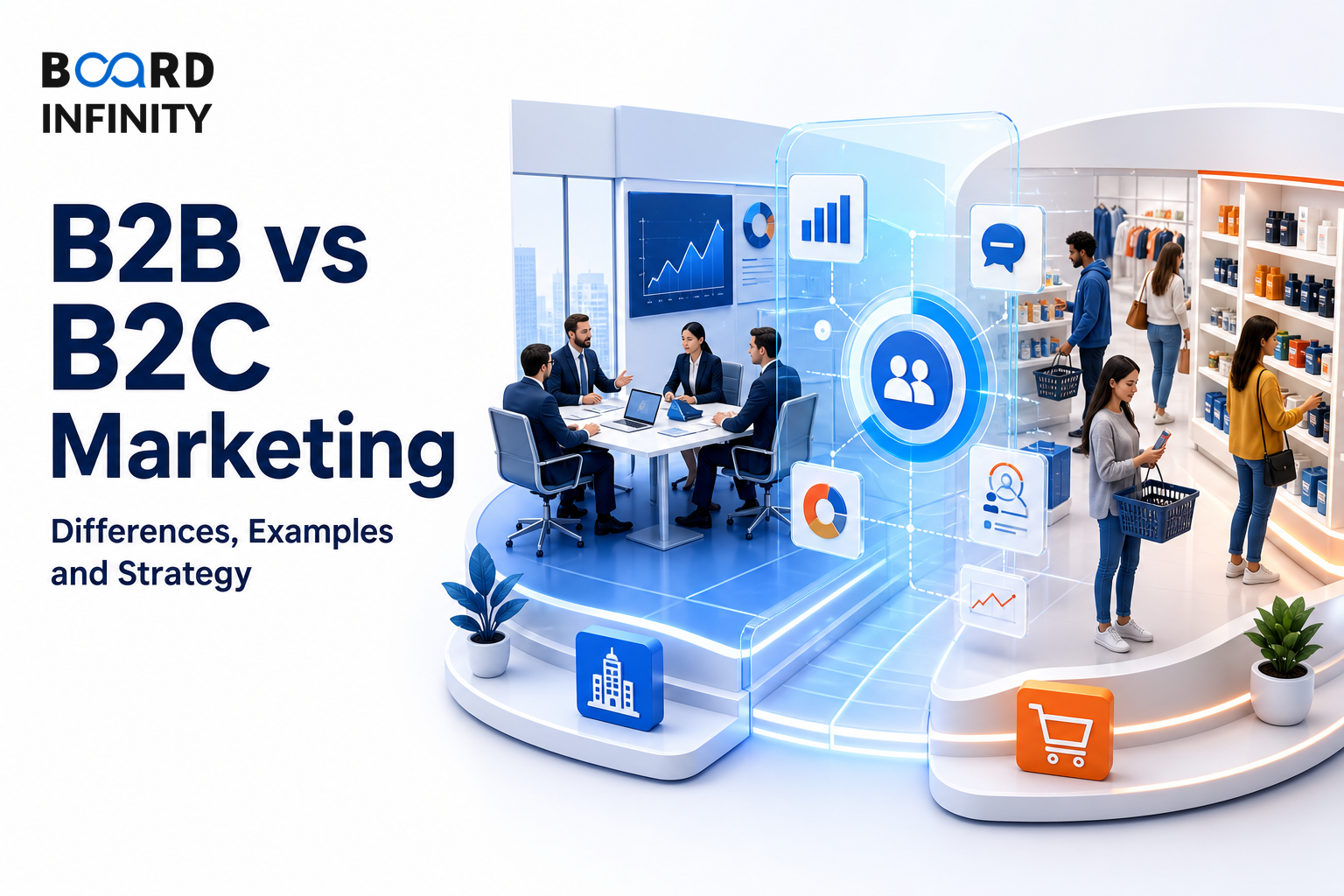
After distinguishing how goods and services are marketed, the next interview question is how marketing changes when the buyer is a business versus an individual consumer. Business-to-Business (B2B) and Business-to-Consumer (B2C) marketing differ fundamentally in their approach, audience, and execution, so interviewers expect a clear comparison of who buys, why they buy, how long decisions take, and which channels or content formats marketers should use.
- B2B means Business-to-Business: marketing and sales from one company to another.
- B2C means Business-to-Consumer: marketing directly to individual consumers.
- B2B decision makers are a buying committee / BANT qualified, while B2C decision makers are an individual consumer or household.
- B2B sales cycles are weeks to months, while B2C sales cycles are seconds to days.
- B2B motivation is ROI, efficiency, business value, risk reduction; B2C motivation is emotion, desire, convenience, status.
- B2B channels include LinkedIn, email, events, direct sales; B2C channels include Instagram, YouTube, WhatsApp, retail.
- BANT means Budget, Authority, Need, Timeline, and is used by sales teams to qualify leads before investing time.
Big Picture: How B2B and B2C Marketing Differ
Business-to-Business (B2B) and Business-to-Consumer (B2C) marketing differ fundamentally in their approach, audience, and execution. The practical comparison is best understood across decision maker, sales cycle, motivation, content, relationship, average deal size, channels, pricing, and decision factors.
BANT Framework for B2B Qualification
BANT is a B2B qualification framework used by sales teams to qualify leads before investing time. It checks whether a lead has the budget, authority, need, and timeline required for a serious buying process.
What B2B Marketing Emphasizes
In B2B, the decision maker is a buying committee / BANT qualified. The sales cycle usually runs from weeks to months because the buying process is complex and multi-stage.
The motivation is ROI, efficiency, business value, and risk reduction. This is why B2B content usually includes whitepapers, case studies, webinars, and ROI calculators, while the relationship is built around long-term partnership and account management.
What B2C Marketing Emphasizes
In B2C, the decision maker is an individual consumer or household. The sales cycle is much shorter, ranging from seconds to days, from impulse to considered purchase.
The motivation is emotion, desire, convenience, and status. This is why B2C content usually includes reels, stories, influencer content, and ads, while the relationship is transactional / loyalty-based.
Channels, Pricing and Decision Factors
B2B channels include LinkedIn, email, events, and direct sales. B2C channels include Instagram, YouTube, WhatsApp, and retail.
B2B pricing usually involves custom quotes, volume discounts, and contracts, while B2C pricing is fixed MRP / dynamic pricing. B2B decision factors include features, integration, support, TCO, and compliance; B2C decision factors include brand, reviews, price, and availability.
Structuring a B2B vs B2C Marketing Interview Answer
"How would you compare B2B and B2C marketing in terms of buyer, decision cycle, motivation, content and channels?"
The strongest answers do not treat B2B versus B2C as only a channel difference. Anchor the comparison in decision maker, sales cycle, motivation, content, relationship, average deal size, pricing and decision factors.
The common mistake is saying B2B uses LinkedIn and B2C uses Instagram without explaining why. That costs points because the deeper difference is the buyer, motivation, decision cycle, relationship, pricing and decision factors.
Conclusion
B2B and B2C marketing differ in approach, audience and execution. For interviews, compare them across decision maker, sales cycle, motivation, content, relationship, deal size, channels, pricing and decision factors, then use BANT to show how B2B leads are qualified.