
Goods vs Services Marketing: What's the Difference?
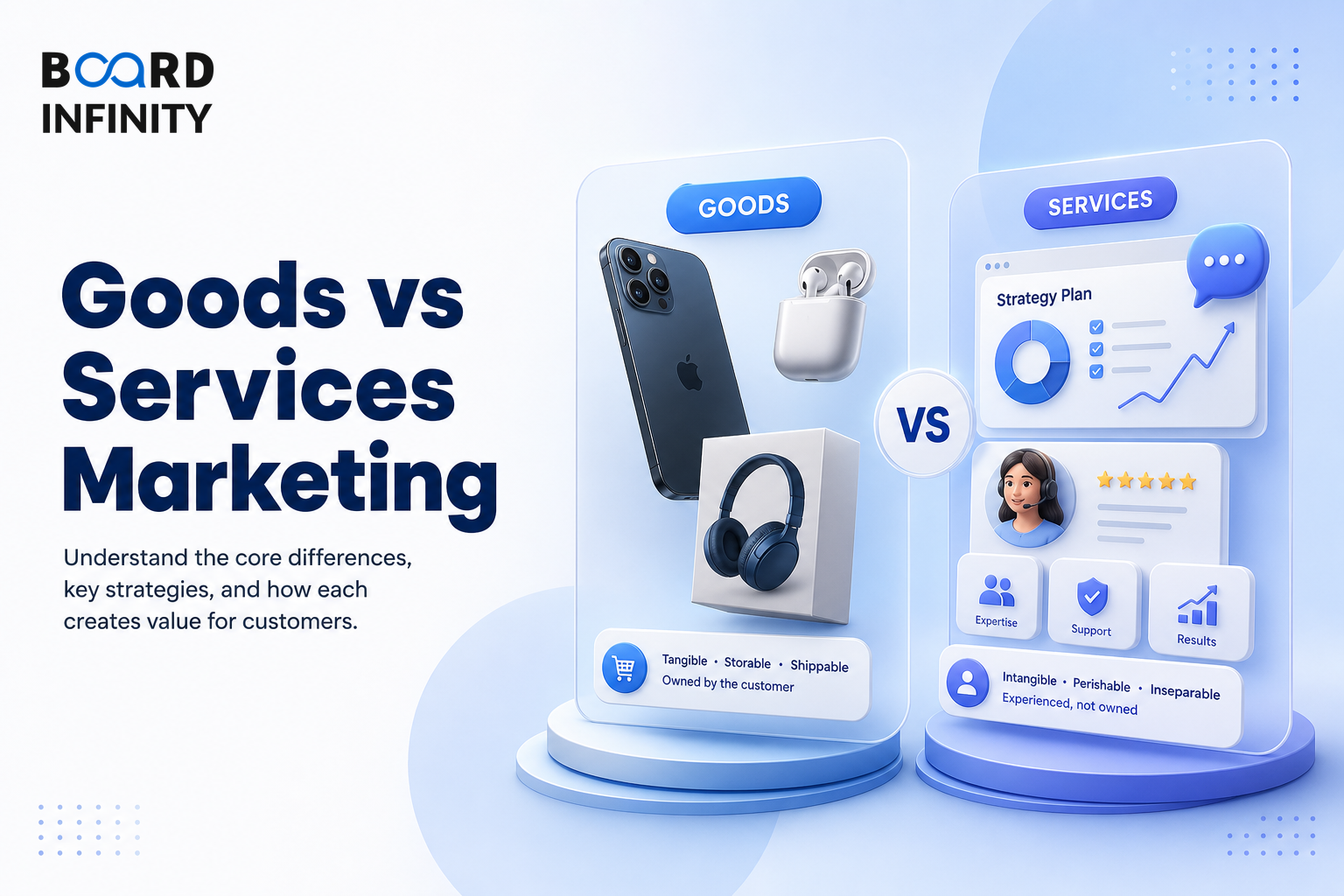
After understanding Sales vs Marketing as complementary roles in driving business growth, the next question is what exactly is being marketed: a good or a service. Understanding the distinction between goods and services is essential because each requires different marketing approaches. In interviews, this matters because physical products can be standardized and inventoried, while services must manage people, process, experience, and variability.
- Goods are physical, can be touched & stored; services are intangible, experienced in the moment.
- Goods are produced first, then consumed; services are produced & consumed simultaneously, which is called inseparability.
- Goods involve ownership transfer to the buyer; services involve no ownership transfer and are access-based.
- Goods typically allow standardized mass production, while services are often customized per customer interaction.
- Goods can achieve consistent quality through QC, while service quality varies with provider, time & context.
- Goods use the 4Ps: Product, Price, Place, Promotion; services use the 7Ps by adding People, Process, Physical Evidence.
- Goods are evaluated through search qualities before purchase, while services are evaluated through experience & credence qualities during or after.
The Big Picture: Goods vs Services as a Marketing Design Problem
The core difference is not just whether the offering is physical or intangible. The difference affects production, consumption, ownership, customization, quality control, perishability, the marketing mix, and how customers evaluate the offering.
The Service-Dominant Logic (S-D Logic) by Vargo & Lusch argues that all economies are moving toward service-based value creation.
Even goods companies like Apple sell an ecosystem of services (Apple Music, iCloud, Apple Care) alongside physical products. The strategic point is that a goods company may still need a service-based marketing approach when value is created through access, experience, and ongoing customer interaction.
Goods Marketing: What Changes When the Offering Is Physical
Goods are physical, can be touched & stored. They are produced first, then consumed, and ownership transfers to the buyer.
This makes standardized mass production typical. Consistent quality is achievable through QC, which means quality control, and goods can be inventoried and stored.
The marketing mix for goods is the 4Ps: Product, Price, Place, Promotion. Since goods have search qualities, customers can evaluate them before purchase.
Services Marketing: What Changes When the Offering Is Experienced
Services are intangible, experienced in the moment. They are produced & consumed simultaneously, which is called inseparability.
Services have no ownership transfer; they are access-based. They are often customized per customer interaction, and quality varies with provider, time & context.
Services also cannot be stored; unused capacity is lost. This is why the marketing mix expands from 4Ps to 7Ps by adding People, Process, Physical Evidence.
The 3 Extra Ps for Services
For services, the extra Ps make the marketing-design problem more practical. They focus on the humans delivering the service, the systems used for delivery, and the tangible cues that signal quality.
How Customers Evaluate Goods and Services
Goods have search qualities, which means customers evaluate them before purchase. Services have experience & credence qualities, which means customers evaluate them during or after.
This distinction matters because the service marketer has to design confidence before purchase, consistency during delivery, and trust after the experience.
Structuring a Goods vs Services Marketing Interview Answer
"What is the difference between goods marketing and services marketing?"
Do not stop at tangible versus intangible. A stronger answer connects that difference to inventory, unused capacity, heterogeneity, evaluation, and the shift from 4Ps to 7Ps.
The most frequent error is treating services like goods and explaining only Product, Price, Place, and Promotion. That costs points because services also require People, Process, and Physical Evidence, and their quality varies with provider, time & context.
Conclusion
Goods and services require different marketing approaches because they differ in tangibility, production and consumption, ownership, customization, heterogeneity, perishability, marketing mix, and evaluation. The final takeaway: goods can often be standardized and stored, while services must be designed around experience, access, and consistent delivery.