
Evolution of Marketing: Eras and Orientations
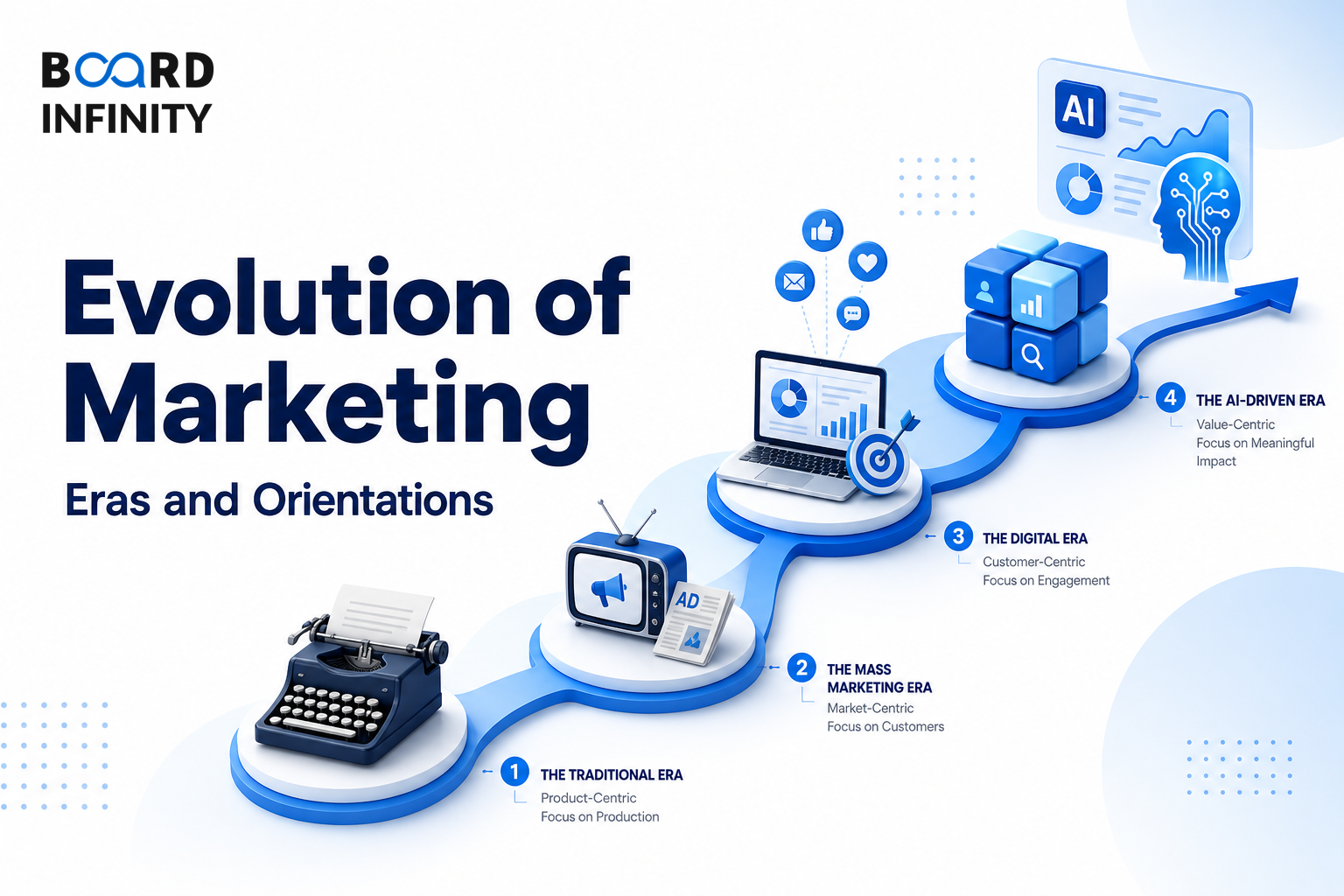
After understanding how internal, task, and macro forces shape marketing choices, the next question is how marketing itself evolved as a business philosophy. Marketing moved from production efficiency to customer-centric, data-driven relationship building, and this matters in interviews because it helps you answer "What is marketing?" with depth instead of a memorized definition.
- Production Orientation was pre-1920s and followed the belief "Build it and they will come", with focus on manufacturing efficiency, mass production, wide distribution.
- Product Orientation in the 1920s-1940s followed "Best product wins", with focus on product quality, features, continuous improvement.
- Sales Orientation in the 1940s-1960s followed "Sell what we make", with focus on aggressive selling, promotions, push tactics.
- Marketing Orientation in the 1960s-1990s followed "Make what customers want", with focus on customer needs, market research, STP.
- Societal Marketing in the 1990s-2010s followed "Balance profit, customer, and society", with focus on sustainability, CSR, ethical practices.
- Digital / Relationship in the 2010s-Present follows "Personalize, engage, build lifetime value", with focus on data-driven, omnichannel, customer lifetime value.
Marketing as an Evolving Business Philosophy
Marketing has evolved through distinct eras and orientations. Each orientation reflects a different core belief, business focus, and example of how organizations approached markets and customers.
Ford Model T is the classic example of Production Orientation: "Any color as long as it's black." The strategic idea was "Build it and they will come", with focus on manufacturing efficiency, mass production, wide distribution.
Modern marketing is customer-centric & data-driven, with the digital era emphasizing personalization, engagement, and customer lifetime value.
Production Orientation
Production Orientation belongs to the pre-1920s period. Its core belief was "Build it and they will come."
The focus was manufacturing efficiency, mass production, wide distribution. Ford Model T captures this orientation through the line: "Any color as long as it's black."
Product Orientation
Product Orientation belongs to the 1920s-1940s period. Its core belief was "Best product wins."
The focus was product quality, features, continuous improvement. The example is focus on R&D and product superiority.
Sales Orientation
Sales Orientation belongs to the 1940s-1960s period. Its core belief was "Sell what we make."
The focus was aggressive selling, promotions, push tactics. Examples include door-to-door sales and hard-sell advertising.
Marketing Orientation
Marketing Orientation belongs to the 1960s-1990s period. Its core belief was "Make what customers want."
The focus was customer needs, market research, STP. The example is P&G's consumer-centric product development.
Societal Marketing
Societal Marketing belongs to the 1990s-2010s period. Its core belief was "Balance profit, customer, and society."
The focus was sustainability, CSR, ethical practices. The example is Tata Group's social responsibility.
Digital / Relationship Orientation
Digital / Relationship belongs to the 2010s-Present period. Its core belief is "Personalize, engage, build lifetime value."
The focus is data-driven, omnichannel, customer lifetime value. Examples include Amazon's recommendation engine and Netflix personalization.
Structuring a Evolution of Marketing Interview Answer
"What is marketing?"
The strongest answer does not stop at a definition. Show depth by moving from production to digital era, then connect modern marketing to customer-centric and data-driven engagement.
The most frequent error is answering "What is marketing?" by only reciting Kotler's definition. It costs points because it misses the evolution from production to digital era, the modern customer-centric and data-driven emphasis, and a current Indian example such as Zomato.
Conclusion
Marketing evolution shows how business thinking moved from manufacturing efficiency to personalization, engagement, and lifetime value. In interviews, the key takeaway is to explain marketing as a customer-centric and data-driven philosophy, not just as a textbook definition.