
Sales vs Marketing: Key Differences Explained
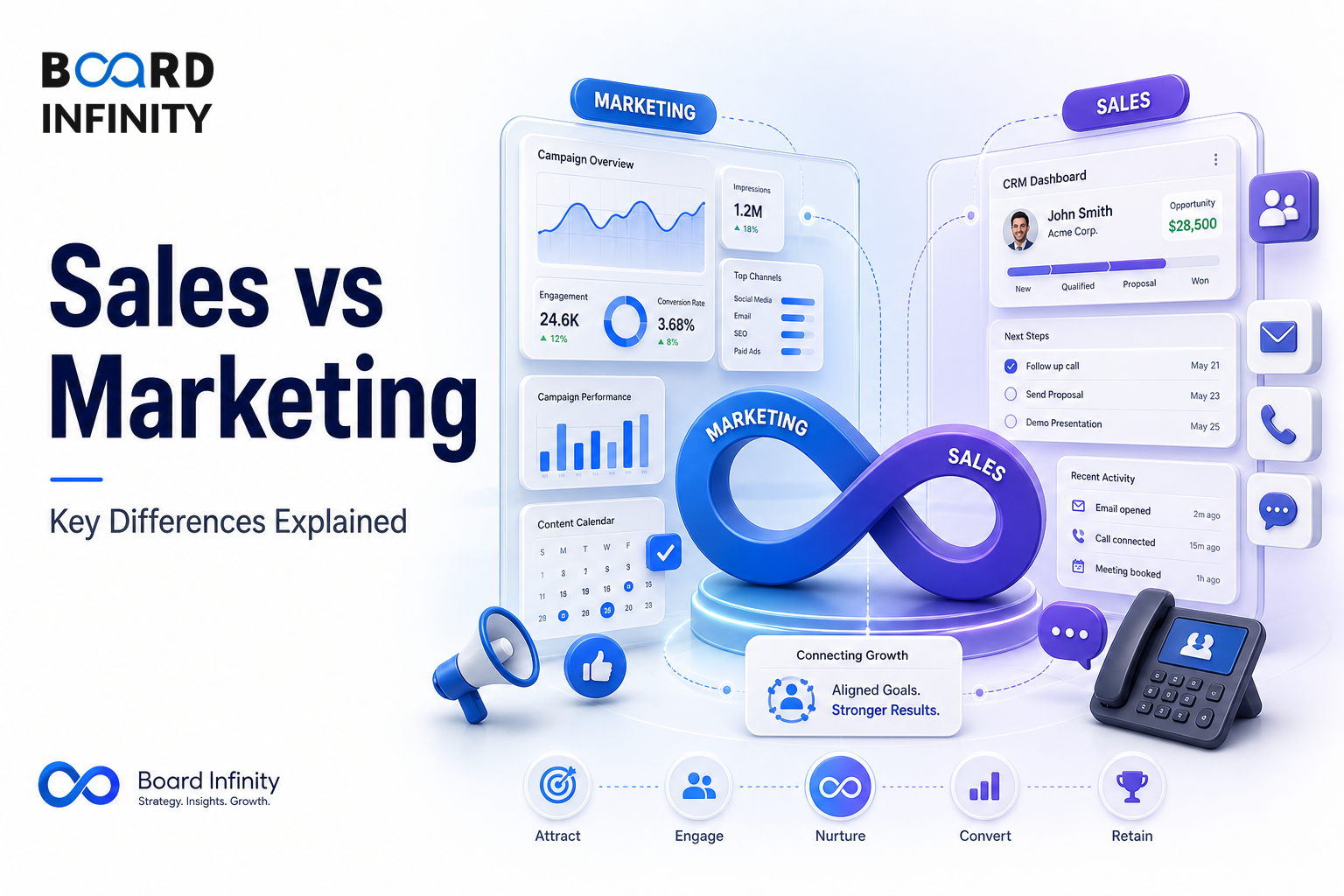
After understanding "What Is Marketing? Definition, Types & Importance", the next interview question is where Marketing ends and Sales begins. While often used interchangeably, Sales and Marketing are fundamentally different functions that serve complementary roles in driving business growth. This distinction matters in interviews because it shows whether you understand the funnel, metrics, and alignment required to convert customer demand into revenue.
- Marketing focuses on customer needs, wants & satisfaction, while Sales focuses on product/service features & benefits.
- Marketing aims at building long-term customer relationships, while Sales aims at closing individual transactions.
- Marketing covers the top of the funnel: Awareness to Interest to Consideration through Advertising, PR, Digital Marketing, Brand Building, and Lead Generation.
- Sales covers the bottom of the funnel: Intent to Evaluation to Purchase to Retention through Demos, Proposals, Negotiation, Closing, CRM, and Upselling.
- Marketing is pull-based through the STP framework, while Sales is push-based through presentation & objection handling.
- In modern organizations, Marketing and Sales alignment, often called Smarketing, is critical.
- Key alignment metrics are MQL-to-SQL conversion rate, lead response time, and shared revenue targets.
Big Picture: Complementary Funnel Roles
Marketing and Sales are not substitutes. Marketing creates demand and qualified leads at the top of the funnel, while Sales converts that demand into customers and revenue through direct customer engagement at the bottom of the funnel.
In modern organizations, Marketing and Sales alignment, often called "Smarketing", is critical. Marketing generates qualified leads (MQLs) and Sales converts them to customers (SQLs).
How Marketing Differs from Sales
Marketing starts with customer needs, wants & satisfaction. Its goal is building long-term customer relationships by creating & delivering value across a broader scope that includes product dev, pricing, distribution, and communication.
Sales starts with product/service features & benefits. Its goal is closing individual transactions by convincing customers to buy, with a narrow focus on closing deals through presentation & objection handling.
How the Funnel Split Works
Marketing covers the top of the funnel: Awareness to Interest to Consideration. It does this through Advertising, PR, Digital Marketing, Brand Building, and Lead Generation.
Sales covers the bottom of the funnel: Intent to Evaluation to Purchase to Retention. It does this through Demos, Proposals, Negotiation, Closing, CRM, and Upselling.
Why Alignment Matters
Misalignment leads to wasted budgets and lost revenue. The key alignment metrics are MQL-to-SQL conversion rate, lead response time, and shared revenue targets.
For interview answers, the strongest framing is not "Marketing versus Sales" as a rivalry. It is that Marketing generates qualified leads and Sales converts them to customers, so both functions serve complementary roles in driving business growth.
Structuring a Sales vs Marketing Interview Answer
"How are Sales and Marketing different, and how do they work together to drive business growth?"
The strongest answer frames Sales and Marketing as complementary funnel roles: Marketing creates demand and qualified leads, while Sales converts that demand into revenue through direct customer engagement.
The most frequent error is using Sales and Marketing interchangeably. It costs points because it misses the top-of-funnel and bottom-of-funnel split, and ignores why Marketing and Sales alignment is critical in modern organizations.
Conclusion
Sales and Marketing are different but complementary: Marketing builds demand, relationships, and value at the top of the funnel, while Sales converts intent into transactions and revenue at the bottom of the funnel. In interviews, anchor your answer on the comparison, the funnel split, and Smarketing alignment.