
Brand Extension vs Line Extension: Strategy, Fit and Risks
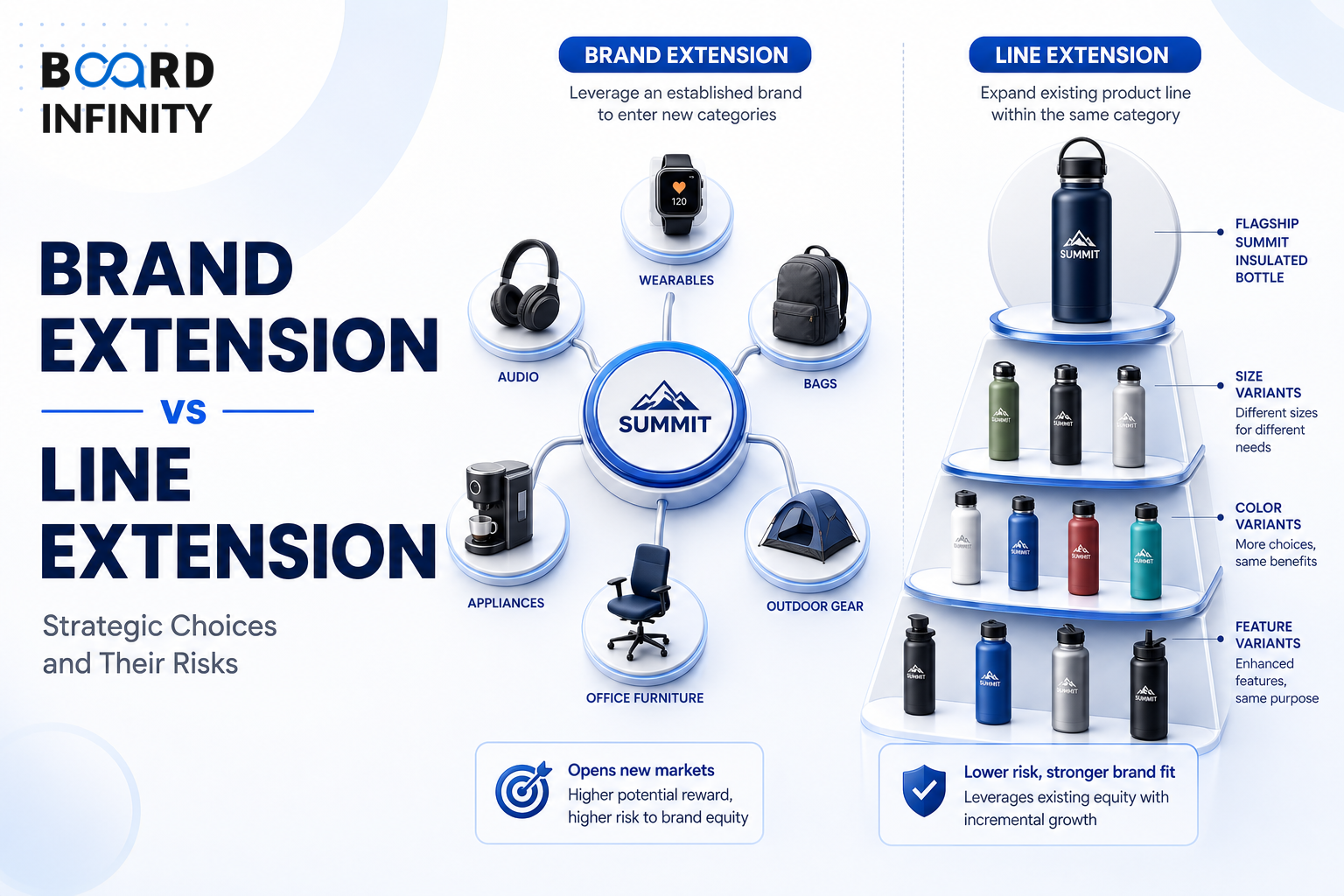
After choosing between a branded house and a house of brands, the next question is how far one brand name can stretch. Extension decisions matter because the right architecture maximizes equity transfer while minimizing risk, and extensions test that transfer in specific products and categories. In interviews, this comparison helps you explain when a variant creates growth and when poor fit causes dilution.
- Line Extension means new variants in same product category, such as Colgate Sensitive, Max Fresh, Vedshakti.
- Brand Extension means leveraging brand to enter new categories, such as Dove: soap -> shampoo -> deodorant.
- Category Extension means new category entirely different from core, such as Amazon: e-commerce -> cloud (AWS) -> streaming.
- Line extension key risk is cannibalization; shelf dilution.
- Brand extension key risk is brand dilution; poor fit.
- Extension success factors are strong parent brand equity, perceived fit, consumer trust transferability, quality consistency, and no negative associations from original category.
Big Picture: Three Ways Brands Expand
Brand extensions and line extensions are practical choices for using existing brand equity to grow. The core distinction is whether the brand is adding new variants in the same product category, entering new categories, or moving into a new category entirely different from core.
Line Extension
Line Extension means new variants in same product category. It is the most common and lowest-risk form of brand expansion.
For example, Colgate adding Colgate Sensitive, Colgate Max Fresh, Colgate Charcoal, Colgate Vedshakti is a line extension. The brand stays in the same product category, but creates variants for different needs or propositions.
The key risk is cannibalization; shelf dilution. In the failure example, Crystal Pepsi is treated as a confusing variant, showing how even a same-category move can weaken clarity if consumers do not understand the variant.
Brand Extension
Brand Extension means leveraging brand to enter new categories. It uses the trust and associations of an existing brand name to move beyond the original product category.
Dove: soap -> shampoo -> deodorant is the success example. The brand moved across categories while relying on parent brand equity, perceived fit, consumer trust transferability, and quality consistency.
The failure example is Colgate Kitchen Entrees (frozen meals!). The key risk is brand dilution; poor fit, especially when the new category does not carry the right connection with the original brand.
Category Extension
Category Extension means new category entirely different from core. This is a broader stretch than a line extension because the brand is not just adding variants within the same category.
Amazon: e-commerce -> cloud (AWS) -> streaming is the success example. BIC: pens -> perfume (failed) is the failure example, with the key risk being no perceived connection.
This makes perceived fit especially important. If consumers cannot see a connection between the original category and the new category, the extension can create confusion rather than growth.
How Success Depends on Fit and Equity
Extension success depends on five factors: strong parent brand equity, perceived fit between original & new category, consumer trust transferability, quality consistency, and no negative associations from original category.
Strong parent brand equity gives the extension a foundation. Perceived fit answers whether the original and new category make sense together. Consumer trust transferability determines whether trust in the original brand can carry into the extension.
Quality consistency protects the parent brand from weak execution. No negative associations from original category matters because the old category can affect how consumers judge the new one.
Worked Example: Dove
Dove is the success example for brand extension: Dove: soap -> shampoo -> deodorant.
The situation is a brand with equity in soap. The framework is brand extension, which means leveraging brand to enter new categories. The decision is to move from soap into shampoo and deodorant. The learning is that extension success depends on strong parent brand equity, perceived fit between original & new category, consumer trust transferability, quality consistency, and no negative associations from original category.
Structuring a Brand Extension vs Line Extension Interview Answer
"How would you compare a Colgate line extension like Sensitive, Max Fresh, Vedshakti with a brand extension like Colgate Kitchen Entrees?"
Do not judge an extension only by the strength of the parent brand. The sharper answer tests perceived fit between original & new category, consumer trust transferability, and quality consistency.
The most frequent error is treating line extension, brand extension, and category extension as the same idea. That costs points because each has a different definition, success example, failure example, and key risk.
Conclusion
Brand extension vs line extension is ultimately a test of how far parent brand equity can travel. Strong fit, trust transferability, and quality consistency can create growth, while poor fit can cause brand dilution, shelf dilution, or no perceived connection.