
Brand Positioning Bullseye Framework
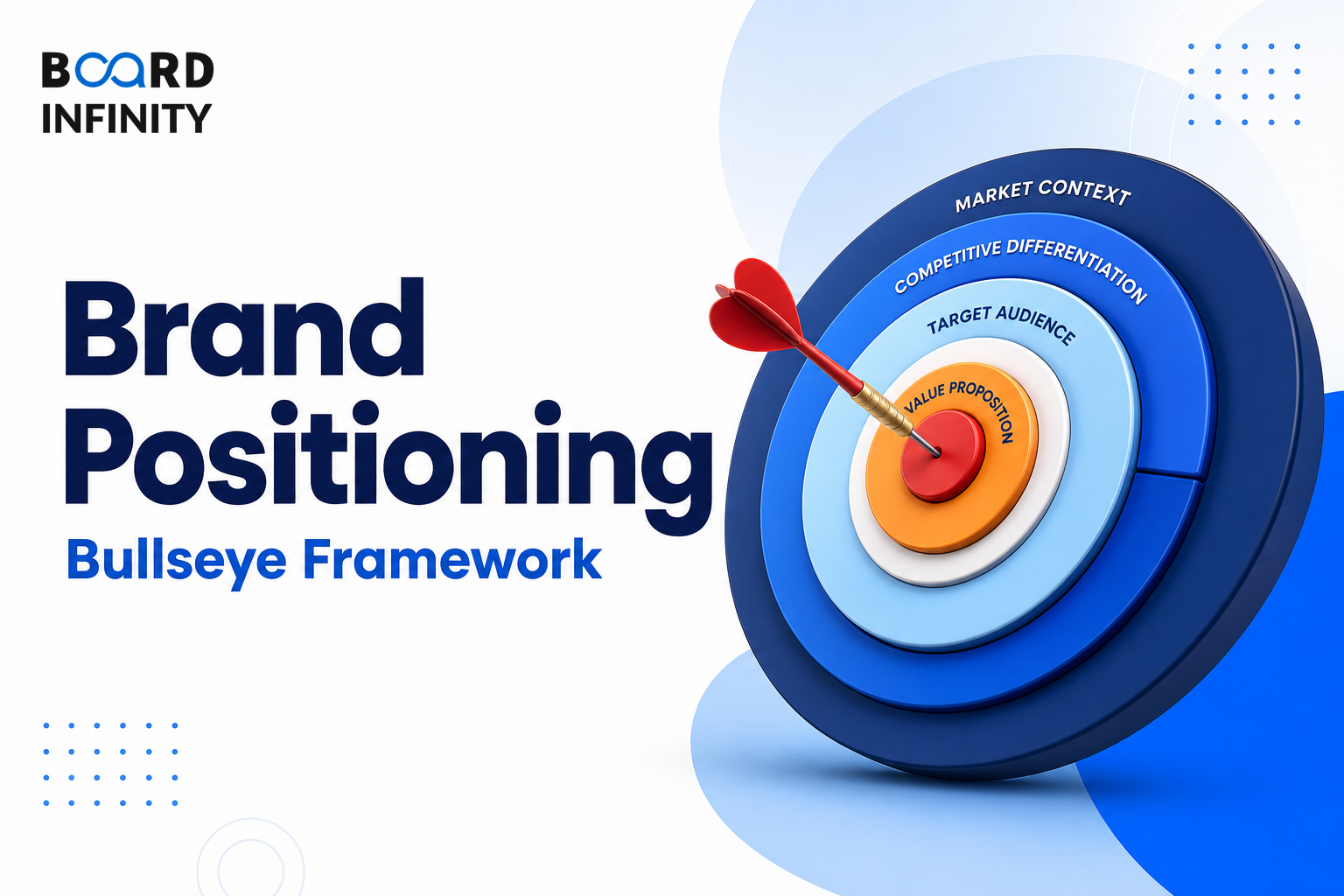
After Kapferer's Brand Identity Prism maps the six facets of brand identity, the Brand Positioning Bullseye answers a sharper question: how does that identity move inward from consumer understanding to the brand's core essence? In interviews, this matters because it gives a structured way to connect target, insight, need state, proof points, and the final 3-5 word brand mantra.
- The Brand Positioning Bullseye is a concentric framework moving from external consumer understanding inward to the brand's core essence.
- The outer ring covers Consumer Target, Consumer Insight, and Consumer Need State.
- The middle ring captures Values / Personality / Character - the human traits and values the brand embodies.
- The inner ring includes Executional Properties / Visual Identity, Substantiators / RTB, and Points of Parity.
- The core is the Brand Mantra - the heart & soul of the brand in 3-5 words.
- Nike Brand Mantra: "Authentic Athletic Performance".
Big Picture: From Consumer Understanding to Core Essence
The Brand Positioning Bullseye works from the outside in. It starts with who the brand is for and what need or tension it addresses, then moves through the brand's personality, proof, category legitimacy, and finally the center: a concise brand mantra.
The heart & soul of the brand in 3-5 words.
Outer Ring: Consumer Target, Insight, and Need State
The outer ring begins with Consumer Target: who specifically is the brand for? Demographics, psychographics, behaviors. It then moves to Consumer Insight: deep understanding of an unmet need or tension in the target's life.
The third outer-ring element is Consumer Need State: the specific occasion, situation, or job-to-be-done. This makes the bullseye practical because the brand is not positioned in the abstract - it is tied to a target, a tension, and a usage context.
Middle Ring: Values, Personality, and Character
The middle ring defines Values / Personality / Character: the human traits and values the brand embodies. This layer connects consumer understanding to how the brand behaves and feels as a human-like entity.
Inner Ring: Identity, Proof, and Legitimacy
The inner ring includes Executional Properties / Visual Identity: distinctive assets such as colors, fonts, imagery, and sound. These are the recognizable signals that help the brand show up consistently.
It also includes Substantiators / RTB, where RTB means Reasons to Believe - proof points that make the promise credible. Points of Parity are category must-haves that ensure legitimacy.
Points of Difference (POD) are unique attributes that distinguish a brand from competitors. They must be desirable to consumers, deliverable by the company, and differentiating from competitors.
Nike: The Bullseye in One Brand
Nike shows how the bullseye can support a sharp core positioning through a clear consumer target, consumer insight, points of difference, points of parity, and reasons to believe.
A shallow answer stops at the mantra. A complete answer shows how the outer, middle, and inner rings support the core positioning.
Structuring a Brand Positioning Interview Answer
"How would you use the Brand Positioning Bullseye to sharpen a brand's positioning?"
The strongest answers do not jump straight to the brand mantra. Build from consumer understanding inward, then make the 3-5 word essence feel earned.
Conclusion
The Brand Positioning Bullseye is useful because it turns positioning into a disciplined inside-out structure: target, insight, need state, character, proof, legitimacy, and finally a sharp brand mantra.
The most frequent error is jumping straight to the core brand mantra while ignoring the outer ring and inner ring proof. That costs points because the framework is explicitly concentric - it moves from external consumer understanding inward to the brand's core essence.