
Kapferer's Brand Identity Prism: The 6 Facets
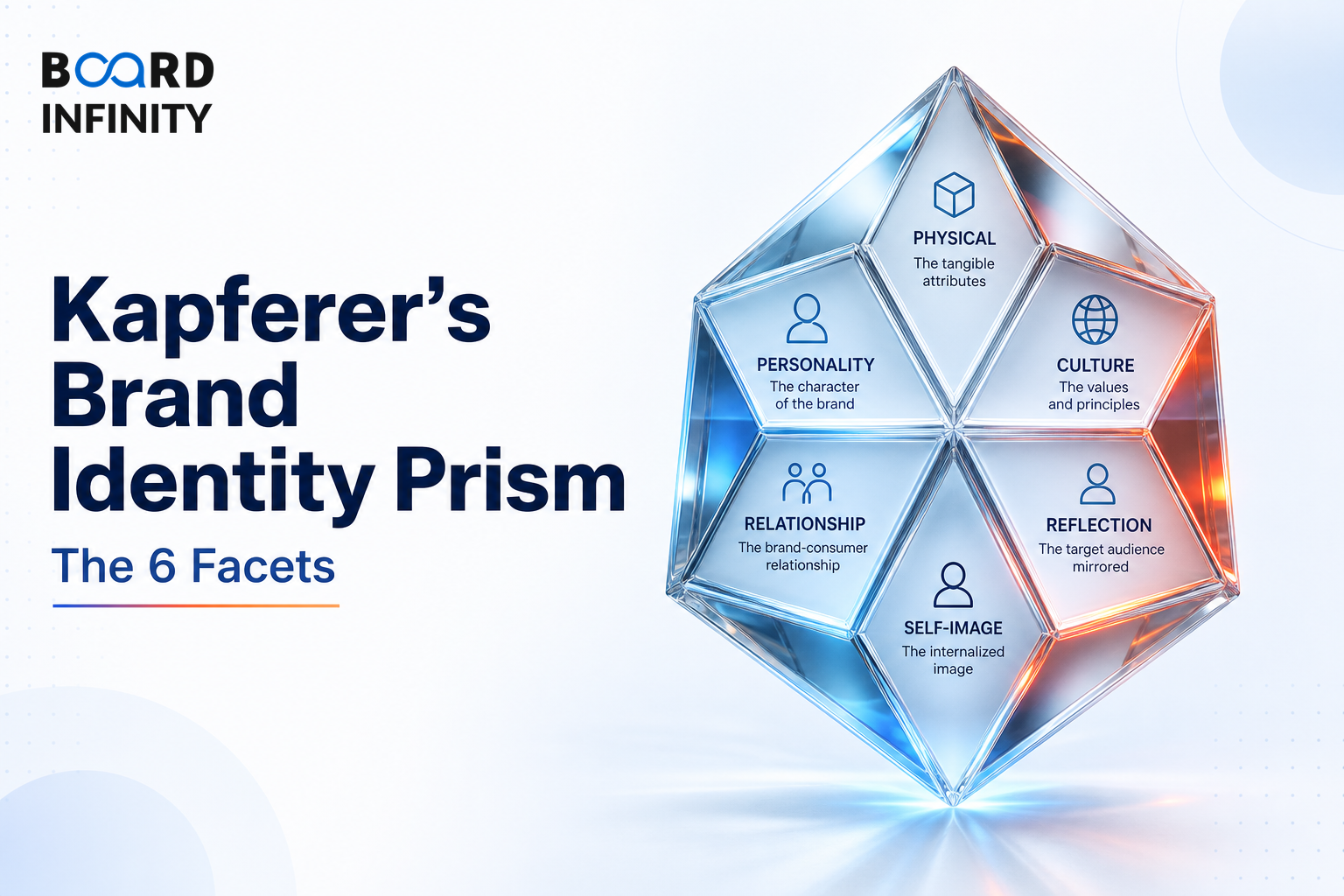
After Brand Extension vs Line Extension: Strategy & Risks, the next question is not only where a brand can stretch, but what identity it is stretching. Jean-Noël Kapferer's Brand Identity Prism provides a holistic view of brand identity through six interconnected facets arranged around two axes - externalization vs internalization and sender vs receiver. In interviews, this matters because it gives you a structured way to explain how a brand projects itself and how consumers see themselves using it.
- Jean-Noël Kapferer's Brand Identity Prism provides a holistic view of brand identity.
- The prism has six interconnected facets: Physique, Personality, Culture, Relationship, Reflection, and Self-Image.
- The facets are arranged around two axes - externalization vs internalization and sender vs receiver.
- Physique covers tangible characteristics - logo, colors, packaging, product form.
- Personality covers human character traits; the brand's voice and tone.
- Coca-Cola can be mapped through its contour bottle, red color, cursive script, fizzy sound, fun and uplifting personality, and the idea of sharing moments of happiness with friends and family.
Kapferer's Brand Identity Prism: The Big Picture
Jean-Noël Kapferer's Brand Identity Prism provides a holistic view of brand identity through six interconnected facets arranged around two axes - externalization vs internalization and sender vs receiver. The six facets show both what the brand sends outward and how the receiver experiences or internalizes the brand.
The Six Facets Explained
Physique is the sender plus external facet. It refers to tangible characteristics - logo, colors, packaging, product form. For Coca-Cola, this is visible in the contour bottle, red color, cursive script, and fizzy sound.
Personality is the sender plus internal facet. It captures human character traits; the brand's voice and tone. Coca-Cola's personality is fun, uplifting, optimistic, and youthful.
Culture sits at the internal core. It includes the values, origin, and principles the brand embodies. Coca-Cola represents American optimism, happiness, togetherness, and celebration.
Relationship also sits at the internal core. It describes the nature of the bond between brand and consumer. For Coca-Cola, that bond is sharing moments of happiness with friends and family.
Reflection is the receiver plus external facet. It is the image of the typical user, often aspirational. Coca-Cola reflects young, social, energetic, fun-loving people.
Self-Image is the receiver plus internal facet. It explains how consumers see themselves using the brand. In the Coca-Cola example, the self-image is: "I am someone who brings people together; life is fun".
Coca-Cola Illustration
Coca-Cola shows how the six facets work together rather than separately. Its physique is built through tangible characteristics such as the contour bottle, red color, cursive script, and fizzy sound, while its personality is fun, uplifting, optimistic, and youthful.
At the internal core, Coca-Cola embodies American optimism, happiness, togetherness, and celebration. The relationship is about sharing moments of happiness with friends and family, while reflection and self-image move to the receiver side: young, social, energetic, fun-loving people, and the feeling, "I am someone who brings people together; life is fun".
Structuring a Kapferer's Brand Identity Prism Interview Answer
"How would you use Kapferer's Brand Identity Prism to explain Coca-Cola's brand identity?"
The strongest answers do not list the six facets mechanically. They show the interconnection between sender, receiver, externalization, and internalization using one consistent brand example.
The most frequent error is confusing Reflection with Self-Image. Reflection is the image of the typical user, while Self-Image is how consumers see themselves using the brand; mixing the two weakens the structure of the prism.
Conclusion
Kapferer's Brand Identity Prism is useful because it captures brand identity through six interconnected facets across sender, receiver, externalization, and internalization. For interview answers, the key is to explain the full prism and support each facet with a consistent example like Coca-Cola.