
Capital Markets Explained for Interviews: Players, Products & Market Plumbing
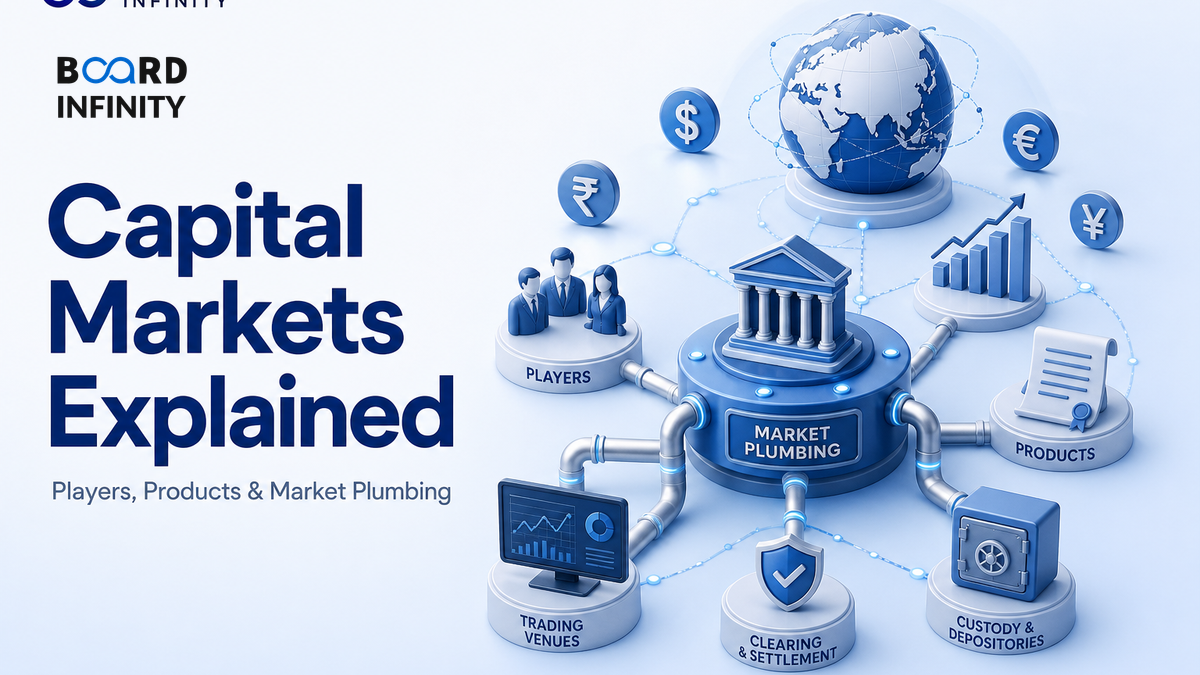
One tap on a trading app feels like a simple buy button. Behind that tap, a broker routes your order, an exchange matches it, a clearing corporation guarantees it, a depository changes ownership records, and banks move money - all before the trade truly becomes yours.
- Capital markets connect providers of long-term capital with governments and companies that need funds.
- The market has two halves: the primary market issues new securities; the secondary market lets investors trade existing securities.
- Core products are equity, debt, derivatives, ETFs, mutual funds, REITs and InvITs.
- The main Indian players are SEBI, issuers, investors, investment banks, brokers, exchanges, clearing corporations, depositories and custodians.
- Market plumbing matters because it creates price discovery, liquidity, risk transfer, settlement finality and investor protection.
- In India, listed equity settlement operates on a T+1 cycle, meaning settlement normally happens one business day after the trade date.
- The interview trap: do not describe capital markets as only “stock trading”; explain the full chain from capital raising to post-trade settlement.
Big Picture: Capital Markets Are a Trust Machine
Capital markets work because they convert scattered savings into investable capital, convert business risk into tradable securities, and convert trades into legally settled ownership. The visible part is the price on the screen; the real system is the chain beneath it.
Core Explanation: Players, Products and Plumbing
The cleanest way to understand capital markets is to separate what is traded, who enables it, and how the trade becomes final.
1. The Two Market Layers: Primary and Secondary
The primary market is where a security is issued for the first time. A company may sell shares through an IPO, a government may issue bonds, or a company may privately place debentures with institutions.
The secondary market is where already-issued securities trade between investors. When you buy a listed share on NSE or BSE, the company usually does not receive that money; another investor does.
2. The Main Players and Their Jobs
Think of capital markets as a coordinated cast. Each player solves one risk: information risk, execution risk, counterparty risk, custody risk, or regulatory risk.
3. The Product Shelf: What Gets Traded
A capital market product is simply a contract that turns a future cash-flow or risk exposure into something investors can buy, sell, value and hold.
India moved listed equity settlement to a T+1 cycle in phases, with full adoption across listed stocks completed in 2023. The strategic so what: faster settlement reduces unsettled exposure and releases investor funds earlier, chiefly because clearing corporations, depositories, exchanges, brokers and payment rails coordinate tightly - not because the exchange alone is efficient.
4. The Plumbing: What Happens After You Click Buy
The trading app shows the front end. The real post-trade sequence is order routing, matching, clearing, margining, settlement and depository record change.
5. What to Track: Liquidity and Market Quality Metrics
Interviewers like candidates who move beyond definitions into market quality. These are the practical measures that tell you whether a capital market is working well.
Worked example: Suppose a stock has a best bid of ₹998 and a best ask of ₹1,000. The mid-price is ₹999, so the bid-ask spread is ₹2 / ₹999 = 0.20%. If you buy 100 shares at ₹1,000 and immediately sell at ₹998, the spread cost is ₹200 before brokerage, taxes or market movement. That is why liquidity is not abstract - it is a real cost.
Definitions
- Capital market: A market where long-term funds are raised and traded through securities such as equity and debt.
- Primary market: The market where issuers sell new securities to investors for the first time.
- Secondary market: The market where investors trade already-issued securities with other investors.
- Clearing: The post-trade process of confirming obligations, netting positions and managing counterparty risk.
- Settlement: The final exchange of securities and funds between buyer and seller.
- SEBI mandate: “To protect the interests of investors in securities and to promote the development of, and to regulate, the securities market.”
Mankind Pharma IPO: Capital Market Plumbing in One Story
Mankind Pharma's 2023 IPO showed how Indian capital markets convert a private business into a widely tradable public security.

Situation: Mankind Pharma was already a well-known Indian pharmaceutical and consumer healthcare business. Its IPO was primarily an offer for sale, meaning existing shareholders sold shares to the public rather than the company raising fresh expansion capital.
The move: The company used the public issue route, with investment banks managing the issue, institutional and retail investors bidding, exchanges enabling listing, and depositories recording demat ownership. Public reports described the IPO size at about ₹4,326 crore, making it one of the notable Indian listings of 2023.
Outcome and lesson: The listing gave existing investors liquidity and gave public market investors access to the company's future performance. The primary driver was the company's readiness for public ownership and investor demand for a scaled domestic pharma-consumer business; supporting drivers included brand familiarity, institutional distribution, exchange liquidity and India's mature demat-settlement infrastructure.
The case is useful because it prevents a shallow answer. A weak candidate says, “IPO means the company raises money.” A strong candidate says, “An IPO can raise fresh capital or provide an exit, but in both cases the market system creates pricing, allocation, listing, liquidity and settlement finality.”
How AI Changes Capital Markets
AI is not replacing market plumbing; it is making parts of it faster, more data-heavy and more surveillance-driven.
- Smarter surveillance and risk detection: Exchanges, brokers and regulators increasingly use machine learning to flag unusual order patterns, spoofing-like behaviour, insider-trading signals and abnormal price-volume moves. The caveat is false positives - surveillance teams still need human judgment and due process.
- AI-assisted research and disclosure analysis: Analysts can use LLMs to summarise annual reports, DRHPs, exchange filings, concall transcripts and risk factors. This improves coverage speed, but the analyst still owns valuation assumptions and source verification.
- Execution and liquidity analytics: Institutional desks use data models to estimate market impact, choose execution slices and reduce slippage. The goal is not “predict the stock”; it is to trade a required quantity with lower cost and lower information leakage.
Use NotebookLM before a capital markets interview: upload a company annual report, its latest investor presentation, and SEBI or exchange filings, then ask, “Map the issuer, investors, intermediaries, listing venue, settlement route and key risks in this company's capital market journey.” Verify every factual claim from the cited source snippets.
Interview Relevance
“Explain how capital markets work in India. Who are the key players, what products trade, and what happens after an investor places an order?”
If the interviewer is from finance, add one sentence on risk control: margins, netting and clearing corporations reduce counterparty risk, which is why trust in settlement is central to market depth.
The mistake: Treating capital markets as only the stock market or only IPOs. This costs candidates because it misses the actual architecture - products, intermediaries, risk management and settlement. One-line fix: Always answer in three buckets: players, products and plumbing.
What to Revise Next
Now that you understand the full market system, go one level deeper into how securities are issued and priced before they begin trading.
Mark Lesson Complete (Capital Markets Explained for Interviews: Players, Products & Market Plumbing)
Mark Complete
Bookmark