
Debt Markets in India Interview Guide: G-Secs, Corporate Bonds & Yields
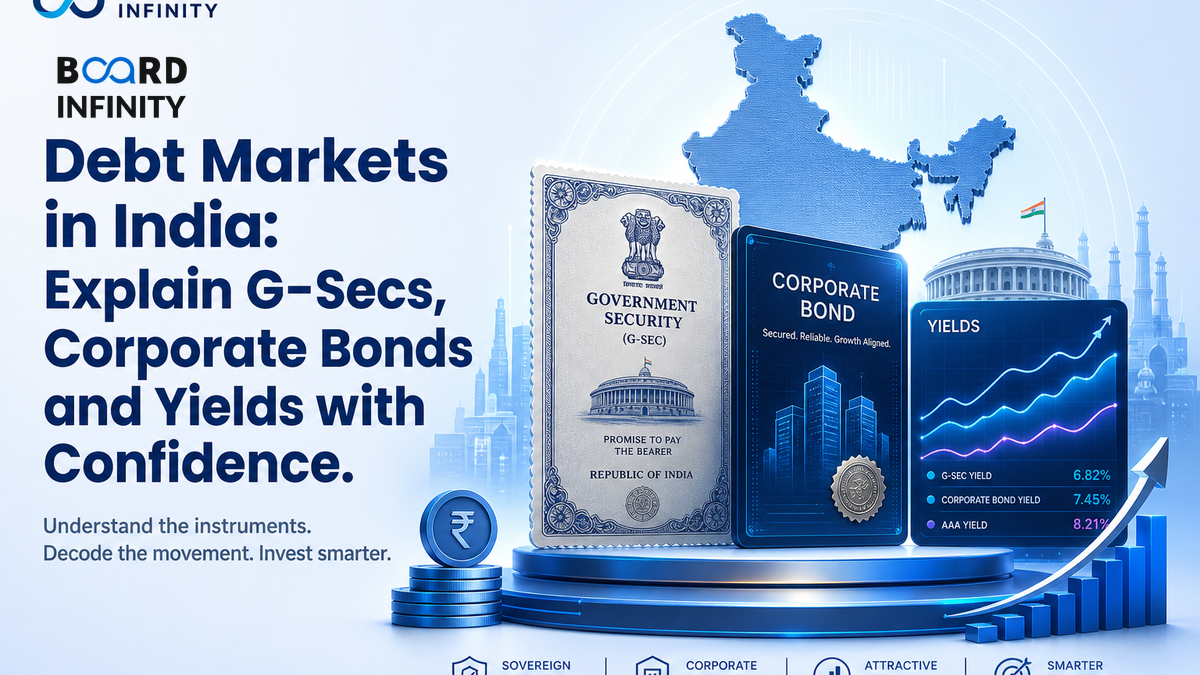
One morning, the same 10-year government bond can look boring at 9:15 and suddenly valuable by lunch - not because its coupon changed, but because the market’s required yield moved. That is the quiet power of debt markets: prices react before most headlines become obvious.
- Debt markets connect borrowers who need funds with investors who want fixed-income cash flows.
- Government securities are sovereign or state debt instruments; they set the risk-free benchmark for the economy.
- Corporate bonds add credit risk, liquidity risk and covenants on top of the government yield curve.
- Bond price and yield move inversely: when market yields rise, existing bond prices fall.
- Credit spread is the extra yield over a comparable G-sec; it compensates for default, liquidity and downgrade risk.
- Duration measures price sensitivity to interest-rate changes; longer-duration bonds are more volatile.
- In interviews, answer using this order: market structure - instruments - yield math - risk - India-specific mechanics.
Big Picture: India’s Debt Market in One Mental Model
Think of India’s debt market as a funding highway. The Government of India, state governments and companies borrow; banks, mutual funds, insurers, pension funds, corporates and individuals invest; prices and yields continuously translate macro expectations into rupee funding costs.
Core Explanation: What Actually Trades in Indian Debt Markets
Debt markets are markets where borrowers issue tradable debt instruments and investors buy claims on future interest and principal payments. In India, the market has two major pillars: government securities and corporate debt securities.
1. Government Securities: The Benchmark Layer
Government securities, or G-secs, are debt instruments issued by the central government or state governments. They are the benchmark because central government securities are treated as having negligible default risk in rupee terms.
The main instruments are:
- Treasury Bills: Short-term instruments with original maturities of 91, 182 or 364 days, issued at a discount and redeemed at face value.
- Dated Government Securities: Longer-term securities with coupon payments and a fixed maturity date.
- State Development Loans: Bonds issued by state governments, usually priced at a spread over comparable central government securities.
- Sovereign Gold Bonds: Government securities linked to gold prices, designed for investors seeking gold exposure without holding physical gold.
In India, RBI conducts government securities auctions, and institutional trading happens through platforms such as NDS-OM. Retail investors can also access G-secs through RBI Retail Direct and through debt mutual funds, ETFs and brokers.
2. Corporate Bonds: The Credit-Risk Layer
Corporate bonds are debt securities issued by companies, financial institutions or public-sector entities. Unlike G-secs, their yield includes compensation for credit risk, liquidity risk, structure, taxation and investor demand.
A corporate bond investor asks four questions:
- Can the issuer pay? Look at cash flows, leverage, interest coverage and credit rating.
- Will I be compensated? Compare the yield spread with a similar-maturity G-sec.
- Can I exit? Check trading liquidity and bid-ask spread.
- What protects me? Examine covenants, security cover, debenture trustee and seniority.
3. Yield, Price and Duration: The Interview-Critical Math
A bond has a face value, a coupon, a maturity and a market price. The yield to maturity is the annualized return an investor earns if the bond is bought at today’s price and held until maturity, assuming promised payments happen.
The key relationship is simple: when required yield rises, the price of an existing fixed-coupon bond falls. Investors will not pay the old high price if new bonds are available at better yields.
Worked Example: Why a Bond Price Falls When Yield Rises
Suppose a 3-year bond has face value ₹100, annual coupon 7 percent, and the market now requires 8 percent yield.
Price = 7 / 1.08 + 7 / 1.08² + 107 / 1.08³
Price = 6.48 + 6.00 + 84.94 = ₹97.42
If the required yield were exactly 7 percent, the bond would be priced near ₹100. Because the market now demands 8 percent, the old 7 percent coupon bond must trade below face value.
Key Measures to Track in Debt Markets
Do not speak about bonds only in adjectives like “safe” or “risky”. Use measures. These are the practical numbers recruiters expect you to understand.
Definitions: Say These Cleanly
- Debt market: A market where borrowers issue debt securities and investors trade claims on future interest and principal.
- Government security: A tradable debt instrument issued by the central or state government to acknowledge borrowing.
- Treasury bill: A short-term government security issued at discount and redeemed at face value.
- Corporate bond: A debt security issued by a company to borrow from investors for a defined maturity.
- Yield curve: A line showing yields of similar-credit bonds across different maturities.
- Credit spread: The extra yield a corporate bond offers over a comparable government security.
REC Limited: Using Bonds to Fund Long-Term Infrastructure Lending
REC Limited, a public-sector infrastructure financier, shows how India’s corporate bond market channels institutional savings into long-tenor power-sector funding.
Situation: Infrastructure lending needs large, long-term funds. Bank loans alone can create asset-liability pressure because infrastructure cash flows often come over many years. A lender such as REC needs a funding mix that can match its lending book better.
The move: REC has been an active issuer in India’s domestic bond market, raising funds from institutional investors through debt securities. Its primary driver is high perceived credit strength due to public-sector ownership and the nature of its lending franchise. Supporting drivers include scale, regular market access, credit ratings, investor familiarity, and the ability to structure borrowings across maturities.
Outcome and lesson: The lesson is not “PSU bonds are safe”. The sharper lesson is that a deep debt market helps convert long-term savings from insurers, pension funds, mutual funds and banks into long-term infrastructure finance. Corporate bonds work best when issuer credibility, transparent pricing, ratings, trusteeship and secondary-market liquidity support each other.

How AI Changes Debt Markets in India
AI is not replacing bond-market judgment; it is changing the speed and evidence base of that judgment. By 2026, the strongest fixed-income teams use AI to screen more issuers, monitor more signals and summarize more documents without skipping human risk review.
- AI-assisted credit surveillance: Models can track financial statements, exchange filings, rating actions, news and payment behavior to flag early credit deterioration.
- Yield-curve and spread analytics: Machine learning can help detect unusual movements in G-sec yields, corporate spreads and liquidity conditions across maturities.
- LLM document review: Large language models can summarize information memoranda, debenture trust deeds, covenants and risk factors faster, but analysts must verify the source text.
Use NotebookLM: upload an issuer annual report, latest credit-rating rationale and a recent bond term sheet; ask it to create 10 interview questions on credit risk, spreads, covenants and refinancing risk. Then verify every answer against the uploaded documents.
Interview Relevance
“Explain how government securities, corporate bonds and yields work in India. If interest rates rise, what happens to bond prices and why?”
If you are asked whether a high-yield bond is attractive, do not answer only from yield. Say: “I would compare the spread with its rating, duration, liquidity, covenants and issuer cash-flow strength.”
Common Mistake
The biggest mistake is saying “bonds are safe fixed-return products.” That ignores price risk, duration risk, credit risk and liquidity risk, and it makes you sound like a retail brochure. Fix it in one line: “A bond has promised cash flows, but its market price and realized return depend on yield movements, credit quality and liquidity.”
What to Revise Next
Next, revise Mutual Funds, Exchange-Traded Funds & Index Investing to understand how debt instruments enter portfolios, and then Alternative Investment Funds, Portfolio Management Services & Trusts to see how sophisticated investors allocate across fixed income, credit and alternatives.
Mark Lesson Complete (Debt Markets in India Interview Guide: G-Secs, Corporate Bonds & Yields)
Mark Complete
Bookmark