
Market Infrastructure for Interviews: Exchanges, Depositories and Clearing Corporations Clearly Explained
At 9:15 a.m., thousands of buy and sell orders hit the market in milliseconds - but the real test begins after the trade is matched. If the buyer cannot pay, the seller cannot deliver, or ownership records do not update correctly, the market stops being a market and becomes a trust crisis.
- Exchanges run the trading venue - they match buy and sell orders and enable price discovery.
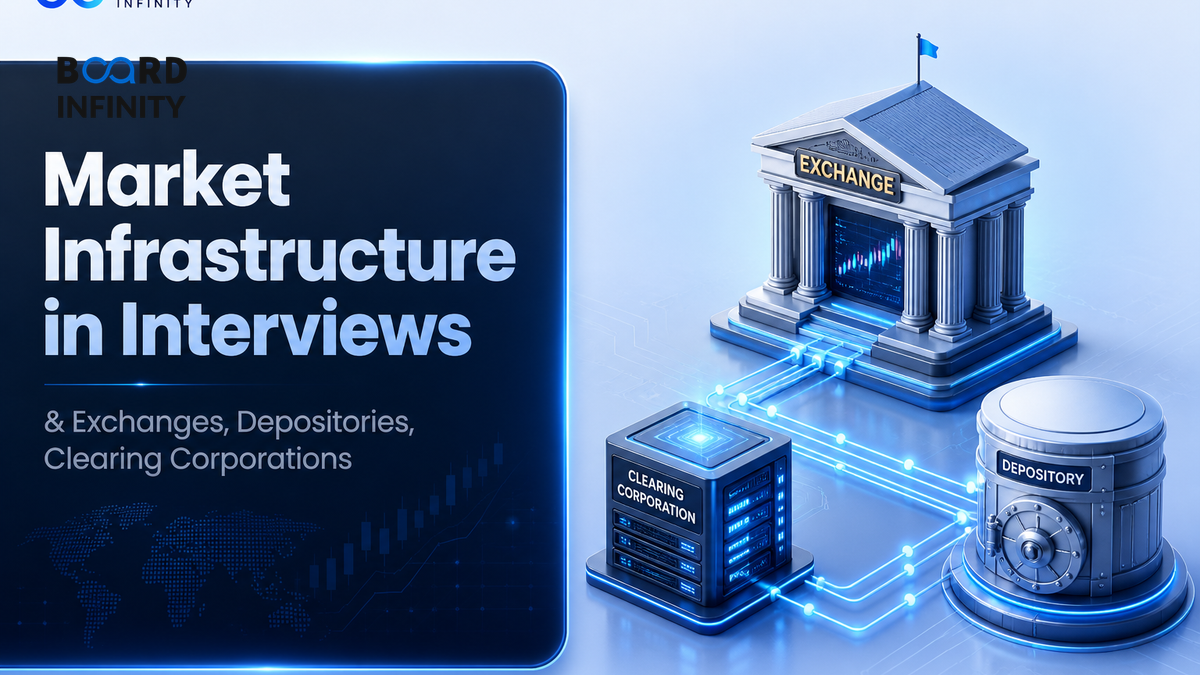
- Clearing corporations sit between buyer and seller after a trade, calculate obligations, collect margins and manage counterparty risk.
- Depositories hold securities in dematerialised form and update ownership records through demat accounts.
- The clean sequence is: trade execution - clearing - settlement - ownership update.
- India has moved to T+1 settlement for listed equities, meaning settlement normally happens one business day after trade date.
- The biggest interview trap is confusing clearing with settlement: clearing calculates and guarantees obligations; settlement transfers funds and securities.
- Market infrastructure is not back-office plumbing - it is the trust layer that lets liquidity, valuation and investor confidence exist.
The Big Picture: The Market’s Trust Stack
Think of capital markets as a layered trust stack. The visible part is the trading screen, but the invisible layers below it - risk management, settlement, custody and regulation - make the screen believable.
The Three Institutions and What They Actually Do
Market infrastructure is the set of regulated institutions that enable securities to be traded, cleared, settled and recorded safely. In India, these institutions are supervised mainly by SEBI for securities markets, with RBI playing a key role in money, government securities and payment systems.
The easiest way to separate them is this: the exchange answers “at what price did the trade happen?”; the clearing corporation answers “who owes what?”; the depository answers “who owns the security now?”
Core Explanation: How the System Protects the Market
Market infrastructure protects the market through four mechanisms: standardisation, netting, collateral and final ownership records.
Why clearing corporations matter so much
A clearing corporation often acts as the central counterparty. Through novation, it becomes the buyer to every seller and the seller to every buyer. That sounds technical, but the business meaning is simple: market participants do not need to worry about the credit quality of every counterparty they trade with.
What a depository really records
A depository does not “trade” shares. It holds securities in electronic form and records beneficial ownership through depository participants, usually banks, brokers or financial institutions. In India, investors generally interact with NSDL or CDSL through a depository participant, not directly.
When an investor buys shares on NSE or BSE, the exchange matches the trade. The clearing corporation handles obligations and risk. The final shares appear in the investor’s demat account through NSDL or CDSL. So what: the trading venue and ownership record are separate by design, which reduces operational concentration and improves auditability.
Key Measures to Track Market Infrastructure Quality
For interviews, do not evaluate market infrastructure with vague words like “safe” and “efficient.” Use measurable operating indicators.
Definitions You Can Say in One Breath
- Exchange: A regulated trading venue where securities orders are matched under transparent rules.
- Clearing corporation: A regulated institution that calculates obligations, manages margins and reduces counterparty default risk.
- Depository: A regulated institution that holds securities electronically and records beneficial ownership through demat accounts.
- Settlement: The final transfer of funds and securities that completes a trade.
- Central counterparty: An entity that becomes the buyer to every seller and the seller to every buyer.
Case Study: CDSL and India’s Move to Faster Settlement
CDSL shows how depository infrastructure made India’s faster equity settlement practical by supporting electronic ownership records at scale.

Situation: India’s listed equity market has seen rising retail participation, heavy IPO activity and a large base of demat accounts. Faster settlement reduces capital blockage for investors, but it also increases the operational burden on brokers, clearing members, banks, depositories and clearing corporations.
The move: India shifted listed equities to T+1 settlement through a phased market-wide transition completed in January 2023. The primary driver was coordinated regulatory and market infrastructure execution. CDSL’s role was crucial but not solitary: it supported electronic securities holding and ownership updates, while exchanges handled trade execution, clearing corporations managed risk and settlement obligations, and brokers connected investors to the system.
Outcome and lesson: India became one of the major equity markets operating on a T+1 cycle. The strategic lesson is not “one institution made settlement faster.” The lesson is that faster markets require a complete infrastructure chain: demat records, risk-based clearing, broker readiness, banking rails, surveillance and investor communication must all work together.
So what: CDSL is a useful case because it reminds you that market infrastructure wins are ecosystem wins. The primary driver was coordinated regulation and market-wide readiness, supported by dematerialisation, robust clearing risk controls and broker-depository connectivity.
How AI Changes Market Infrastructure
AI is not replacing exchanges, clearing corporations or depositories. It is changing how they monitor risk, detect abuse and serve participants.
- Smarter market surveillance: ML models can flag unusual trading patterns, spoofing-like behaviour, circular trading signals or abnormal price-volume movement faster than rule-only systems. Human investigation remains essential because false positives can be costly.
- Dynamic risk and margin analytics: Clearing corporations can use advanced models for stress scenarios, liquidity risk signals and participant-level exposure monitoring. The challenge is model governance: regulators and risk committees must understand why the model recommends action.
- Depository servicing and compliance: AI can improve KYC review, document classification, investor grievance routing and anomaly detection in demat transactions. The risk is bias or over-automation in account restrictions, so audit trails matter.
Use NotebookLM: upload SEBI circulars on settlement cycles, an exchange annual report and a depository annual report. Ask it to create a one-page comparison of exchange, clearing corporation and depository roles, then generate five interview questions on T+1 settlement risk.
Interview Relevance
“Explain the difference between an exchange, a depository and a clearing corporation. Use an Indian market example.”
If the interviewer asks a follow-up on T+1, say: “T+1 is not just faster settlement; it requires tighter coordination among brokers, clearing corporations, depositories and banks.” That answer sounds mature because it links speed with operational risk.
Mixing up clearing and settlement. Candidates often say the clearing corporation “transfers shares to the investor,” which is incomplete and technically weak. Fix: say clearing calculates and guarantees obligations; settlement completes the funds and securities transfer, and the depository records ownership.
What to Revise Next
Revise Case Study: A Recent Indian Public Issue, from Filing to Listing Day. It will connect this infrastructure layer to the IPO journey - merchant bankers, SEBI filings, book building, allotment, exchange listing and demat credit.
Mark Lesson Complete (Market Infrastructure for Interviews: Exchanges, Depositories and Clearing Corporations Clearly Explained)
Mark Complete
Bookmark