
Secondary Markets for Interviews: Order Books, Settlement & Circuit Filters
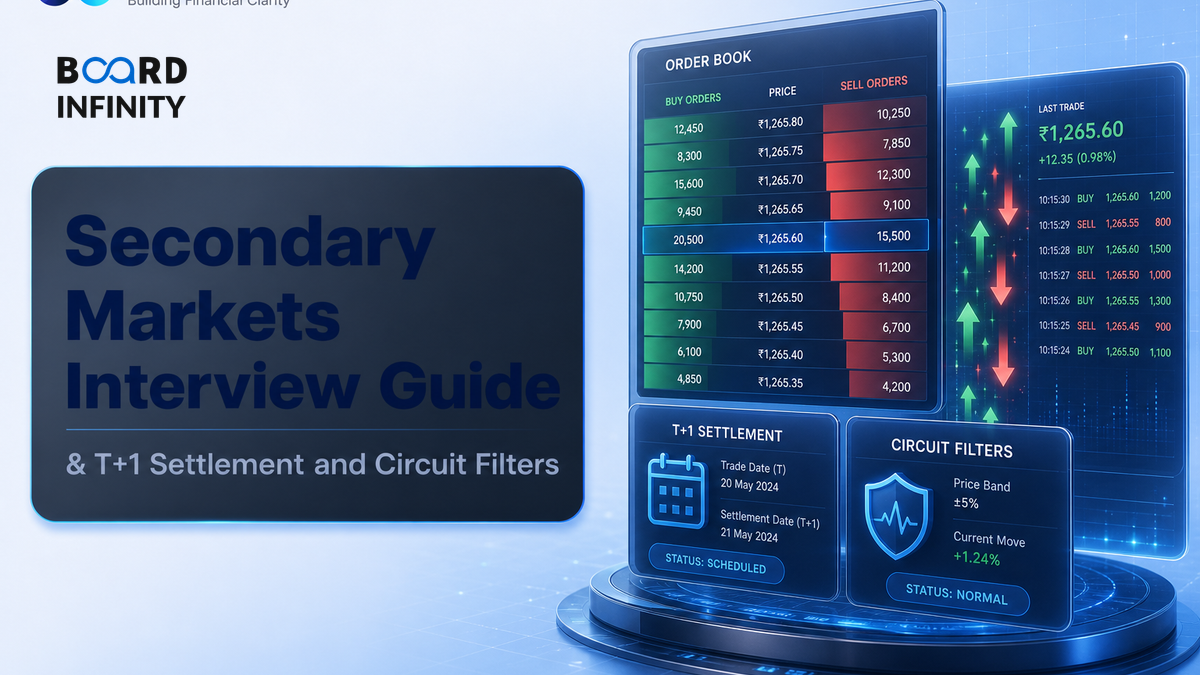
Most people think the stock market is where companies raise money. On most trading days, it is not - it is a giant resale market where investors trade with each other, while the exchange, clearing corporation and depositories quietly make sure every rupee and every share reaches the right place.
- Secondary market means trading of already-issued securities between investors; the company usually does not receive money from these trades.
- Order book is the live queue of buy and sell orders, usually matched by price-time priority.
- Clearing calculates obligations and manages counterparty risk; settlement completes the exchange of funds and securities.
- India moved to T+1 rolling settlement for equities in a phased manner, completed in January 2023; optional T+0 settlement has been introduced in a limited beta framework.
- Circuit filters are speed breakers against extreme price moves; they pause or restrict trading, but they do not decide fair value.
- The best interview answer links all three layers: price discovery, risk management and final settlement.
Think of the secondary market as a machine with three jobs: find a price, guarantee the trade, and finish delivery. The visible part is the trading screen; the critical part is the infrastructure behind it.
Core Explanation - How the Secondary Market Actually Works
The secondary market is where existing securities are bought and sold after issuance. If Reliance, HDFC Bank or Infosys shares trade today, most transactions are investor-to-investor trades; the issuing company is not raising fresh capital in those trades.
The exchange does three economic jobs:
- Liquidity: It allows investors to enter or exit positions without searching privately for a counterparty.
- Price discovery: It converts dispersed buy and sell intentions into a market price.
- Risk reduction: It routes trades through clearing and settlement infrastructure so that default risk is controlled.
Order Books - The Price Discovery Engine
An order book is the exchange's live list of unmatched buy and sell orders. In an electronic, order-driven market like Indian equities, buyers place bids, sellers place asks, and trades happen when compatible prices meet.
The most important rule is price-time priority: the best price gets priority; if prices are equal, the order entered earlier gets priority. A buyer willing to pay more ranks ahead of a buyer willing to pay less. A seller willing to sell cheaper ranks ahead of a seller asking more.
Worked Example - One Market Buy Order
Suppose the best sellers in the order book are:
- 300 shares available at ₹100.00
- 700 shares available at ₹100.10
You place a market buy order for 600 shares. The exchange fills the order against the cheapest available sellers first:
The important lesson: a market order guarantees speed, not price. If the order book is thin, your own order can walk up the ask ladder and increase your average execution price.
Settlement - The Trade Is Not Over at Execution
Execution is the moment the order matches. Settlement is the final exchange of securities and money. Between the two sits clearing, where obligations are calculated and risk is managed.
In Indian equities, settlement runs through market infrastructure institutions such as stock exchanges, clearing corporations and depositories. India completed its move to T+1 rolling settlement for equities in January 2023, meaning trades settle on the next business day after the trade date, subject to the applicable market framework.
Circuit Filters - Speed Breakers, Not Valuation Tools
Circuit filters limit or pause trading when prices move too sharply. Their purpose is to slow disorderly markets, allow information absorption and reduce panic-driven execution. They do not mean the stock is cheap, expensive, safe or unsafe by themselves.
There are two broad types in Indian equity markets:
- Index-wide market circuit breakers: Triggered by sharp movement in broad indices such as the Nifty 50 or Sensex.
- Stock-specific price bands: Applied to individual securities, commonly seen as daily upper and lower bands depending on the security's category and surveillance framework.
After the RBI's action against Paytm Payments Bank in early 2024, shares of One97 Communications saw sharp selling pressure and lower-circuit moves. The strategic point is simple: circuit filters slowed the adjustment, but the market still had to reprice the business risk. The primary driver was a regulatory shock, supported by uncertainty around payments-bank dependence, customer retention and investor confidence.
Key Market Quality Metrics to Track
If you are asked whether a secondary market is healthy, do not answer only with “volume is high.” Use market quality metrics.
Definitions - Say These Cleanly
- Secondary market: A market where investors trade already-issued securities with other investors, not directly with the issuer.
- Order book: The live queue of buy and sell orders waiting to be matched on an exchange.
- Clearing: The post-trade process of calculating obligations and managing counterparty risk before settlement.
- Settlement: Completion of a securities trade through final transfer of funds to seller and securities to buyer.
- Circuit filter: A market safeguard that restricts or pauses trading when prices move beyond prescribed limits.
Case Study - Angel One: Building Trust on Invisible Market Plumbing
Angel One shows how a broker's customer experience depends on mastering the hidden mechanics of orders, risk controls, demat movement and settlement.

Situation: Indian retail participation shifted rapidly toward app-based broking, while the market infrastructure underneath became faster and stricter. With T+1 settlement completed in 2023 and a limited optional T+0 beta later introduced, brokers had to make execution, margin, collateral and demat workflows feel simple without weakening controls.
The move: Angel One's digital broking model is built around connecting the customer-facing app to exchange order routing, pre-trade risk checks, margin requirements, demat account workflows and post-trade reporting. The primary driver is reliable technology and risk infrastructure. Supporting drivers include mobile-first acquisition, simplified onboarding, investor education, analytics-led engagement and integration with Indian market infrastructure such as depositories and clearing systems.
Outcome or lesson: The lesson is not “apps made broking easy.” The stronger answer is: secondary-market trust comes from making complex infrastructure invisible but dependable. A broker wins when the investor sees a clean order screen, while the back end correctly handles price priority, margins, settlement obligations, pledge or delivery workflows and regulatory reporting.
How AI Changes Secondary Markets in 2026
AI does not replace the exchange rulebook. It changes how participants read the market, detect risk and support decisions around the order book.
- Smarter market surveillance: Exchanges and regulators can use machine learning to flag spoofing-like patterns, circular trading suspicion, abnormal order cancellations and unusual price-volume behaviour faster than manual review.
- Execution analytics for brokers and institutions: AI can estimate market impact, recommend order slicing, compare execution quality against benchmarks and alert traders when liquidity is thin.
- Retail decision support with risk warnings: Broker apps increasingly use models to surface volatility alerts, unusual price-band behaviour, margin risk and portfolio concentration warnings. The caveat: these tools must avoid becoming unsuitable advice.
Use Perplexity or NotebookLM to load SEBI circular summaries, an exchange FAQ on settlement, and a broker's annual report. Ask: “Create 10 interview questions on how T+1 settlement affects brokers, clearing corporations and retail investors, with model answers.”
Interview Relevance
“Walk me through what happens when an investor places a buy order for a listed equity share in India. Where do order books, settlement and circuit filters fit in?”
Use one sentence that shows maturity: “A trade has three lives - economic decision, exchange execution and legal settlement.” Interviewers remember that because it separates the screen from the infrastructure.
Common Mistake
Candidates often say “the trade is done when the order is executed.” That misses clearing, settlement, delivery risk and the role of market infrastructure. One-line fix: always say execution creates the trade, but settlement completes it!
What to Revise Next
Next, revise Equity Markets: Indices, Free Float & Market Capitalisation Segments to understand how listed shares are grouped and tracked. Then move to Debt Markets in India: Government Securities, Corporate Bonds & Yields so you can compare how equity and debt secondary markets differ in trading, pricing and risk.
Mark Lesson Complete (Secondary Markets for Interviews: Order Books, Settlement & Circuit Filters)
Mark Complete
Bookmark