
Coaching vs Mentoring: What's the Difference for HRBPs?
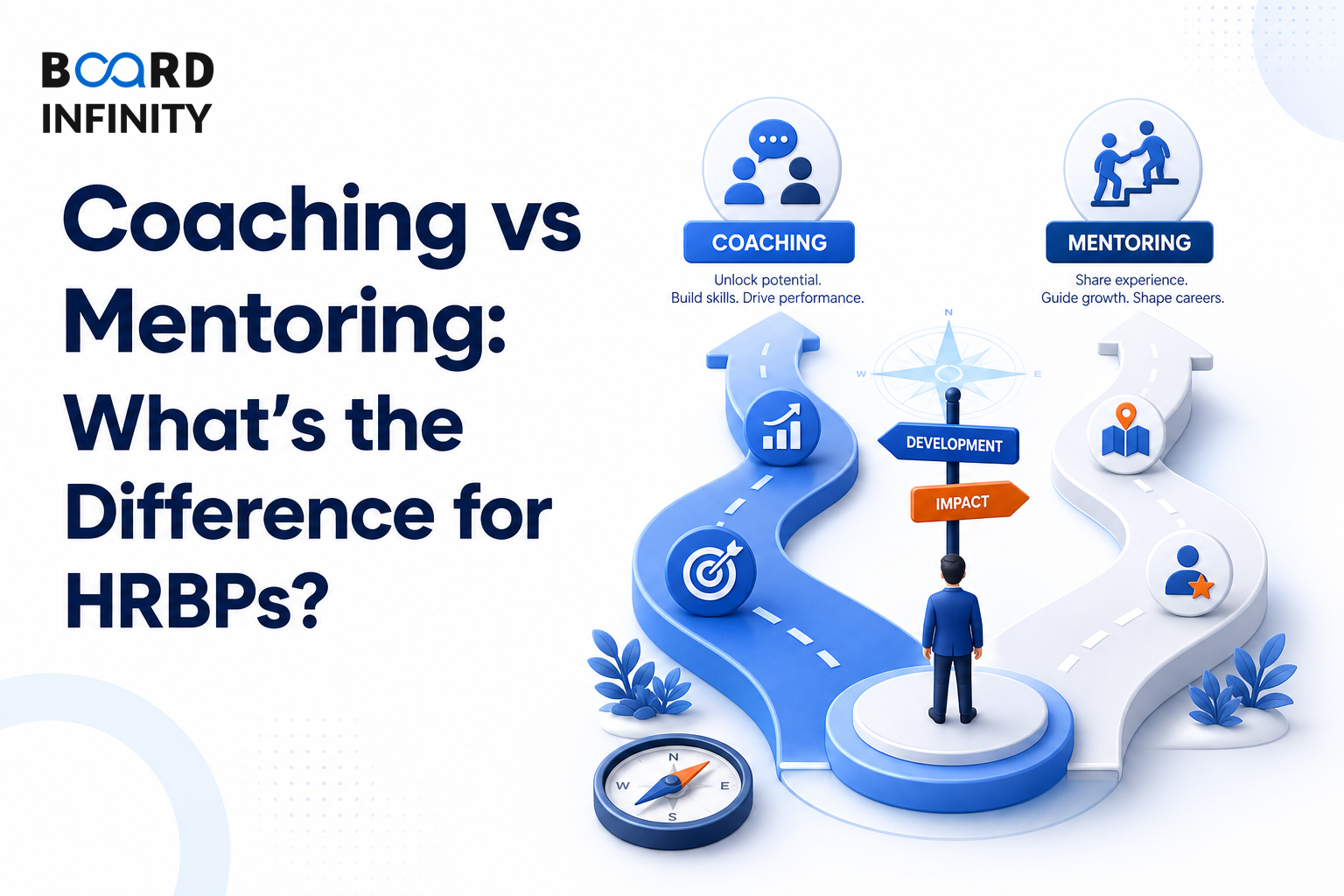
After calculating Learning and Development (L&D) ROI, the next HRBP question is which developmental intervention will drive the required outcome. Coaching and mentoring are often used interchangeably but represent distinct developmental interventions. In interviews, this distinction matters because HRBPs must deploy the right tool for the right developmental need.
- Coaching and mentoring are often used interchangeably but represent distinct developmental interventions.
- Coaching is non-directive - coach asks questions, coachee finds answers.
- Mentoring is directive - mentor shares experience, advice, and guidance.
- Coaching is short to medium term, 6-12 months, and goal-specific.
- Mentoring is long-term, 1-3+ years, and career-oriented.
- Coaching focuses on specific skills, behaviors, or immediate performance challenges; mentoring focuses on career development, networking, and organizational navigation.
- Coaching outcomes are measurable behavior change and skill acquisition; mentoring outcomes are career clarity, expanded network, and cultural integration.
Coaching vs Mentoring: The Big Picture
Coaching and mentoring are different HRBP tools, not interchangeable labels. The choice depends on the developmental need, direction of support, relationship type, duration, focus, trigger, confidentiality, and expected outcome.
For new hires, time-to-productivity is the number of days from joining to reaching a defined performance threshold, e.g., achieving 80% of target KPIs.
Coaching as Goal-Specific Behavior Change
Coaching is best suited for a performance gap, role transition, or high-potential development. It is non-directive - coach asks questions, coachee finds answers.
The relationship is professional, often paid external coach or internal certified coach. The duration is short to medium term, 6-12 months, and goal-specific. The focus is specific skills, behaviors, or immediate performance challenges, with outcomes such as measurable behavior change and skill acquisition.
Mentoring as Career Navigation
Mentoring is best suited for career uncertainty, underrepresentation, or new leader onboarding. It is directive - mentor shares experience, advice, and guidance.
The relationship is personal - usually senior leader volunteering time. The duration is long-term, 1-3+ years, and career-oriented. The focus is career development, networking, and organizational navigation, with outcomes such as career clarity, expanded network, and cultural integration.
Coaching, Mentoring, and Managing
Coaching is structured, goal-oriented, time-bound; coach need not have domain expertise. Mentoring is a long-term relationship; mentor has domain expertise and shares career wisdom. Both are distinct from managing - which has an authority dimension.
Indian IT firms use structured mentoring for campus-to-corporate transition.
Confidentiality and Relationship Nuance
Confidentiality is high in both interventions, but the operating norm differs. In coaching, the coach maintains strict confidentiality. In mentoring, confidentiality is high but informal - mentor may share observations with others.
Time-to-Productivity in Onboarding
Research by Aberdeen Group shows that organizations with structured onboarding achieve 58% better new hire retention and 50% greater new hire productivity within the first year. HRBPs should establish role-specific productivity benchmarks and track new hire progress at 30, 60, and 90 days post-joining.
The most common bottlenecks:
- Delayed system access (IT)
- Unclear role expectations (manager)
- Social isolation (lack of buddy/mentor program)
Structuring a Coaching vs Mentoring Interview Answer
"How would you decide whether an employee needs coaching or mentoring?"
The strongest answers do not treat coaching and mentoring as synonyms. They connect the developmental need to the right trigger, duration, focus, and outcome.
The most frequent error is choosing mentoring for a specific performance gap or coaching for broad career uncertainty. This costs points because coaching is goal-specific and should lead to measurable behavior change, while mentoring is career-oriented and should create career clarity, expanded network, and cultural integration.
Conclusion
Coaching and mentoring are distinct HRBP interventions for different developmental needs. Use coaching for goal-specific behavior change and mentoring for longer-term career navigation, then define success through the right outcome.