
Learning Frameworks Every L&D Professional Should Know: ADDIE and 70-20-10
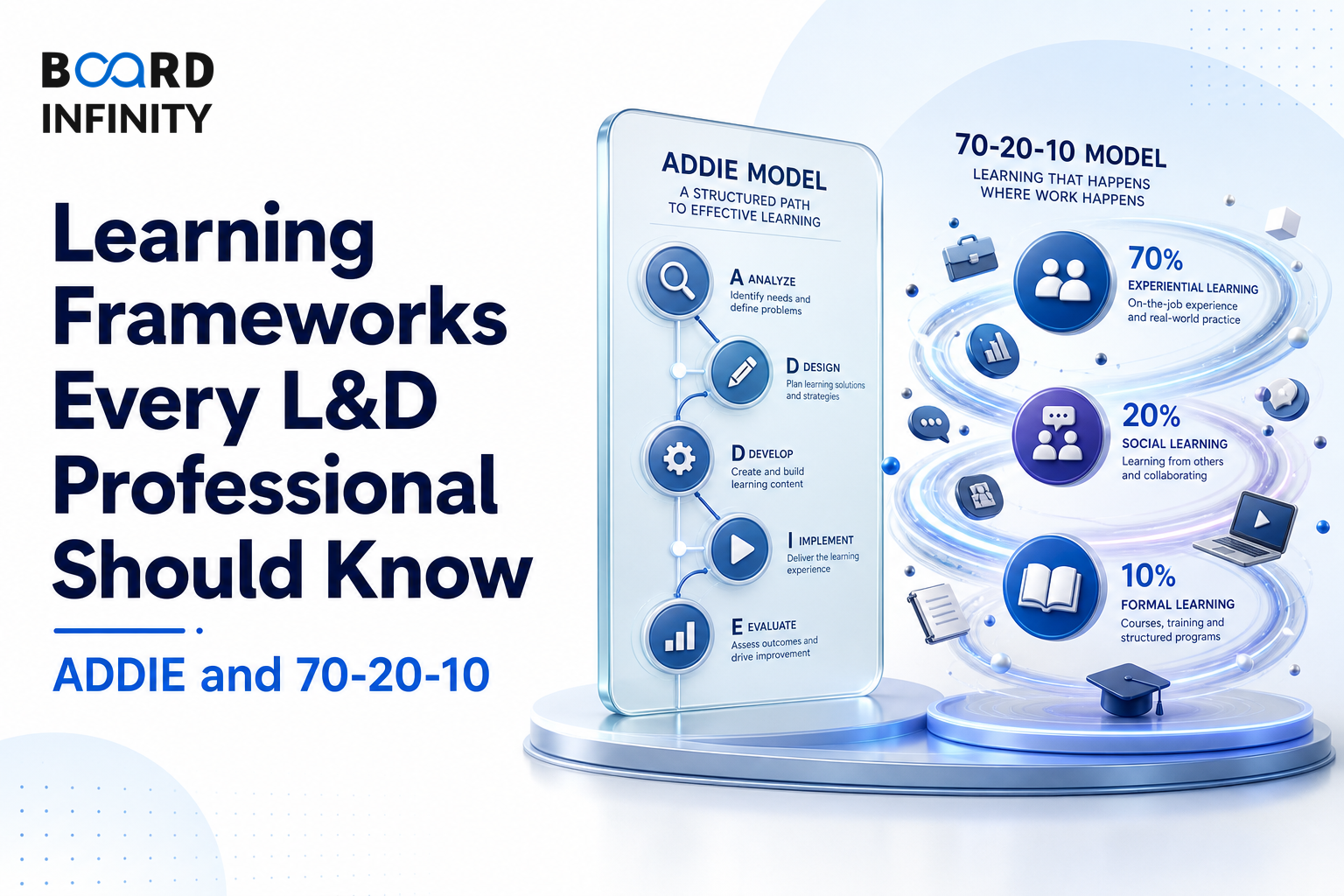
After Training Needs Analysis (TNA), the next L&D question is how to design the intervention. Training Needs Analysis is the systematic process of identifying gaps between current employee capabilities and the capabilities required for organizational success. ADDIE helps build training systematically, while 70-20-10 ensures development happens beyond classroom courses. In interviews, this matters because it shows that you can move from need identification to learning design, delivery and evaluation.
- ADDIE is the foundational instructional design framework used by L&D professionals worldwide.
- ADDIE organizes training design across Analyze, Design, Develop, Implement and Evaluate.
- Analyze includes TNA, audience analysis, learner profile and constraints assessment, leading to a learning needs report and performance gap analysis.
- Evaluate means measuring effectiveness using Kirkpatrick's 4 levels and calculating ROI.
- The 70-20-10 model was developed by Morgan McCall, Michael Lombardo and Robert Eichinger at the Center for Creative Leadership.
- 70-20-10 describes how professionals actually learn: Experiential 70%, Social 20% and Formal 10%.
- The framework does not mean 70% of L&D budget should go to experiential learning; it means the IDP design should deliberately incorporate all three.
Big Picture: Two Core L&D Design Lenses
ADDIE is the lens for building training systematically. 70-20-10 is the lens for ensuring the IDP (Individual Development Plan) design deliberately incorporates experiential, social and formal learning.
The ADDIE Model
ADDIE is the foundational instructional design framework used by L&D professionals worldwide:
ADDIE organizes L&D work across Analyze, Design, Develop, Implement and Evaluate - from TNA, audience analysis and learner profile through evaluation report and recommendations for improvement.
How ADDIE Works in L&D Design
The model starts with Analyze, where the L&D professional uses TNA, audience analysis, learner profile and constraints assessment. The key output is a learning needs report and performance gap analysis.
Design then defines learning objectives, instructional strategy, assessment methods and content outline. Develop converts that blueprint into training materials, e-modules and facilitator guide.
Implement focuses on delivery, logistics, facilitation and learner feedback. Evaluate measures effectiveness using Kirkpatrick's 4 levels and calculates ROI, producing an evaluation report and recommendations for improvement.
The Learning Mix Beyond Formal Training
Developed by Morgan McCall, Michael Lombardo, and Robert Eichinger at the Center for Creative Leadership, the 70-20-10 model describes how professionals actually learn:
Applying the Learning Mix in Practice
Applying 70-20-10 in practice: The framework does not mean 70% of L&D budget should go to experiential learning. It means the IDP (Individual Development Plan) design should deliberately incorporate all three.
A common HRBP mistake is over-investing in formal training (courses, workshops) which represents only 10% of actual learning, while neglecting structured on-the-job experiences and mentoring. Best-in-class organizations use the framework to justify stretch assignments, mentoring stipends, and communities of practice as L&D investments.
Structuring a Learning Frameworks Every L&D Professional Should Know Interview Answer
"How would you use ADDIE and 70-20-10 to design an L&D intervention after TNA?"
Do not treat 70-20-10 as a budget allocation rule. The strongest answer says that the framework guides IDP design and helps justify stretch assignments, mentoring stipends and communities of practice as L&D investments.
The most frequent error is over-investing in formal training, which represents only 10% of actual learning, while neglecting structured on-the-job experiences and mentoring. This costs points because it shows a classroom-first view of L&D instead of a development design view.
Conclusion
ADDIE helps L&D professionals design training systematically, while 70-20-10 ensures development is not limited to formal courses. The practical takeaway is simple: build the intervention through ADDIE, then design the Individual Development Plan to include experiential, social and formal learning.