
Kirkpatrick's 4 Levels of Training Evaluation Explained
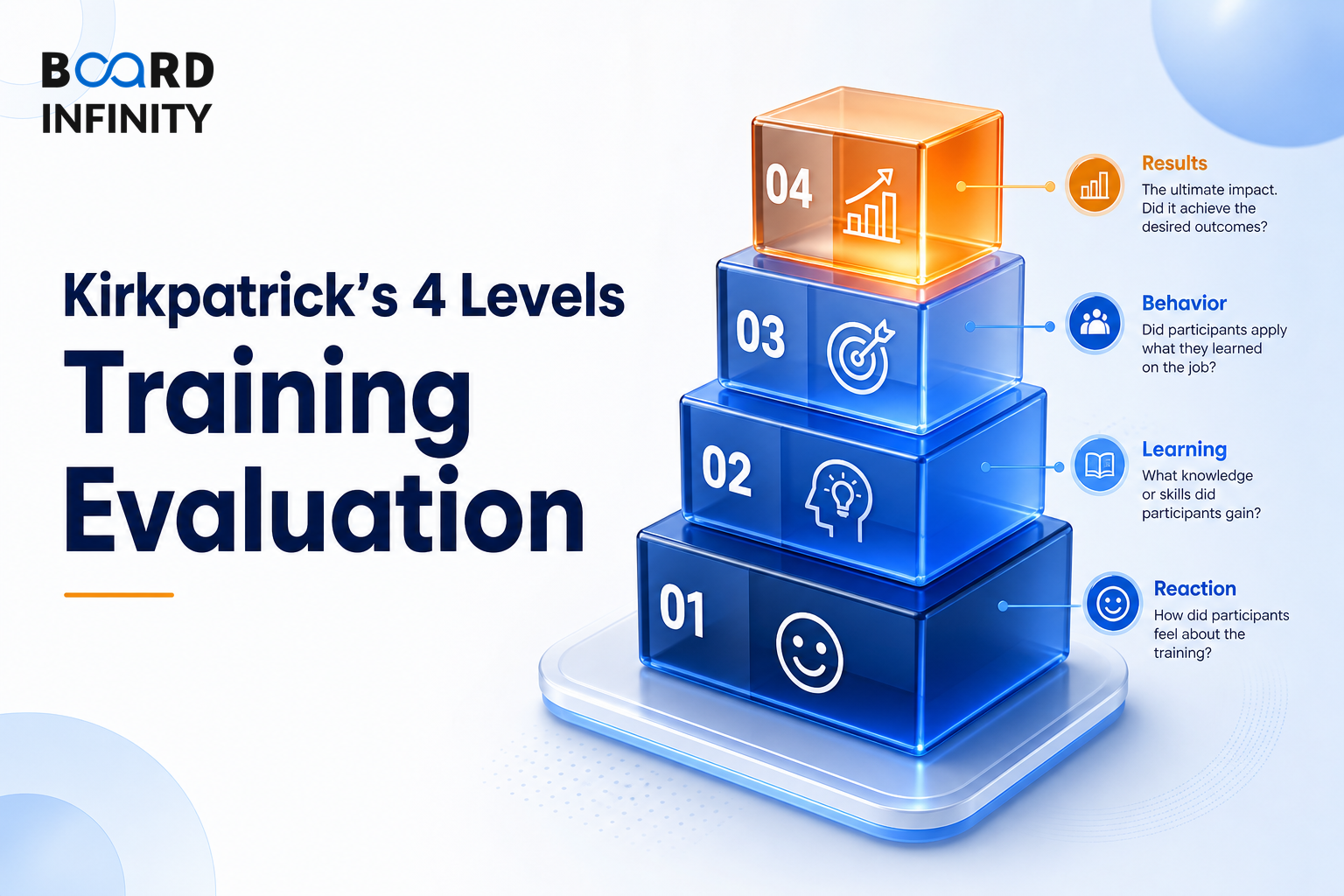
After Learning Frameworks Every L&D Professional Should Know, the next interview question is measurement: did the training actually work? Kirkpatrick's 4 Levels of Training Evaluation helps Human Resource Business Partners (HRBPs) and Learning and Development (L&D) teams move beyond satisfaction surveys to measurable business impact. In interviews, it matters because it shows whether you can connect training design to outcomes, not just delivery.
- Donald Kirkpatrick's evaluation model (1959, updated 2016 by Jim and Wendy Kirkpatrick) remains the gold standard for measuring training effectiveness.
- The model works best when applied backwards - starting with Level 4 (business results) to design meaningful evaluation.
- Level 1 Reaction asks: did learners find it valuable?
- Level 2 Learning asks: did learners acquire the knowledge/skills?
- Level 3 Behavior asks: are learners applying what they learned?
- Level 4 Results asks: did training impact business outcomes?
- The Kirkpatrick Evaluation Gap shows that only 4% consistently measure at Level 4 (business results).
The Big Picture: Apply the Model Backwards
The model works best when applied backwards - starting with Level 4 (business results) to design meaningful evaluation. This backwards design helps HR and L&D teams define the business outcome first, then decide what behavior, learning, and reaction evidence must be measured.
Donald Kirkpatrick's evaluation model (1959, updated 2016 by Jim and Wendy Kirkpatrick) remains the gold standard for measuring training effectiveness.
How the Four Levels Work
Level 1 Reaction measures whether learners found the training valuable. Typical methods are post-training survey (Likert scale), NPS, and verbal feedback, measured immediately post-training.
Level 2 Learning measures whether learners acquired the knowledge or skills. The methods include pre/post knowledge tests, skill demonstrations, and simulations during and immediately after training.
Level 3 Behavior measures whether learners are applying what they learned. This is evaluated through manager observations, 360 feedback, and performance data 30/60/90 days later or 30-90 days post-training.
Level 4 Results measures whether training impacted business outcomes. The methods include KPI analysis, ROI calculation, cost savings, and revenue impact, typically 3-6 months post-training.
The Kirkpatrick Evaluation Gap
The Kirkpatrick Evaluation Gap: ATD (Association for Talent Development) research shows that virtually all organizations measure at Level 1 (reaction surveys), ~70% measure at Level 2 (learning tests), ~30% measure at Level 3 (behavior change), and only 4% consistently measure at Level 4 (business results).
This gap exists because Level 3 and 4 require collaboration with business stakeholders, a control group methodology, and longer measurement timelines. For HRBPs, the ability to demonstrate Level 4 impact is a significant differentiator - it transforms L&D from a cost center to a value driver.
Why Level 4 Changes the Conversation
Level 4 is where training evaluation connects to business outcomes through KPI analysis, ROI calculation, cost savings, and revenue impact. KPI means Key Performance Indicator, and ROI means Return on Investment; both help frame training as a value driver rather than only a participation activity.
The practical nuance is that Level 4 cannot be claimed immediately after a workshop. It typically needs collaboration with business stakeholders, control group methodology, and longer measurement timelines.
Level 4 ROI Calculation Example
The Phillips ROI Model extends Kirkpatrick's Level 4 to calculate a specific financial return on training investment.
ROI (%) = [(Program Benefits − Program Costs) ÷ Program Costs] × 100
Example: A sales training program for 50 managers costs ₹10 lakhs total (design + delivery + opportunity cost). Post-training, the cohort shows a 12% average increase in quarterly sales conversion rate. If average quarterly revenue per manager = ₹25L, a 12% improvement = ₹3L additional revenue per manager.
Total benefit = 50 managers × ₹3L = ₹1.5 Cr benefit. ROI = [(₹1.5 Cr − ₹10L) ÷ ₹10L] × 100 = 1,400% ROI.
Caveat: Always isolate training effects from other variables (market conditions, manager changes) using control groups or trend analysis.
Structuring a Kirkpatrick's 4 Levels of Training Evaluation Explained Interview Answer
"How would you evaluate whether a training program was effective beyond learner satisfaction surveys?"
The strongest answers do not stop at Level 1 reaction surveys. Tie the evaluation to Level 4 business outcomes and explain why Level 3 and 4 require collaboration with business stakeholders, a control group methodology, and longer measurement timelines.
The most frequent error is treating learner satisfaction as proof of training effectiveness. This costs points because virtually all organizations measure at Level 1, but only 4% consistently measure at Level 4, where L&D becomes a value driver.
Conclusion
Kirkpatrick's 4 Levels of Training Evaluation remains the gold standard because it connects reaction, learning, behavior, and business results. The strongest interview takeaway is to apply the model backwards - start with Level 4 impact, then design the evidence needed at Levels 3, 2, and 1.