
Company-Specific Prep: FMCG, Consulting, D2C & Tech
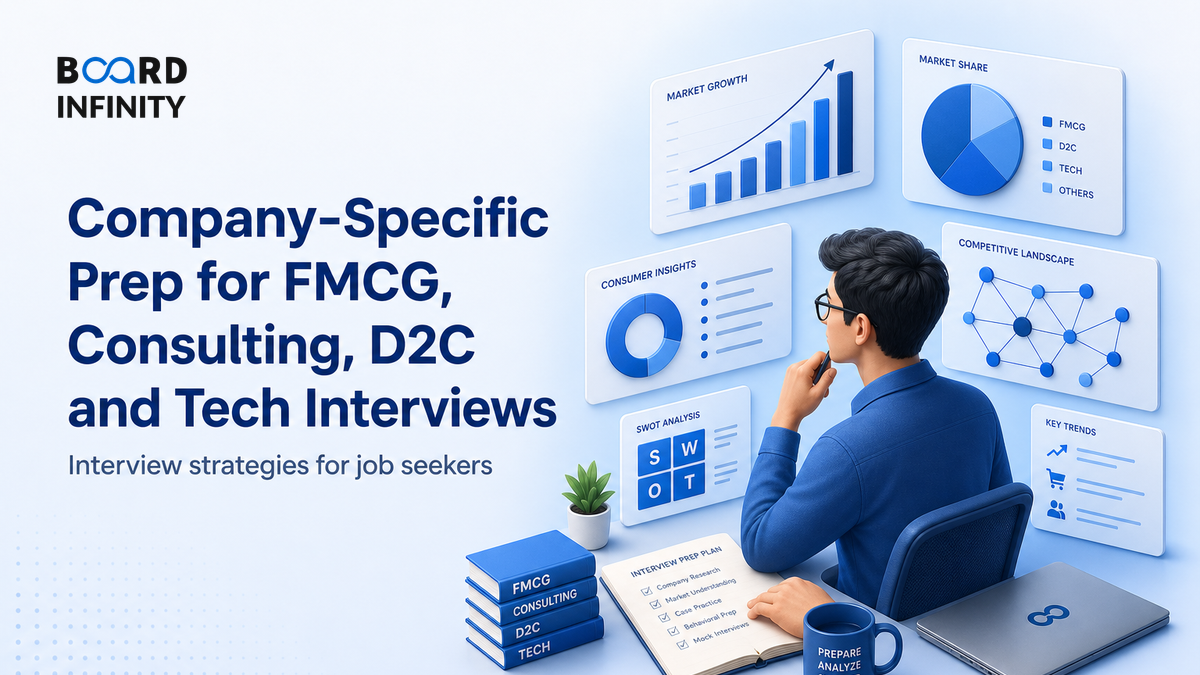
A candidate says, “I love your brand because it is innovative,” and the panel hears nothing. Another candidate says, “Your growth challenge is different from a classic FMCG player because your CAC, repeat purchase and offline expansion are now pulling in different directions,” and the room changes.
- Company-specific prep is not company trivia. It is the ability to connect business model, sector economics, role fit and your proof stories.
- FMCG prep needs category, distribution, penetration, pricing, trade marketing and brand-building logic.
- Consulting prep needs industry POV, structured thinking, client problem diagnosis and evidence of analytical judgment.
- D2C prep needs CAC, retention, gross margin, omnichannel expansion and cohort thinking.
- Tech prep needs product adoption, user pain points, monetisation, ecosystem dynamics and responsible AI/data awareness.
- The best answers follow a ladder: fact - implication - role relevance - your contribution.
- Never stop at “I researched your company.” Show what the company is trying to win next and why you are useful there.
The Big Picture
Think of company prep as a pyramid. Most candidates stay at the bottom - founders, products, recent news. Strong candidates climb upward to business implications and finally to a role-specific point of view.
The Core Framework: Prepare the Company, Not Just the Logo
The same “I know your company” answer cannot work for FMCG, consulting, D2C and tech. Each sector rewards a different lens because each sector creates value differently.
What to Look For by Sector
The Metrics You Should Know Before Walking In
Do not quote random numbers unless you are sure. Instead, know what the metric means, where to find it, and how to interpret whether the company is improving versus itself and peers.
For an FMCG company like Hindustan Unilever, a weak answer says, “HUL has strong brands.” A stronger answer says, “HUL’s strength is not only brand recall; it is the combination of portfolio depth, distribution reach, pricing packs and category development. For a marketing role, I would study how it grows penetration while protecting margin in competitive categories.” The so what: you have moved from admiration to business understanding.
Definitions You Can Say in One Breath
- Company-specific prep: Role-focused research that connects a firm’s business model, sector economics, recent moves and your fit.
- FMCG: Frequently purchased, low-unit-price consumer products that move quickly through retail and distribution channels.
- D2C: A model where a brand sells directly to customers, often using digital channels, first-party data and owned communities.
- Tech company: A firm whose core value comes from software, data, platforms, networks or technology-enabled scalability.
- Porter on strategy: “Competitive strategy is about being different. It means deliberately choosing a different set of activities to deliver a unique mix of value.”
Honasa Consumer: D2C Prep Done Like a Business Analyst
Honasa Consumer, the parent of Mamaearth, shows why D2C prep must go beyond Instagram popularity to unit economics, brand portfolio and omnichannel execution.

Situation: Mamaearth grew as a digital-first personal care brand in India, helped by a strong online presence, influencer-led discovery and a clear consumer proposition around safe, everyday personal care. But as D2C brands scale, the game changes. Growth cannot depend only on performance marketing; CAC can rise, product categories can become crowded, and customers still discover many beauty and personal-care products offline.
The move: Honasa evolved from a single digital-first brand story into a broader house-of-brands and omnichannel consumer company. Its primary driver was using digital consumer insight to launch and scale brands, while supporting drivers included influencer-led content, marketplace distribution, product extensions, offline retail expansion and portfolio diversification through brands such as The Derma Co. and Aqualogica. The company listed in India in 2023, making it a useful example for MBA interviews because its journey forces you to discuss both growth and profitability discipline.
The lesson: A shallow answer says, “Mamaearth is good at social media.” A strong answer says, “Honasa’s challenge is to convert digital-first demand into durable consumer brands, where repeat purchase, gross margin, offline distribution and portfolio focus matter as much as online reach.”
How AI Changes Company-Specific Prep
AI does not replace preparation. It compresses the first draft, helps you find patterns faster, and raises the bar because every serious candidate can now access surface-level research.
- Faster company synthesis: Tools can summarise annual reports, investor presentations, founder interviews, app reviews and news into themes. Your job is to verify and convert themes into judgment.
- Sharper sector comparison: For D2C and tech, AI can cluster customer reviews into pain points. For FMCG, it can compare product claims and pack-price architecture from public listings. For consulting, it can summarise recent thought leadership into likely client problems.
- Better answer rehearsal: You can ask an AI tool to challenge your company POV with follow-up questions, forcing you to defend assumptions instead of memorising a script.
Use NotebookLM for one target company: upload the annual report, investor presentation, job description and two credible news articles. Ask it for “five interview questions on this company’s growth risks, margin drivers and role fit,” then verify every factual claim through the original sources.
Interview Relevance
“You have applied to FMCG, consulting, D2C and tech roles. How would your company preparation change across these sectors?”
Carry a one-page “company card” for each shortlist company: business model, three recent moves, two metrics, one risk, one opportunity, and one role-fit story. This is enough to sound prepared without sounding rehearsed.
Common Mistake
The single biggest mistake is giving a generic admiration answer: “great brand, strong culture, innovative products.” It costs candidates because it proves enthusiasm but not business thinking. One-line fix: convert every company fact into an implication - “because of this, the company’s next challenge is likely to be...”
What to Revise Next
Once your company-specific prep is sharp, move to the two places where it gets tested under pressure: group discussions and project-based interview stories.