
Building a Standout Marketing Resume & LinkedIn Profile
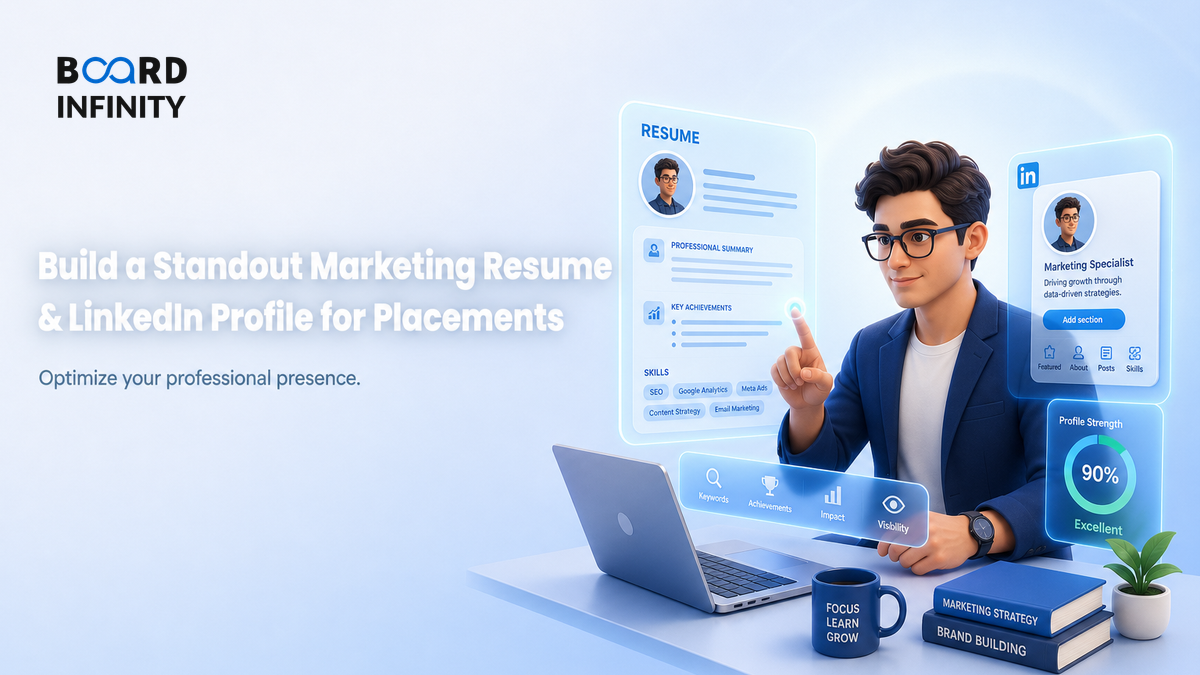
Two students can have the same internship, the same live project, and the same campus committee role - yet one profile feels like “future brand manager” while the other reads like a list of chores. The difference is not decoration; it is positioning, proof, and consistency across resume and LinkedIn.
- Your resume and LinkedIn are not biographies; they are marketing collateral for one target role.
- Start with a clear positioning promise: “I solve X marketing problem using Y strength, proven by Z evidence.”
- Every strong resume bullet follows this logic: action + marketing context + tool/method + measurable or specific result.
- LinkedIn must reinforce the same story through headline, About section, Featured work, Experience, Skills and recent activity.
- Use recruiter keywords naturally: brand management, GTM, consumer insights, CRM, performance marketing, SEO, campaign analytics, category growth.
- The best profiles show proof before personality - projects, dashboards, campaigns, research notes, case competition decks or portfolio links.
- Biggest filter: can a recruiter understand your target role and strongest evidence in 10 seconds?
The Big Picture
Think like a marketer: the recruiter is the customer, the job description is the demand signal, and your resume plus LinkedIn profile is the product page. A standout profile does not say “I am passionate about marketing”; it makes the recruiter believe “this candidate has already behaved like a marketer.”
Core Explanation: Build the Profile Like a Marketing Campaign
The mistake most students make is writing a resume from memory. A marketer writes from the customer backward. For placements, that customer is a recruiter or hiring manager scanning for role fit, credibility and evidence.
1. Choose one target lane before writing
“Marketing” is too broad. A brand management recruiter, a performance marketing recruiter and a category management recruiter look for different signals. Pick one primary lane and one backup lane before editing your resume.
2. Write a positioning promise
Your positioning promise is the one idea the recruiter should remember. Use this formula:
“I help solve [marketing problem] through [your strength], proven by [credible evidence].”
Example: “I help consumer brands turn shopper insight into sharper campaigns, proven by a rural retail research project and two live brand audits.” This is far stronger than “MBA marketing student seeking challenging opportunities.”
3. Convert every resume bullet into proof
A weak bullet describes activity. A strong bullet reduces hiring risk. Use this structure:
Action verb + marketing context + method/tool + result or learning.
If you do not have a hard metric, do not invent one. Use real proof types: sample size, duration, number of SKUs studied, number of stores visited, tools used, decision influenced, campaign asset created or stakeholder presented to.
4. Build the resume pyramid
The top half of your first page must do the heaviest work. A recruiter may not read every line, so the most role-relevant evidence should appear early.
5. Make LinkedIn the extended proof layer
Your resume gets you screened. LinkedIn often confirms whether the story is real. The platform lets you show what a one-page resume cannot: portfolio links, campaign thinking, industry curiosity and professional credibility.
6. Audit the profile with practical metrics
These are not official recruiter rules; use them as internal audit thresholds before applications begin.
Definitions You Can Say Clearly
Keller: “Brand image is consumers’ perceptions about a brand, as reflected by the brand associations held in consumer memory.”
Apply this directly to your career profile: your personal brand is not what you claim; it is the association a recruiter remembers after seeing your evidence.
The Whole Truth Foods: A Personal Branding Lesson for Marketing Students
The Indian food brand built differentiation through radical ingredient transparency, showing why a profile wins when every touchpoint proves the same promise.

Situation: Packaged “healthy” snacks in India often suffer from a trust problem. Consumers see claims like high protein, no added sugar or natural ingredients, but may still doubt what is inside the pack.
The move: The Whole Truth Foods positioned itself around ingredient honesty. Its primary driver was a clear transparency promise: make the product story easy to verify. Supporting drivers made the promise credible - minimalist packaging, ingredient-led communication, founder-led educational content and consistent messaging across product pages, social content and community conversations.
Outcome and lesson: The brand became memorable not because it shouted louder, but because each touchpoint reinforced the same association. That is exactly how a marketing candidate should build a resume and LinkedIn profile: choose one promise, then make every bullet, keyword, portfolio link and post prove it.
So what: A standout profile is built like a trusted brand. The primary driver is sharp positioning, supported by evidence, consistency, visible proof and a point of view.
How AI Changes Marketing Resumes and LinkedIn Profiles
AI has changed profile building in three practical ways, but it has not removed the need for judgment.
- Recruiter search is becoming more semantic. Profiles are increasingly discovered through role-relevant language, not just exact keywords. Use natural phrases like “consumer research,” “go-to-market planning,” “retention campaigns” and “category analysis” where they are true.
- AI screening rewards evidence-rich writing. Generic bullets sound similar when everyone uses AI. Specific context - tools, sample size, channel, consumer segment, market, output - separates real work from polished filler.
- LinkedIn content can now become a portfolio faster. Students can convert project work into short posts, carousels or summaries, but the insight must be yours. AI can polish; it cannot replace original observation.
Use ChatGPT or Claude with three inputs: one target job description, your raw resume and 3 target company profiles. Ask: “Identify missing marketing keywords, rewrite bullets without inventing facts, and suggest 5 LinkedIn Featured assets I can create from my real work.” Then manually verify every claim.
For company-specific preparation, use Perplexity to gather recent brand campaigns or market moves, then use NotebookLM to load your resume, the JD and company notes and generate likely profile-based interview questions.
Interview Relevance
“Walk me through your resume and tell me why you are a good fit for a marketing role.”
Prepare a 60-second version and a 2-minute version of your resume walkthrough. The first gets you through screening; the second helps when the interviewer probes deeply.
Common Mistake
The most costly mistake is listing responsibilities instead of proving positioning. It costs candidates because the recruiter cannot see role fit quickly, even if the student has done good work. One-line fix: rewrite every major bullet to answer, “What marketing problem did I help solve, how did I do it, and what proof can I show?”
What to Revise Next
Once your profile is sharp, prepare for the conversations it will create. Move next to The Marketing Case Interview: Frameworks That Work so you can structure brand and growth problems, then revise Guesstimates & Market Sizing for Interviews (Applied) to handle market potential, demand and sizing questions with confidence.