
The HR & Behavioral Round for Marketing Roles
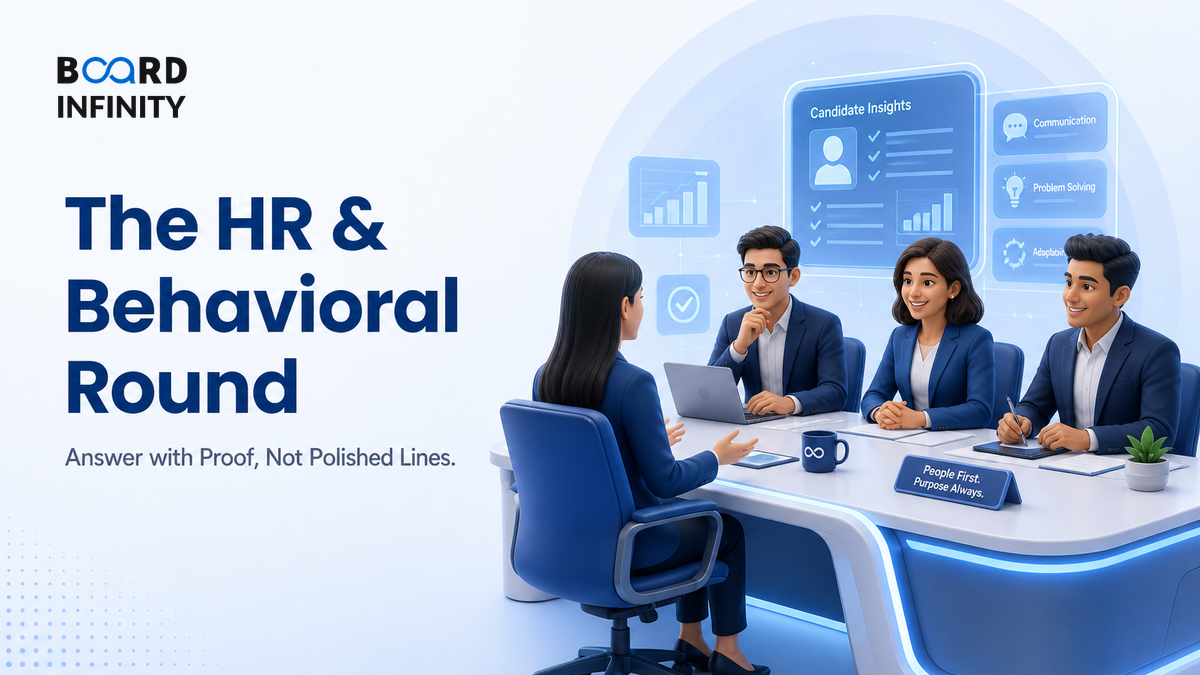
The biggest myth about the HR round is that it is the “easy” round after marketing concepts are done. In reality, this is where a recruiter checks whether your love for brands survives pressure, ambiguity, field realities, targets, cross-functional conflict and uncomfortable feedback.
- The marketing HR round tests role fit through evidence - not personality, charm or memorised values.
- Your safest structure is STAR-M: Situation, Task, Action, Result, Marketing Learning.
- Prepare 6 story types: customer insight, persuasion, conflict, failure, ambiguity, ownership and ethics.
- Every answer should connect your behaviour to a marketing reality: consumer empathy, execution discipline, sales collaboration or commercial judgment.
- For “Why marketing?”, use a three-part answer: trigger, proof and role connection.
- The strongest candidates sound specific: names of tasks, constraints, trade-offs, decisions and learning.
- The most common mistake is giving adjectives - “I am creative, passionate and a team player” - without behavioural proof.
Big Picture: The Round Is a Fit-Proof Loop
A marketing HR round is not a casual culture-fit chat. It is a loop where the interviewer keeps checking whether your motivation, past behaviour and understanding of marketing roles point in the same direction.
Core Explanation: What the Marketing HR Round Really Tests
The interviewer is not trying to find the “nicest” candidate. They are trying to predict how you will behave when a brand plan meets messy reality - late sales data, a demanding key account, a rejected campaign idea, field feedback that contradicts your hypothesis or a target that needs execution discipline.
For marketing roles, the HR and behavioral round usually tests six signals.
The STAR-M Framework: The Safest Way to Structure Behavioral Answers
Most candidates know STAR, but marketing candidates need one extra layer: Marketing Learning. Without it, your answer may show effort, but not role readiness.
Your 6-Story Bank for Marketing Behavioral Questions
Do not prepare 40 answers. Prepare six reusable stories and learn how to bend each one to a different question.
For example, if you worked on a college fest sponsorship pitch, do not describe it as “I was in the marketing team.” Say what you sold, who the audience was, what objection sponsors had, how you changed the pitch and what you learned about matching brand objectives with audience access.
The Story Quality Matrix: Which Answers Actually Work
A behavioral answer wins only when it has both proof and role relevance. A dramatic story with no marketing link is entertainment. A marketing buzzword answer with no proof is theatre.
Definitions You Should Be Able to Say in One Breath
- Marketing - Kotler and Keller: “Marketing is about identifying and meeting human and social needs.”
- Behavioral interview: A structured interview method that uses past actions in specific situations to predict future workplace behaviour.
- Role fit: The match between a candidate’s motives, skills, behaviours and the realities of the job.
- Culture fit: Alignment with how an organisation makes decisions, collaborates, handles conflict and treats customers.
Case Study: The Whole Truth - Turning Brand Belief into Behavioral Proof
The Whole Truth built a differentiated Indian packaged-food brand around ingredient transparency, making it a useful example of conviction, consumer trust and consistent marketing behaviour.

Situation: India’s packaged-snacking space is crowded with large FMCG players, D2C brands and protein-led health claims. Consumers often want healthier choices but also struggle to decode ingredient lists, claims and hidden trade-offs.
The move: The Whole Truth chose a clear brand position: radical ingredient transparency. Its marketing did not rely only on glossy aspiration. It used founder-led education, simple ingredient communication, content around food labels, community trust and D2C-first discovery supported by marketplaces and modern retail presence. The primary driver was a sharp trust-based positioning. Supporting drivers included product-policy consistency, educational content, founder credibility, packaging simplicity and distribution expansion.
Outcome or lesson: The lesson for a marketing HR round is powerful: a brand belief is not a line in a campaign deck. It becomes convincing when behaviour supports it repeatedly - what the company says, what the product contains, how claims are made and how trade-offs are explained.
So what: If you cite this case, do not say “The Whole Truth succeeded because it was honest.” Say the primary driver was a trust-first positioning, supported by product consistency, content education, founder-led credibility and channel expansion.
How AI Changes The HR & Behavioral Round for Marketing Roles
AI is changing this round in practical ways, especially for preparation quality and recruiter evaluation. The advantage goes to students who use AI to sharpen evidence, not to manufacture personality.
- Better story diagnosis: Tools can now identify whether your answer is too vague, too long or missing a result. For marketing roles, ask the tool specifically to check whether your story shows customer empathy, commercial thinking or cross-functional collaboration.
- Company-specific behavioral prep: AI can summarise a company’s recent campaigns, category moves, founder interviews and annual-report themes, helping you connect your motivation to the actual business.
- Async and AI-assisted hiring: Some employers use digital forms, recorded responses, resume screening or structured scoring aids. The risk is that generic answers get filtered out quickly. Specific examples, clear role keywords and measurable outcomes help.
Upload your resume, the job description, the company website pages and two recent campaign articles into NotebookLM. Ask: “Generate 12 HR and behavioral questions for a marketing trainee role, map each question to one resume story, and flag where my evidence is weak.” Then practise aloud and rewrite only the weak stories.
Interview Relevance
“Why do you want a marketing role, and can you give me an example that proves you are suited for it?”
For “Tell me about yourself,” use the same logic: profile in one line, two proof points, marketing fit, and why the current role is the natural next step. Keep it under 90 seconds.
Common Mistake
The biggest error is answering with personality labels instead of behavioural proof: “I am creative, passionate and a people person.” It costs candidates because the interviewer cannot verify it. The one-line fix: replace every adjective with one specific past action, the constraint you faced and the result or learning.
What to Revise Next
Once your behavioral stories are ready, move from self-fit to context-fit. Revise Company-Specific Prep: FMCG, Consulting, D2C & Tech so your answers match the employer’s business model, then practise Marketing Group Discussion (GD) Topics & Strategy to show the same maturity in a group setting.