
Marketing Day 0 Cheat Sheet
A shopper pauses in a Croma aisle, comparing two ceiling fans that look almost identical. One feels like a commodity; the other promises lower electricity bills, smart control and a cleaner modern home - that difference is marketing at work.
- Marketing starts with value, not advertising: identify a customer need, create a relevant offering, communicate it, deliver it and capture profit.
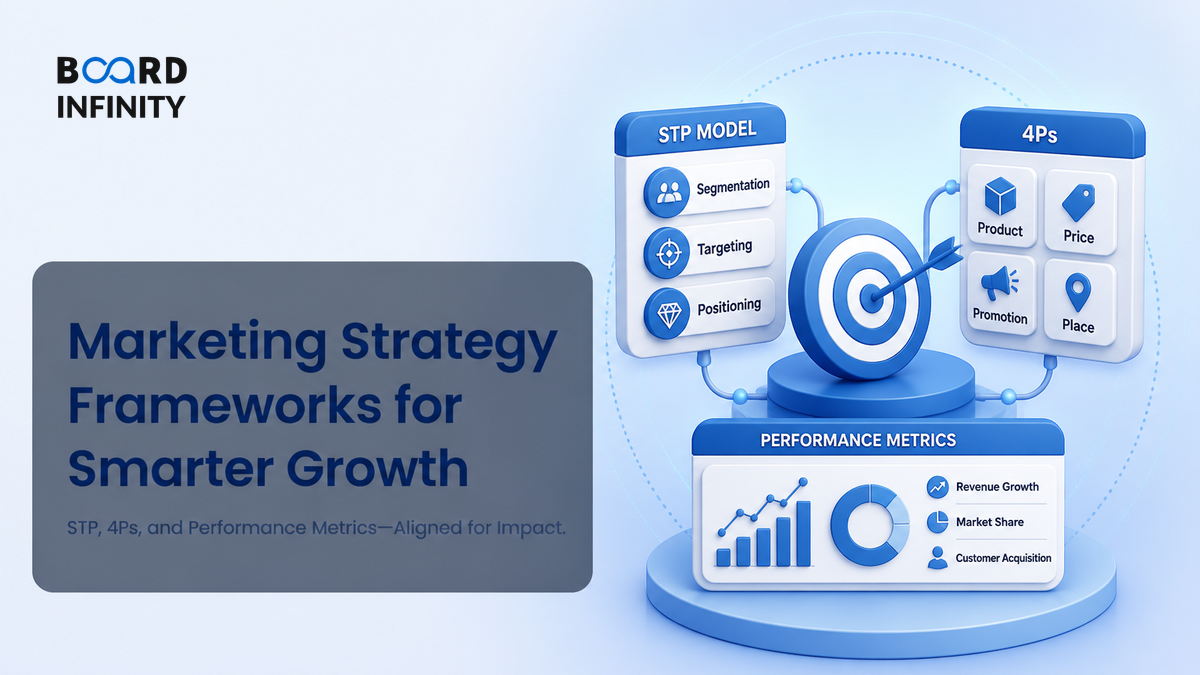
- Use the master sequence: market understanding → STP → positioning → 4Ps → funnel → metrics → iteration.
- STP means: segment the market, target the most attractive segment, then position the brand sharply in that customer's mind.
- The 4Ps must fit together: product, price, place and promotion should all reinforce the same positioning.
- Marketing answers need numbers: track conversion rate, CAC, LTV:CAC, repeat rate, NPS and revenue lift.
- Good interview answers are commercial: explain who the customer is, why the brand wins, how it reaches buyers and how success is measured.
- The biggest trap: jumping straight to campaigns before defining customer, positioning and business objective.
The Big Picture: Marketing Is a Value System
Think of marketing as a value engine. It converts messy customer needs into a clear target, a believable promise, a designed offer, a buying journey and measurable business outcomes.
Core Explanation: STP, Positioning, 4Ps, Funnel, Metrics
Segmentation divides a broad market into groups with similar needs, behaviours or responses. Common bases are demographic, geographic, psychographic, behavioural and occasion-based.
Targeting is choosing which segment to serve. A good target is attractive, reachable, profitable and a fit with the company's strengths.
Positioning is the specific space the brand wants to occupy in the customer's mind. A practical positioning statement is: For [target], brand is [frame of reference] that provides [benefit] because [reason to believe].
Once STP is clear, design the 4Ps:
- Product: features, quality, packaging, service, variants and experience.
- Price: list price, discounts, financing, freemium, premium or value pricing.
- Place: distribution channels - D2C, marketplaces, retail, distributors, quick commerce or enterprise sales.
- Promotion: advertising, influencer marketing, sales promotion, PR, performance marketing, content and trade schemes.
Many Indian D2C beauty brands do not win only through Instagram ads. Their primary driver is a clear underserved customer segment, supported by product formulation, marketplace visibility, creator-led proof, trial-friendly pack sizes and repeat-purchase nudges. The strategic so what: promotion works only when the product, price and channel make the promise believable.
The Marketing Funnel: Where Demand Leaks
The funnel shows how a potential customer moves from knowing the brand to buying and returning. It is useful because every stage has a different job, message and metric.
Marketing Metrics You Should Know Cold
Marketing becomes credible when you connect creativity to measurement. Use these as directional interview benchmarks; actual “good” values vary by category, ticket size and channel.
Mini worked example: Suppose a D2C brand spends ₹10,00,000 on a campaign and acquires 2,000 first-time buyers. CAC = ₹10,00,000 ÷ 2,000 = ₹500. If contribution margin per order is ₹300 and the average buyer makes 4 purchases, gross-profit LTV = ₹1,200. LTV:CAC = ₹1,200 ÷ ₹500 = 2.4:1. The campaign is promising but not yet excellent; the brand should improve repeat purchase or reduce CAC to move closer to 3:1.
Definitions You Can Say in One Breath
Philip Kotler: “Marketing is the science and art of exploring, creating, and delivering value to satisfy the needs of a target market at a profit.”
- Segmentation: dividing a market into groups with similar needs, behaviours or responses.
- Targeting: choosing the segment the firm can serve most profitably and credibly.
- Positioning: the intended meaning of a brand in the target customer's mind.
- Brand: a name, symbol or set of associations that identifies and differentiates an offering.
- Marketing mix: the controllable product, price, place and promotion choices used to serve a target market.
Ries and Trout: “Positioning is not what you do to a product. Positioning is what you do to the mind of the prospect.”
Case Study: Atomberg - Turning a Fan Into a Smart Savings Story
Atomberg made energy-efficient BLDC ceiling fans more understandable to Indian consumers by positioning them around savings, design and smarter home usage.

Situation: The Indian ceiling fan market has long been highly competitive and price-sensitive, with many buyers treating fans as low-involvement electrical products. BLDC technology offered energy efficiency, but a technical claim alone was not enough to change behaviour.
The move: Atomberg reframed the product from “just a fan” to a modern appliance that could reduce electricity consumption and improve home convenience. The primary driver was category reframing around energy savings and smarter usage. Supporting drivers included product proof, design cues, marketplace visibility, digital education, customer reviews, retail expansion and after-sales confidence.
Outcome or lesson: The brand shows how marketing can create value in a mature category without relying only on discounts. The deeper lesson is that innovation needs translation: technology becomes desirable only when the customer can see a relevant benefit.
Takeaway: A shallow answer says Atomberg won because it had a better product. A complete answer says it converted technology into a customer-relevant positioning, then aligned product proof, pricing logic, channels and communication.
How AI Changes Marketing
AI does not replace marketing fundamentals. It compresses the time between insight, creative testing, personalisation and measurement.
- Search is shifting from SEO to answer visibility: brands now think about how they appear in Google AI Overviews, Perplexity, ChatGPT-style answers and marketplace search. Clear product information, expert content, reviews and structured data matter more.
- Creative testing is faster: marketers can generate multiple ad angles, landing page variants and product-benefit messages, then test them quickly across channels. The skill is not prompt writing alone; it is choosing the right customer insight.
- Personalisation is more granular: AI models can predict churn risk, next-best offer, customer lifetime value and campaign propensity, but brands must handle consent and privacy carefully under India's DPDP Act regime.
Load a company website, recent annual report or investor presentation into NotebookLM. Ask: “Extract the target customer, positioning, 4Ps, funnel metrics and likely marketing risks. Then generate five placement interview questions with model answer bullets.” Verify every factual claim before using it.
Interview Relevance
“Pick any consumer brand you like. How would you evaluate its marketing strategy, and what would you improve?”
Use one sentence like this: “I will evaluate the brand from customer to cash - target customer, positioning, 4Ps, funnel leakage and measurable business impact.” It sounds structured without sounding memorised.
Common Mistake
The mistake that costs candidates is treating marketing as only promotion - “run influencer campaigns, do social media, give discounts.” It costs you because interviewers want strategic thinking, not a list of tactics. One-line fix: always begin with customer, objective and positioning before you suggest any campaign.
What to Revise Next
This is the final lesson in the marketing course, so do not add more theory now. Do a capstone review: pick one Indian brand and build a one-page marketing diagnosis using the Day 0 map.