
Conversion Rate Optimization (CRO) Fundamentals
What if your website does not need more traffic - it needs fewer leaks? A brand can spend lakhs bringing users to a landing page, only to lose them at a confusing product page, a weak trust signal, or one extra checkout field.
- CRO improves the percentage of users who take a desired action - purchase, signup, demo request, app install, lead form, or subscription.
- The CRO mindset is not “change button colour”; it is diagnose friction, form a hypothesis, test, learn and scale.
- Start with the funnel: traffic source - landing page - product/value page - cart/form - payment/submission - confirmation.
- Track both primary metrics like conversion rate and revenue per visitor, and guardrails like refund rate, lead quality and repeat purchase.
- A/B testing is useful only when the test has a clear hypothesis, enough sample size, and one primary success metric.
- The best CRO teams prioritize by impact versus effort - quick wins first, strategic experiments next, vanity changes last.
- The biggest trap: celebrating a higher conversion rate while hurting business quality, margins, or customer trust.
The Big Picture
CRO is the operating system for getting more qualified outcomes from the traffic you already have. It sits between marketing, product, analytics, UX and sales - because conversion improves only when the user journey becomes clearer, easier and more trustworthy.
The Core Idea: CRO Is Revenue Discipline, Not Cosmetic Tweaking
A conversion happens when a user completes the action the business wanted from that journey. For an ecommerce brand, it may be purchase. For SaaS, it may be demo booking. For banking, it may be completed KYC or loan application submission. For media, it may be paid subscription.
The core CRO question is simple: where are high-intent users dropping off, and what friction can we remove without damaging business quality?
Think of CRO in three layers:
- Data diagnosis: Where is the leak? Page, device, traffic source, form step, payment step, pricing page, or trust moment?
- Behaviour explanation: Why is the leak happening? Lack of clarity, risk, effort, poor speed, weak offer, wrong audience, or missing proof?
- Experimentation: What change can we test to reduce that friction while protecting revenue quality?
The CRO Funnel: Where Conversion Usually Breaks
A CRO answer becomes strong when you can map the full funnel, not just the final purchase button. Every stage has a different user question.
The Five-Step CRO Process
The Prioritization Matrix: What to Fix First
Most teams have too many CRO ideas: shorter forms, new copy, trust badges, testimonials, video demos, pricing changes, page speed work, checkout redesign. The discipline is to prioritize, not randomly test.
Core CRO Metrics You Must Know
There is no universal “good” conversion rate across industries, categories, devices, geographies or traffic sources. A high-intent branded search visitor and a cold Instagram visitor should not be benchmarked the same way. In interviews, the strongest answer is: compare against the right baseline, segment the data, and protect guardrail metrics.
A Small Worked Example
Suppose a D2C skincare brand gets 10,000 eligible product-page visitors in a week.
- Current purchases = 300, so conversion rate = 300 / 10,000 x 100 = 3.0%.
- The team tests a clearer product-benefit section plus stronger delivery and return reassurance.
- Variant purchases = 360 from 10,000 eligible visitors, so new conversion rate = 360 / 10,000 x 100 = 3.6%.
- Absolute lift = 3.6% - 3.0% = 0.6 percentage points.
- Relative lift = 0.6 / 3.0 = 20%.
- If average order value is ₹1,200, incremental revenue for those 10,000 visitors = 60 extra orders x ₹1,200 = ₹72,000.
The interview nuance: this is promising, but you should still ask whether the sample size was adequate, whether traffic mix was comparable, and whether returns or cancellations increased.
Definitions You Can Say Cleanly
- Conversion: A conversion is the completion of a desired user action, such as purchase, signup, download, or qualified lead submission.
- Conversion rate: Conversion rate is conversions divided by total eligible visitors or sessions, expressed as a percentage.
- CRO: Conversion Rate Optimization is the structured practice of improving the percentage of visitors who complete a desired action.
- A/B test: An A/B test compares two versions of an experience to estimate which performs better on a defined metric.
Booking.com is widely known for using controlled experiments to improve search, listings, messaging and booking flows. Its CRO strength does not come from one trick; the primary driver is a disciplined experimentation culture, supported by high traffic volume, granular user data and rapid product iteration. So what: CRO becomes a competitive capability when learning speed compounds over many small decisions.
Lenskart: Reducing Purchase Risk in an Omnichannel Funnel
Lenskart shows CRO in an Indian context by reducing the uncertainty of buying eyewear online through try-on tools, service options and omnichannel reassurance.
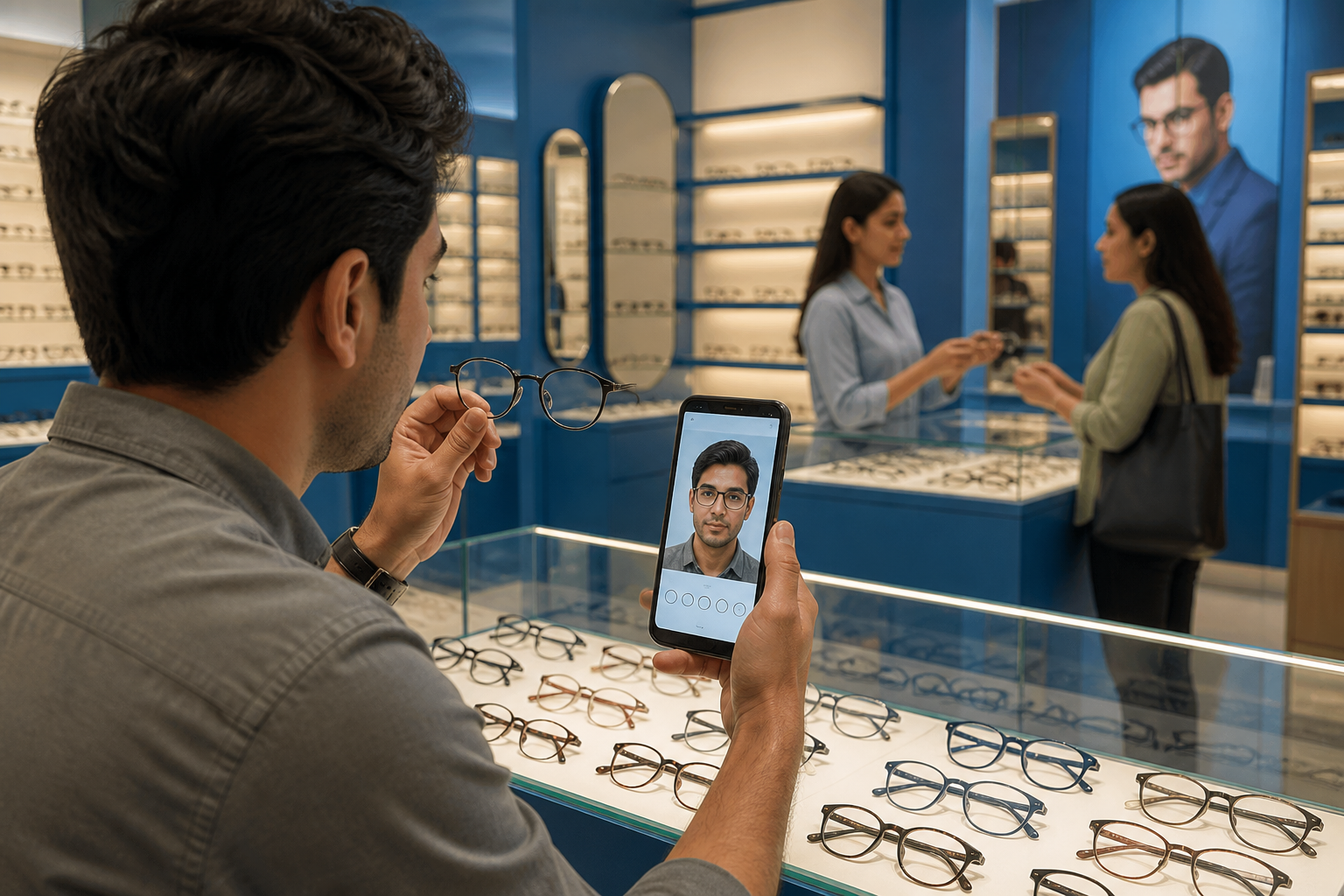
Situation: Eyewear has a naturally high-friction buying journey. Users worry about frame fit, face shape, lens accuracy, return hassle and whether the online product will match the real look. In India, the journey is further shaped by price sensitivity, comfort with cash or assisted purchase, and the importance of local service.
The strategic move: Lenskart reduced friction across the funnel instead of optimizing only one screen. Its digital experience uses virtual try-on and product discovery to reduce fit uncertainty. Its physical stores and home eye-check style services add reassurance for users who are not fully comfortable completing the journey online. Clearer product information, offers, lens options and service touchpoints support the final decision.
Outcome or lesson: The lesson is not “virtual try-on increases conversion” as a single-cause story. The primary driver is risk reduction in a high-consideration category, supported by omnichannel access, assisted service, pricing architecture and post-purchase reassurance. CRO works best when it matches the real anxiety of the category.
How AI Changes Conversion Rate Optimization
AI is changing CRO from slow manual diagnosis to faster pattern discovery, but it does not replace judgment. The best use is to generate sharper hypotheses and analyze more customer signals, while humans still decide what is ethical, brand-safe and commercially meaningful.
- AI-assisted funnel diagnosis: AI tools can summarize session recordings, heatmap patterns, search queries, support tickets and chat transcripts to identify repeated friction points such as confusing pricing, missing delivery information or form anxiety.
- Personalized experiences: ML-based systems can adapt recommendations, offers, content order and product discovery by user segment. The risk is over-personalization that feels intrusive or optimizes short-term clicks over long-term trust.
- Experiment ideation and copy variants: LLMs can generate landing-page headlines, CTA alternatives, objection-handling blocks and FAQ structures. These should be tested, not blindly shipped.
Use ChatGPT or Claude with this prompt: “Act as a CRO analyst. I am evaluating an Indian eyewear ecommerce funnel. Here are the funnel stages, drop-off rates, customer complaints and page screenshots described in text. Identify the top five friction points, write testable hypotheses, and suggest primary and guardrail metrics for each.” Then ask Perplexity to find credible examples of similar CRO changes in the same category.
Interview Relevance
“Suppose an ecommerce brand has high website traffic but low purchases. How would you improve its conversion rate?”
In a marketing interview, always mention segmentation. “Low conversion” is rarely one problem. Mobile users may face speed issues, paid social users may have weak intent, and returning users may need a different offer from first-time visitors.
Common Mistake
The mistake that costs candidates is treating CRO as random UI tweaking - “change the CTA colour, add discounts, reduce price.” It costs you because it shows no diagnosis, no funnel thinking and no concern for business quality. The one-line fix: start with funnel data, identify friction, write a hypothesis, test it, and judge success using one primary metric plus guardrails.
What to Revise Next
After CRO, revise the growth topics that begin after the first conversion: how to retain users, deepen relationships and turn happy customers into acquisition channels.