
Marketing Funnels & the AARRR ("Pirate") Metrics
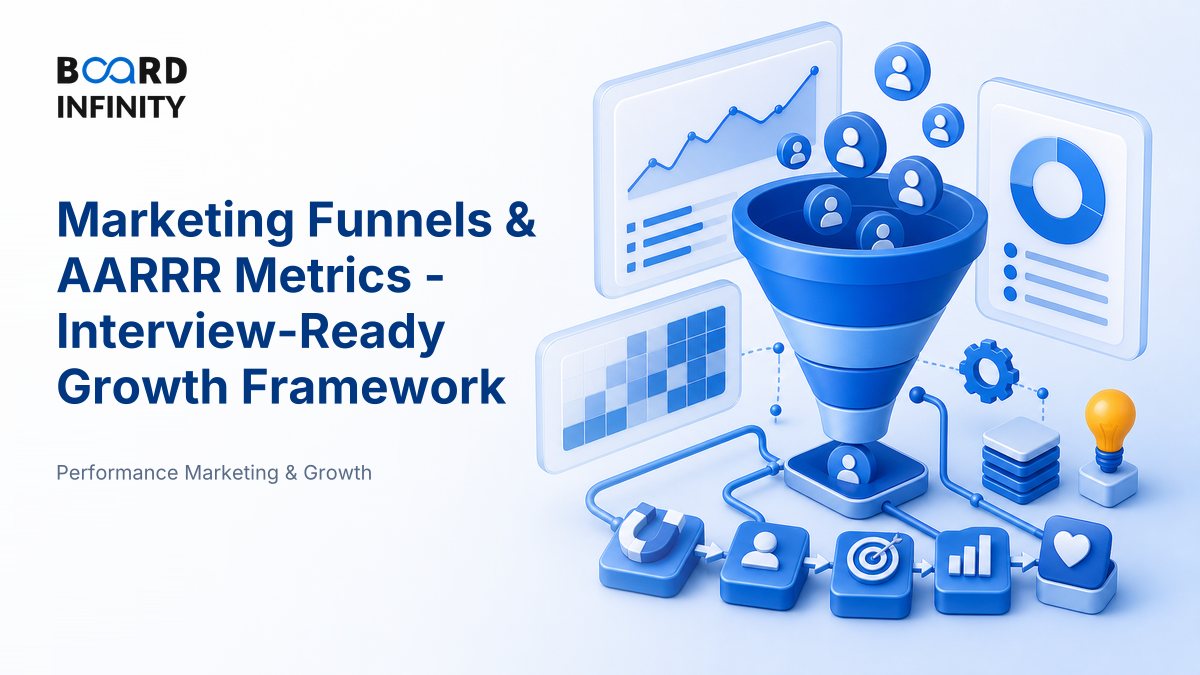
A growth team opens Monday dashboards and sees a painful truth: traffic is up, ad spends are up, but paid users are flat. The problem is not always acquisition - often the leak is hidden two steps later, where users fail to activate, return, refer or pay.
- A marketing funnel breaks the customer journey into measurable stages so teams can find where growth is leaking.
- AARRR stands for Acquisition, Activation, Retention, Referral and Revenue - the five pirate metrics popularised by Dave McClure for startup growth.
- The most important funnel habit is cohort thinking: do not mix users acquired in different periods and call it one clean number.
- Good funnel diagnosis asks: where is the biggest drop, what behaviour causes it, and which experiment can move it fastest?
- Activation is usually the make-or-break stage because users must reach the product's first real value moment.
- Revenue metrics mean little unless you connect them to unit economics: CAC, LTV, payback and margin quality.
- In interviews, do not recite AARRR. Apply it to a real product, name stage metrics and propose a test.
The big picture is simple: a funnel is not a poster of customer stages; it is a diagnostic machine. AARRR turns that machine into five measurable questions - how users arrive, experience value, return, spread the product and generate money.
Core Explanation - How the Funnel and AARRR Work Together
A marketing funnel maps the customer journey as stages with measurable conversion between each stage. AARRR is a startup-friendly funnel that focuses less on brand awareness and more on product-led growth behaviour.
The five stages answer five management questions:
Notice the order. Acquisition comes first chronologically, but activation and retention often decide whether acquisition spend is sensible. Pouring paid media into a weak activation flow is like filling a leaking bucket.
The Metrics You Must Be Able to Calculate
These are the numbers interviewers expect you to name without hesitation. Benchmarks vary by category, price point and purchase frequency, so use the ranges below as directional digital-product heuristics, not universal laws.
Worked example: Suppose 10,000 users visit a learning app landing page. 800 sign up, 360 complete their first lesson, 108 return on day 7, 18 invite a friend, and 24 become paid users.
The diagnosis: sign-up and paid conversion look healthy, activation is acceptable, but D7 retention is weak. The next experiment should improve habit formation - reminders, streaks, course recommendations or onboarding quality - before scaling acquisition spend.
Definitions You Can Say in One Breath
- AMA: “Marketing is the activity, set of institutions, and processes for creating, communicating, delivering, and exchanging offerings that have value.”
- Marketing funnel: A staged model of how prospects move from awareness to conversion, with measurable drop-offs between stages.
- AARRR: Dave McClure's startup metrics framework: Acquisition, Activation, Retention, Referral and Revenue.
- Cohort: A group of users who entered the product in the same time period or through the same source.
How to Diagnose a Funnel Like a Growth Manager
Do not start with “increase awareness.” Start with the leak. A strong funnel answer moves from measurement to diagnosis to experiment.
Dropbox made referral part of the product by offering extra storage to both the inviter and the invited user. The primary driver was a product-native incentive directly tied to the core value of storage, supported by low sharing friction and visible user benefit. The strategic so what: referral works best when the reward reinforces the product, not when it feels like a detached coupon.
Case Study - Lenskart's Funnel from Trust Problem to Repeat Commerce
Lenskart shows how an Indian consumer brand can fix funnel friction by combining digital discovery, assisted trial, stores and repeat-purchase CRM.

Situation: Buying spectacles online has natural friction. Customers worry about frame fit, lens accuracy, face shape, after-sales support and whether an online brand can be trusted with a need-based purchase.
The move: Lenskart did not treat the funnel as only a media problem. Its primary driver was reducing activation friction - helping users experience confidence before purchase through assisted discovery, try-on, eye tests and omnichannel stores. Supporting drivers included wide frame variety, private-label economics, app and website flows, store expansion, service support and repeat reminders for eyewear needs.
Outcome and lesson: The brand's funnel became stronger because each stage solved a specific customer anxiety. Acquisition created discovery, activation created confidence, retention came from repeat eyewear needs and service, and revenue improved through omnichannel conversion. The lesson for interviews: a funnel is not just ad spend - it is the design of customer confidence at every stage.
How AI Changes Marketing Funnels & AARRR Metrics
AI changes funnel work by making diagnosis faster, personalisation sharper and experimentation more continuous. The danger is also higher: teams can optimise a proxy metric quickly and still damage long-term retention.
In 2026, AI-led funnel work should be measured with both growth and quality metrics. Use holdouts wherever possible so you know whether the model caused the lift.
Practical student workflow: Open Perplexity or ChatGPT, choose one company you are preparing for, and ask: “Map this company's acquisition, activation, retention, referral and revenue metrics. List likely funnel leaks, the metric to verify each leak, and one experiment per stage.” Then cross-check the answer with the company's app, website, annual report or credible interviews.
Interview Relevance
“Suppose you are the growth manager for a new fitness app. Installs are rising but paid subscriptions are not. How would you use AARRR metrics to diagnose the issue?”
Use one sentence per stage, then go deep on the suspected leak. Interviewers reward prioritisation more than a long list of possible tactics.
Common Mistake
The biggest mistake is treating AARRR as a memorised acronym instead of a diagnostic system. It costs candidates because they sound theoretical and cannot decide what to fix first. One-line fix: define one metric per stage, identify the largest meaningful leak, and propose one experiment with a success metric.
What to Revise Next
Once AARRR is clear, move from funnel diagnosis to growth economics and paid media execution. Revise Paid Acquisition: CAC, ROAS, LTV & Payback Period first, then study The Meta & Google Performance Playbook: Structures, Creative Testing & Marginal ROAS so you can connect funnel thinking to media budgets and campaign decisions.