
Credit Risk and NPA Management in Indian Banking: AI, Governance and Surveillance
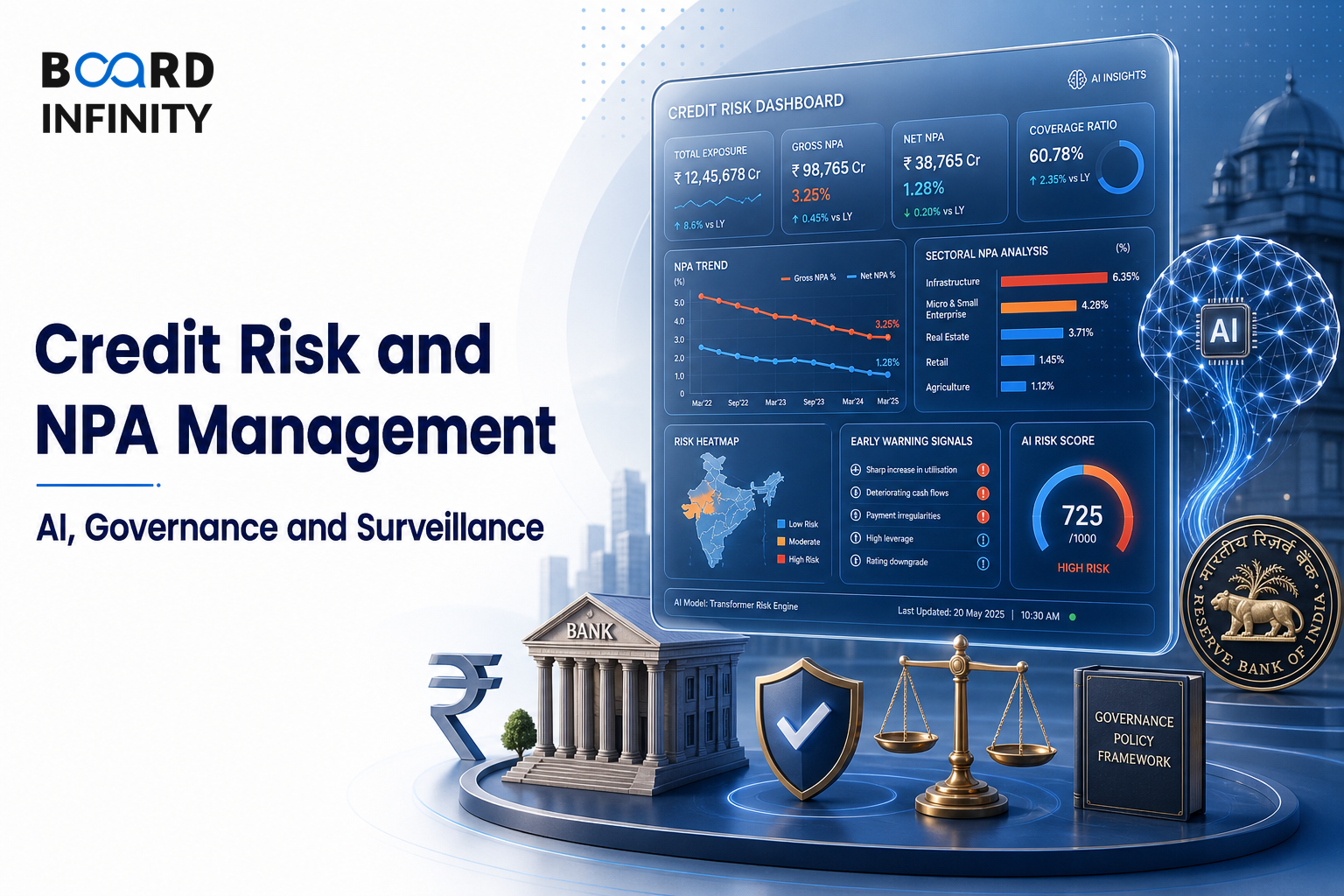
In the previous concept, Risk Management - Types, Measurement & Frameworks, the focus was on identifying, measuring and controlling risk. This lesson extends that thinking to Artificial Intelligence (AI), meaning computer systems that support tasks such as prediction, pattern detection and decision support, in Indian finance. For interviews, the key question is not whether AI is being used, but how regulators, exchanges, payment networks and banks are balancing speed with governance, explainability and customer protection.
- AI in Indian finance is being adopted with caution: RBI, SEBI, NPCI, BSE, NSE, HDFC Bank and Zerodha all use or regulate AI-led systems in different risk contexts.
- For credit risk and Non-Performing Asset (NPA) discussions, the strongest interview lens is early risk detection, faster underwriting, model risk governance and explainable credit decisions.
- RBI’s Report on Currency & Finance 2022-23 focused on AI in finance, and draft AI governance guidelines for banks emphasise model risk management and explainability.
- SEBI has regulated algorithmic trading since 2008 and issued a 2023 circular requiring SEBI-registered Investment Advisers using AI to disclose methodology.
- NPCI uses Machine Learning (ML) for real-time UPI fraud detection across 14 billion+ monthly transactions, reducing the UPI fraud rate to <0.002%.
- HDFC Bank’s EVA chatbot has handled 100M+ queries, while AI-based MSME loan underwriting reduced turnaround from 15 days to 59 minutes.
- The interview mistake to avoid is treating AI as a magic automation tool rather than a governed risk system that needs documentation, explainability and controls.
At a big-picture level, AI in Indian finance can be mapped across five layers: regulation, market surveillance, payment security, bank credit operations and finance career readiness.
The Context: AI is Now Part of Indian Financial Risk Management
AI has moved from a back-office productivity tool to a core part of risk management in Indian finance. Machine Learning (ML), a type of AI that learns patterns from data, is being used for fraud detection, surveillance and credit decision support. Natural Language Processing (NLP), an AI method for interpreting text, is being used by BSE and NSE to analyse corporate announcements.
For credit risk and NPA management, the practical link is straightforward: better underwriting and early warning systems can help banks identify risky borrowers earlier, while governance rules ensure that model-based decisions are documented and explainable. An NPA, or Non-Performing Asset, is a loan-quality problem where the asset is not generating expected repayments; in interviews, connect NPAs to the quality of credit appraisal, monitoring and risk controls rather than only to recovery after default.
Regulatory Lens: RBI and SEBI Want AI, but Not Black Boxes
The Reserve Bank of India (RBI) and the Securities and Exchange Board of India (SEBI) are both engaging with AI, but their emphasis is governance. RBI’s AI focus is especially relevant for banks because credit decisions affect customers directly, and the source highlights model risk management and explainability as central requirements. SEBI’s focus spans algorithmic trading, AI-based advisory disclosure and surveillance of unusual trading patterns.
RBI’s Report on Currency & Finance 2022-23 was devoted to AI in finance, and the source highlights draft guidelines on AI governance for banks. The practical implication is that banks must document AI model risk, and explainability is required for credit decisions under SEBI/RBI frameworks. The strategic point: AI can speed up finance, but regulated decisions still need accountability.
Payments and Fraud Risk: NPCI Shows AI at Transaction Scale
The National Payments Corporation of India (NPCI) operates key retail payment infrastructure, including Unified Payments Interface (UPI), a real-time digital payment system. In the source, NPCI uses ML for real-time UPI fraud detection across 14 billion+ monthly transactions. NPCI Bharat BillPay also uses AI for dispute resolution.
This is important because fraud risk is an operational risk that can quickly become a trust problem. The reported impact is a reduction in the UPI fraud rate to <0.002% despite massive transaction volume. In interviews, this is a strong example of AI being used not for lending, but for protecting payment rails at scale.
NPCI screens 14 billion+ monthly UPI transactions using ML for real-time fraud detection. The reported fraud rate is <0.002% despite massive volume, which makes this a high-quality interview example of AI working at infrastructure scale. The strategic point: AI is valuable when the system is too large and fast for purely manual monitoring.
Credit Risk and NPA Management Lens for Banks
Credit risk is the risk that a borrower may not meet repayment obligations. In Indian banking interview answers, NPA management should be positioned as the downstream consequence of credit risk decisions: if underwriting, monitoring and early warnings are weak, asset quality can deteriorate. The source does not provide NPA numbers, so the right approach is to discuss how AI strengthens the risk process rather than inventing asset-quality outcomes.
HDFC Bank gives the clearest banking example. EVA, or Electronic Virtual Assistant, is described as India’s first AI-powered banking chatbot and has handled 100M+ queries. HDFC Bank also uses AI-based credit underwriting for Micro, Small and Medium Enterprise (MSME) loans, including MSME loan in 59 minutes, reducing turnaround from 15 days to 59 minutes.
Worked Example - HDFC Bank MSME Digital Credit Underwriting
The interview takeaway is that AI-based underwriting should not be presented as “automatic lending.” A stronger answer says that AI can reduce turnaround time, but banks still need model risk controls because credit decisions affect borrowers and asset quality.
Market and Trading Risk: SEBI, BSE, NSE and Zerodha
AI in Indian finance is not limited to banks. SEBI’s surveillance system flags unusual trading patterns using AI, and the source states that 50%+ NSE volumes are algorithm-driven. SEBI’s Integrated Market Surveillance System (IMSS) uses ML for insider trading detection, which links AI to market integrity rather than only operational efficiency.
BSE’s Project SMART uses AI-powered market surveillance, while NSE uses AI for risk management at its clearing corporation. Both exchanges use NLP for corporate announcement analysis, supporting early detection of market manipulation, circular trading and coordinated pump-and-dump schemes. Zerodha adds a conduct-risk angle through Kite platform’s Nudge system, which warns retail traders about high-risk Futures and Options (F&O) trades in real time.
Zerodha’s Kite platform uses an AI-powered Nudge system to warn retail traders about high-risk F&O trades in real time. The source says this reduced retail trader losses and that SEBI cited Zerodha’s nudge system as a best practice in its 2023 study on F&O trader profitability. The strategic point: AI can be used not only to approve or reject decisions, but also to improve user behaviour before risk materialises.
Career Readiness: What Finance Students Should Learn
The source highlights three AI tools every finance student should master before placement season. ChatGPT or Claude can help draft financial memos, debug Python or Excel, and practise interview Q&A. Python plus pandas, where pandas is a Python library for data analysis, helps with financial data analysis; even basic screener.in data manipulation is positioned as a differentiator.
Bloomberg and Refinitiv are also highlighted if the campus has access. The career logic is simple: these skills signal readiness for Day 1 productivity. In interviews, do not only say “I know AI”; explain the finance workflow where you used it, such as memo drafting, data cleaning, market research or interview practice.
Structuring a Credit Risk & NPA Management in Indian Banking Interview Answer
"How are Indian banks and regulators using AI for credit risk and NPA management, and what governance concerns should they address?"
The strongest answers separate use cases from controls. Say what AI does, name the institution using it, state the risk being reduced, and then add the governance requirement that prevents the model from becoming a black box.
Conclusion
AI is becoming a practical risk-management layer across Indian finance, from RBI-governed bank credit decisions to NPCI fraud detection, exchange surveillance and broker nudges. For placement interviews, the winning answer is balanced: AI improves speed, scale and detection, but regulated finance still depends on explainability, documentation and human accountability.
The most common mistake is saying “AI will solve credit risk and NPAs” without explaining governance, model risk or named Indian examples. That costs points because interviewers expect a regulated-finance answer: faster underwriting or surveillance matters only when the model is explainable, documented and controlled.