
Derivatives - Futures, Options and Swaps Explained
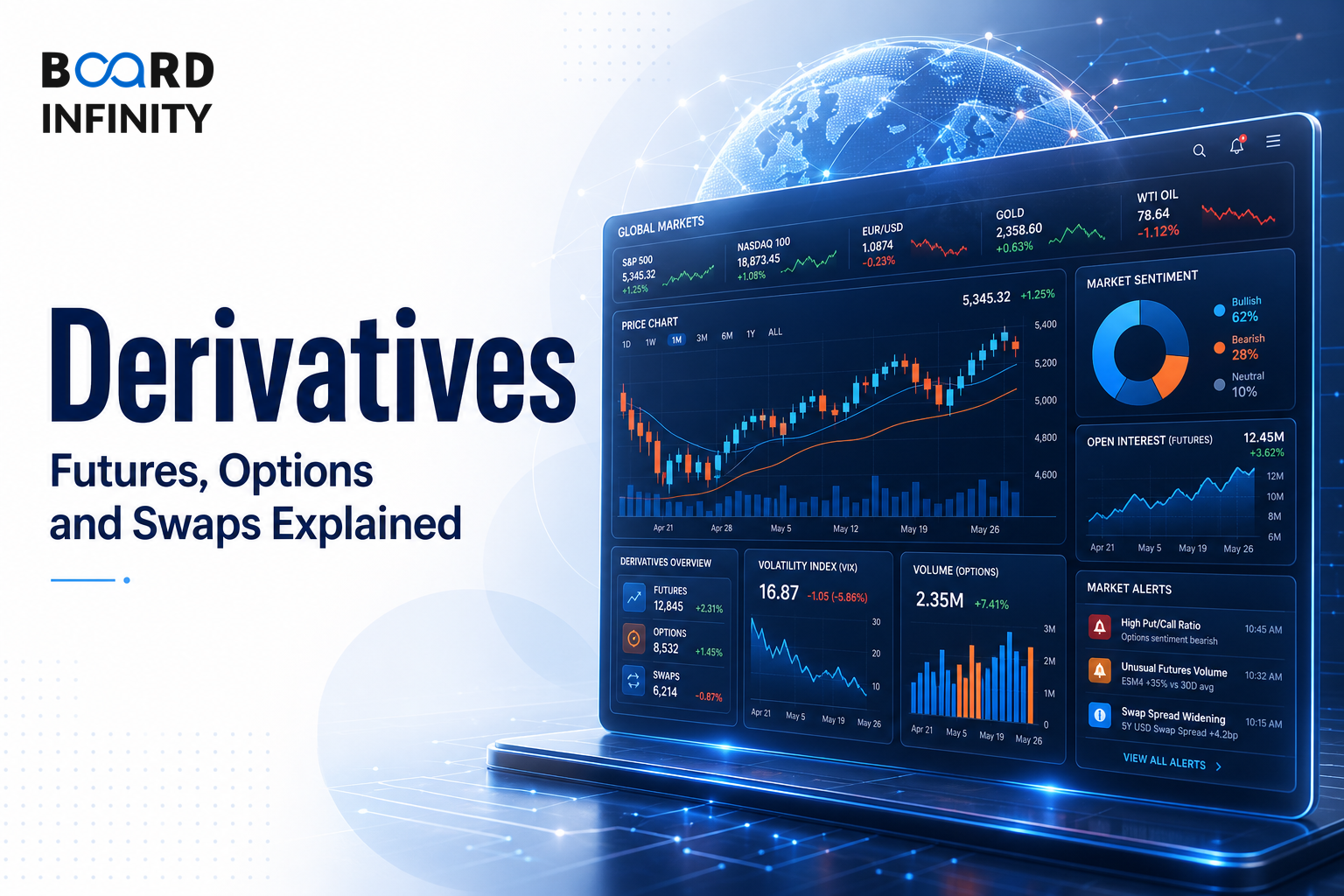
Derivatives look intimidating because they combine markets, risk, leverage and regulation in one topic. In India, the concept is especially interview-relevant because NSE-anchored futures and options activity has grown into one of the largest derivatives markets globally by contract volume, with index options at the centre of the boom. This lesson explains futures, options and swaps through that India-specific lens, so you can discuss both the mechanics and the regulatory context clearly.
- A derivative is a financial contract whose value is linked to an underlying asset or index, such as Nifty 50, Nifty Bank or an eligible stock.
- Futures create an obligation to transact later, while options give the buyer a right and create an obligation for the seller.
- Swaps are derivative contracts where parties exchange cash flows based on agreed terms, and should not be confused with NSE-listed index options.
- India's NSE F&O market has consistently ranked as the world's largest derivatives exchange by number of contracts, according to the FIA Global Futures & Options Report 2023-24.
- In FY24, monthly NSE F&O turnover was ₹8,000+ lakh crore notional, with equity derivatives accounting for ~95% of volume and index options dominating.
- SEBI tightened weekly expiries in 2023-24: on NSE, only Nifty 50 and Nifty Bank retain weekly expiries, while other index weekly contracts were phased out to curb retail speculation.
- For interviews, avoid explaining derivatives only as profit-making tools; frame them as instruments for risk transfer, speculation, liquidity and regulation.
Derivatives at a Glance
The big picture is simple: derivatives are contracts, not standalone businesses. Their value comes from something else - an underlying index, stock, rate or cash-flow reference. In the India F&O context provided by NSE and SEBI sources, the most important visible segment is equity derivatives, especially index options on Nifty 50 and Nifty Bank.
A derivative is a contract whose value is derived from an underlying reference such as Nifty 50, Nifty Bank or an eligible F&O stock; the contract defines what each party can or must do in the future.
Why Derivatives Matter in India's NSE-led F&O Boom
India's derivatives market matters because scale, access and regulation now meet in the same place. The source states that NSE F&O consistently ranks as the world's largest derivatives exchange by number of contracts, based on the FIA Global Futures & Options Report 2023-24. It also states that monthly NSE F&O turnover was ₹8,000+ lakh crore notional in FY24.
The composition is equally important. Equity derivatives account for ~95% of volume, and index options dominate. That means an interview answer on Indian derivatives should not remain abstract; it should connect the mechanics of options to the actual market structure around Nifty 50 and Nifty Bank.
The final layer is regulation. SEBI's 2023-24 restriction on weekly expiries allowed only Nifty 50 and Nifty Bank to retain weekly expiries on NSE, while all other index weekly contracts were phased out to curb retail speculation. This is a strong example of how a market can grow rapidly while regulators adjust contract design to manage participant behaviour.
Futures: Obligation, Contract Size and Market Discipline
A futures contract is a derivative that obligates both parties to transact later based on pre-agreed contract terms. In simple interview language, the buyer and seller do not merely express a view; they accept an obligation. This makes futures different from options, where the buyer has a right rather than an obligation.
In the India F&O setting, futures are part of the NSE F&O market, but the source highlights that index options dominate total equity derivative activity. Futures still matter conceptually because they help candidates explain obligation-based derivatives, contract value and the role of lot sizes.
SEBI sets lot sizes with a minimum contract value of ₹5-10 lakh, revised periodically. That number is not just an operational detail. It affects who can participate, how much exposure a single contract creates and why derivatives can amplify both gains and losses.
Explain futures as obligation-based derivatives: underlying reference, contract size, expiry, obligation of both parties and the risk created by exposure larger than the upfront cash outlay.
Options: Rights, Obligations and Index Options Dominance
An option is a derivative where the buyer receives a right, while the seller carries the corresponding obligation. The source does not require a deep payoff calculation, but it does make one market point unavoidable: in India, index options dominate the equity derivatives volume on NSE.
This dominance is linked to retail participation in index options. For interviews, that means you should discuss options not only as textbook contracts but also as products whose popularity can create regulatory concern. The SEBI 2023-24 weekly-expiry restriction is the clearest source-backed example.
A useful nuance is that high contract volume does not automatically mean the product is simple or low risk. The source specifically links the restriction on weekly expiries to curbing retail speculation. In an interview, this is where candidates can show maturity by distinguishing market popularity from suitability for every participant.
Swaps: Cash-flow Exchange Logic
A swap is a derivative where parties agree to exchange cash flows based on defined terms. Compared with exchange-traded index options, swaps are best understood as customised cash-flow exchange contracts rather than the centre of the NSE index-options boom described in the source.
This distinction matters because many candidates lump all derivatives into the same bucket. Futures, options and swaps all derive value from something else, but the contract logic differs: futures create mutual obligation, options split right and obligation, and swaps focus on exchanging streams of payments.
The source material is anchored in NSE F&O data, SEBI rules and index-option activity, so a careful interview answer should avoid inventing India-specific swap statistics. Instead, use swaps to complete the derivative taxonomy, then bring the discussion back to the source-backed Indian market facts.
Market Structure: Underlyings, Eligibility, Lots and Expiries
Derivative markets are shaped by rules. In India, the source lists three practical rule layers: eligible stocks, lot sizes and weekly expiries. These rules determine what can be traded, how large a contract is and how frequently certain index contracts expire.
Market cap means market capitalisation, or the total market value of a company's equity. Liquidity refers to how easily a security can be bought or sold without major price disruption. Float means the shares actually available for trading, rather than locked away with long-term holders or promoters.
These terms matter because SEBI's criteria are not cosmetic. They help ensure that F&O contracts are built on securities where trading activity and market depth are sufficient. Depending on the security and the business model of participants, these rules can affect hedging access, speculation and market stability.
Worked Example: SEBI Tightens Weekly Index Expiries
This example is powerful in interviews because it connects definition, data and regulation. You can start with options mechanics, show why index options became central to India's F&O market, and then explain why SEBI changed weekly-expiry rules without arguing that derivatives are inherently bad.
How to Discuss Derivatives Without Sounding Theoretical
A strong answer should move from contract mechanics to market behaviour. First, identify the instrument: future, option or swap. Second, identify the underlying: Nifty 50, Nifty Bank or an eligible F&O stock. Third, explain the participant's intent, such as risk management or speculation. Finally, connect the instrument to rules such as lot sizes, eligibility and expiries.
The nuance is that ownership and intent may overlap. A broker, exchange, regulator, institutional participant and retail trader may each view the same derivative contract differently. Interviewers reward candidates who can explain the same market through multiple lenses instead of giving only a payoff diagram.
Structuring a Derivatives Interview Answer
"India has become one of the largest derivatives markets by contract volume. Explain futures, options and swaps, and discuss why SEBI tightened weekly index expiries."
The best answers do not stop at definitions. They connect product mechanics to actual Indian market structure: NSE scale, index options dominance, retail participation and SEBI's contract-rule tightening.
Conclusion
Derivatives are best understood as contracts that transfer or reshape exposure, and India's NSE-led F&O boom shows why the topic is now central to finance interviews. If you can distinguish futures, options and swaps, then connect index options dominance to SEBI's weekly-expiry and lot-size rules, you will sound practical rather than textbook-only.
The most frequent error is treating derivatives as just high-risk speculation. That misses the interview point: derivatives are contract structures, and in India the real story is how NSE scale, retail index-option participation and SEBI rules interact!