
Risk Management: Types, Measurement and Frameworks
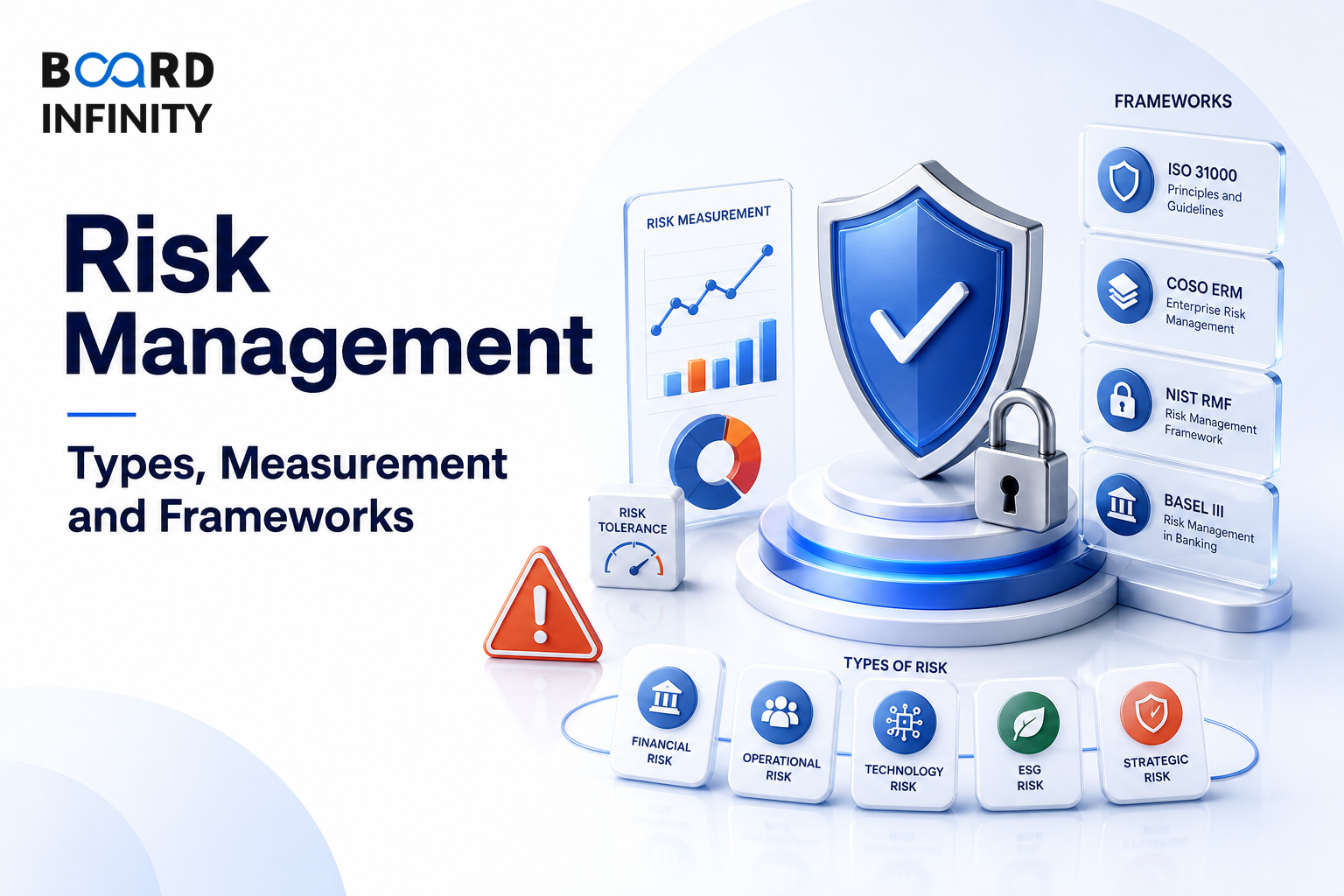
After learning derivatives such as futures, options and swaps, the next question is what they are often used for: managing financial risk. In finance, risk and return are inseparable - higher expected returns require bearing higher risk. This lesson connects portfolio theory with real finance decisions: identify which risks can be diversified, measure risk-adjusted performance, and price expected returns using the Capital Asset Pricing Model. In interviews, this matters because risk management is central to every finance role, from portfolio evaluation to equity analysis.
- Risk and return move together: higher expected returns require bearing higher risk.
- Systematic risk, also called market risk, affects the entire market and cannot be diversified away.
- Unsystematic risk, also called specific risk, is unique to a company or industry and can be reduced through diversification across sectors and assets.
- Total risk is systematic risk plus unsystematic risk; only the unsystematic part can be diversified.
- Standard deviation measures total volatility, while beta measures sensitivity to market movements.
- Sharpe Ratio, Treynor Ratio and Jensen's Alpha evaluate whether a portfolio or fund earned enough return for the risk taken.
- CAPM prices expected return using the risk-free rate, beta and market risk premium, such as the TCS example with beta 0.65 giving 10.6% expected annual return.
Risk Management in the Big Picture
Risk management starts by separating what kind of risk exists, then measuring whether the return earned is adequate for that risk. The key bridge is this: diversification handles company-specific risk, while CAPM handles compensation for market risk.
Risk management in finance means identifying the type of risk, measuring it with the right metric, deciding what can be diversified, and judging whether the expected return compensates for the risk taken.
Fraud at Satyam and a drug recall at Sun Pharma are examples of unsystematic risk because they are specific to a company or industry. The strategic point is that an investor should not expect extra return for holding avoidable concentration risk if diversification across sectors and assets can reduce it.
Types of Risk: Systematic, Unsystematic and Total Risk
The first interview distinction is between risk that belongs to the whole market and risk that belongs to a particular company or industry. This matters because not all risk deserves the same treatment: some risk can be diversified, while some remains inherent in all investments.
Systematic risk is also called market risk. It includes events that move the entire market, such as an RBI rate hike, where RBI means Reserve Bank of India, or a Budget shock that changes investor expectations broadly.
Unsystematic risk is specific risk. It could come from fraud at Satyam, a drug recall at Sun Pharma, or a management change. Because these risks are tied to a company or industry, a diversified investor can reduce their impact by holding exposure across sectors and assets.
Total risk combines both. A single stock's standard deviation captures total volatility, but a well-diversified portfolio is expected to reduce the unsystematic part. The nuance is important: diversification reduces specific risk, not market risk.
Risk and Return Across Asset Classes
The source frames expected return and standard deviation together across asset classes. At the lower-risk end are FD and G-Sec, where FD means Fixed Deposit and G-Sec means Government Security. At the higher-risk end are mid or small cap equity and crypto.
This is the intuition behind the Capital Market Line mentioned in the source: investors compare expected return against standard deviation. In practical finance, this map helps explain why a portfolio cannot be judged by return alone. A higher return is only meaningful when the associated risk is understood.
Key Risk Metrics and What They Measure
Once the risk type is clear, the next step is measurement. Different metrics answer different questions: volatility, market sensitivity, return per unit of total risk, return per unit of market risk, and value added over the CAPM-predicted return.
Standard deviation is the broadest measure because it captures total volatility. It is useful when evaluating a single stock or a portfolio where both systematic and unsystematic risk may matter.
Beta focuses only on market sensitivity. If beta is greater than 1, the stock or portfolio is aggressive relative to the market. If beta is less than 1, it is defensive. If beta is 0, it is treated as risk-free in the source benchmark.
Sharpe Ratio and Treynor Ratio both measure risk-adjusted performance, but they use different definitions of risk. Sharpe uses total risk through standard deviation. Treynor uses systematic risk through beta, so it is more relevant for well-diversified portfolios where unsystematic risk has already been reduced.
Jensen's Alpha asks whether performance beat the return predicted by CAPM. A positive alpha means the fund manager added value; a negative alpha means underperformance relative to the CAPM benchmark.
CAPM: Pricing Expected Return for Market Risk
CAPM means Capital Asset Pricing Model. It links expected return to systematic risk, measured by beta, because systematic risk cannot be diversified away. This makes CAPM the natural pricing framework after diversification has reduced company-specific risk.
E(Rᵢ) = Rf + βᵢ × [E(Rₘ) - Rf]. Here, Rf is the risk-free rate, the India example in the source uses 10Y G-Sec yield around 7%, βᵢ is the stock beta, and [E(Rₘ) - Rf] is the market risk premium, around 5-6% for India.
The CAPM logic is straightforward: start with the risk-free rate, then add compensation for market risk. A stock with higher beta should require a higher expected return because it is more sensitive to market movements. A defensive stock with lower beta should require less market-risk compensation.
The source gives TCS with beta 0.65. Using Rf = 7% and market risk premium = 5.5%, CAPM gives E(R) = 7% + 0.65 × 5.5% = 10.6% expected annual return. The strategic takeaway is that TCS has a lower beta than the market, so its expected return under CAPM is lower than what a higher-beta stock would require.
Worked Example: Using CAPM to Evaluate TCS
A complete risk-management answer should not stop at naming the formula. It should show the situation, identify the risk problem, choose the right framework, make a decision, and state the learning.
This example also shows why beta is not just a statistic. It connects a stock's market sensitivity to the return investors should expect for bearing that market risk.
Choosing the Right Metric in an Interview
A strong answer explains which metric fits the portfolio context. If you are looking at a single stock, total risk through standard deviation may matter. If the portfolio is already well-diversified, beta, Treynor Ratio and Jensen's Alpha become more relevant because unsystematic risk has been reduced.
The nuance is that no single metric is automatically best. The right metric depends on whether total risk or systematic risk is the relevant risk for the decision.
Structuring a Risk Management Interview Answer
"How would you explain risk management in a portfolio, and how would you measure whether return justifies the risk?"
The number one way candidates get this wrong is by treating all risk as the same. Interviewers expect you to distinguish diversifiable specific risk from non-diversifiable market risk, then choose the metric accordingly.
Conclusion
Risk management is the bridge between return expectations and real finance decisions. The core takeaway is simple: diversify what can be diversified, measure what remains, and use CAPM to price the expected return for systematic risk.
The most frequent error is saying that diversification removes risk completely. It only reduces unsystematic risk; systematic risk remains in all investments and must be measured through market-risk tools such as beta and CAPM. This costs points because it misses the central risk-return trade-off.