
ESG Investing and Sustainable Finance: BRSR, Metrics and Interview Framework
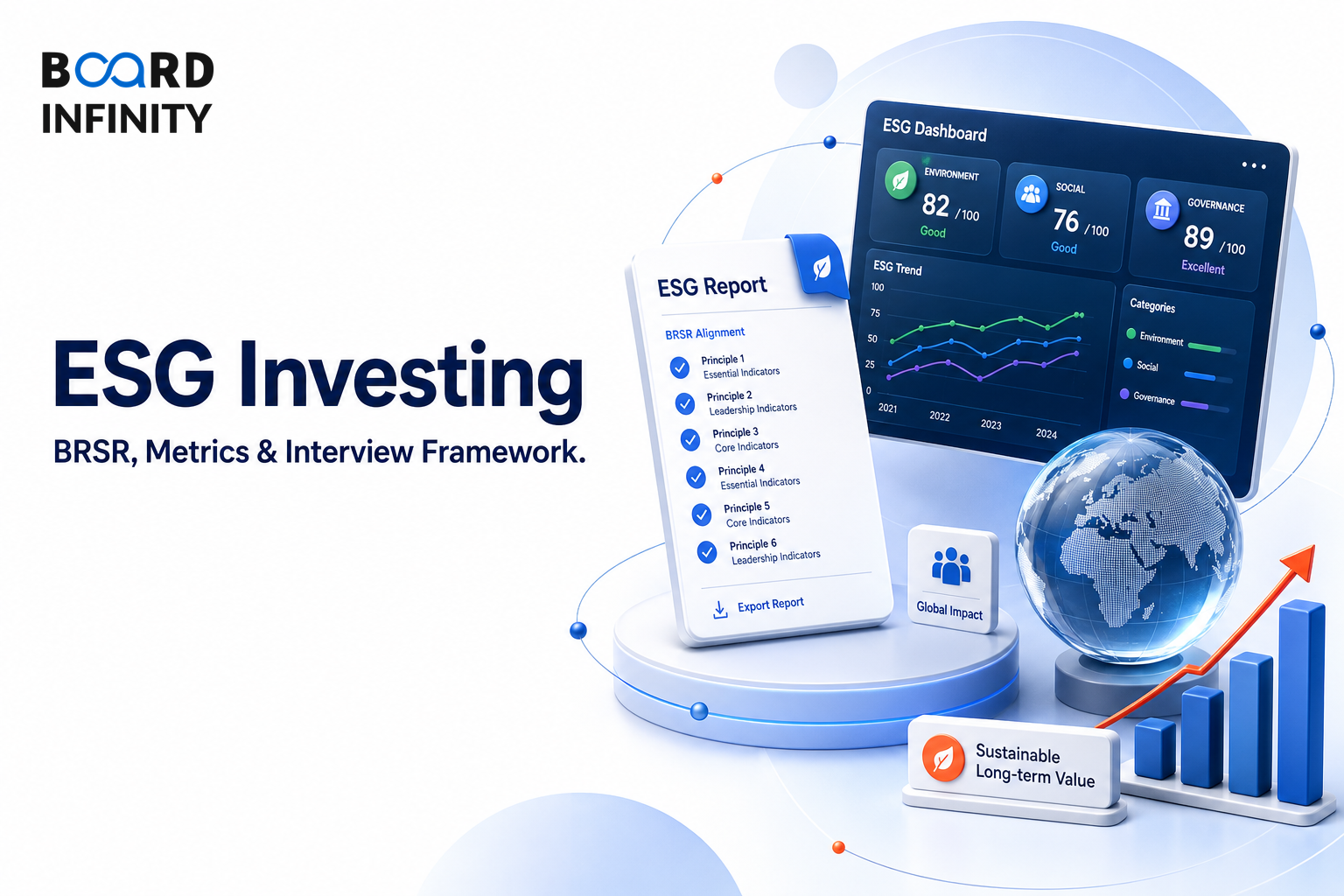
In the previous concept on Fintech in India - UPI, neobanks, BNPL and wealthtech - the focus was on how technology changed the delivery of financial services. ESG investing asks a related but different question: how do environmental, social and governance factors change investment analysis itself? This matters in interviews because sustainability is no longer just a CSR conversation - SEBI's BRSR framework is turning ESG metrics into structured disclosures, analyst work, risk assessment and career relevance.
- ESG stands for Environmental, Social and Governance, and ESG investing integrates non-financial factors into investment analysis.
- ESG has moved from niche to mainstream, with global ESG AUM exceeding $35 trillion by 2024.
- In India, SEBI's BRSR framework has accelerated adoption by mandating BRSR reporting for the top 1,000 listed companies by market cap from FY2022-23.
- BRSR Core requires assured ESG disclosures for the top 150 companies from FY2023-24, creating demand for ESG analysts and sustainability managers.
- The three pillars are Environmental metrics such as carbon emissions and renewable energy %, Social metrics such as diversity and labour practices, and Governance metrics such as board independence and audit quality.
- Green bonds finance green projects, while impact investing targets measurable social or environmental outcomes alongside financial returns.
The Big Picture: ESG as an Investment Analysis Lens
ESG investing is best understood as a lens added to traditional investment analysis, not as a separate universe of feel-good investing. An analyst still studies a business, but now also asks how carbon emissions, labour practices, data privacy, board independence or related-party transactions may affect risk, credibility and long-term positioning.
ESG investing integrates Environmental, Social and Governance factors into investment analysis so that non-financial metrics become part of risk assessment, company comparison and capital allocation.
Why ESG Has Become Mainstream
ESG has grown from a niche to mainstream, with global ESG assets under management, or AUM, exceeding $35 trillion by 2024. AUM means the total value of money managed by investors, funds or institutions. When ESG AUM reaches this scale, sustainability metrics stop being optional reading and become part of how capital markets evaluate companies.
In India, the key trigger is regulatory push. SEBI, the Securities and Exchange Board of India, mandated Business Responsibility and Sustainability Reporting, or BRSR, for the top 1,000 listed companies by market capitalisation from FY2022-23. FY means financial year. BRSR Core then took this further by requiring assured ESG disclosures for the top 150 companies from FY2023-24.
The interview-relevant point is simple: once disclosures are mandated and assured, ESG becomes more measurable. That creates work for equity research teams, credit analysts, risk teams, ESG analysts and sustainability managers. In many organisations, ownership may overlap across finance, compliance, investor relations and sustainability teams.
The Three Pillars of ESG
The Environmental, Social and Governance pillars help analysts avoid treating sustainability as a vague theme. Each pillar has specific metrics, and each can influence how investors question a company's risk profile, execution quality and stakeholder credibility.
Environmental analysis focuses on how a company interacts with natural resources and climate-related issues. For example, a candidate can mention Reliance Industries' net-zero 2035 pledge, Adani Green's 25 GW renewable target or Tata Steel's green steel initiative as examples of environmental positioning from the Indian market.
Social analysis studies how a company manages people and communities. TCS's gender diversity initiatives, ITC's social investment in agriculture and HDFC Bank's CSR in rural finance are examples that connect social metrics to company-level stakeholder practices. CSR means Corporate Social Responsibility, which refers to company initiatives aimed at social contribution beyond core operations.
Governance analysis examines whether the company is run with credible controls, accountability and transparency. Metrics such as board independence %, audit quality, related-party transactions, executive pay and anti-corruption policies are especially relevant because weak governance can affect investor confidence even when operating performance appears strong.
How BRSR Turns ESG Into Finance-Relevant Data
BRSR stands for Business Responsibility and Sustainability Reporting. It is important because it shifts ESG from broad narrative to structured disclosure. For analysts, this matters because comparable reporting makes it easier to ask sharper questions across companies and sectors.
A common interview nuance is to avoid saying BRSR automatically makes every company sustainable. BRSR is a reporting and disclosure framework. It improves visibility into sustainability metrics, but the analyst still has to interpret whether the metrics indicate strength, weakness, transition risk or improvement potential.
ESG Investing, Green Bonds and Impact Investing
Sustainable finance includes several related but distinct ideas. ESG investing is a broad investment-analysis approach, green bonds are financing instruments, and impact investing focuses on measurable positive social or environmental outcomes alongside financial returns.
The distinction is useful in case interviews. If the question is about how an investor evaluates a listed company, ESG investing is the primary lens. If the question is about raising money for green projects, green bonds are more relevant. If the question is about capital that intentionally targets measurable social or environmental outcomes alongside financial returns, impact investing is the better term.
Use this structure: define ESG, split into Environmental - Social - Governance, connect to Indian regulation through SEBI BRSR, give named Indian examples, then explain how it affects investment analysis, risk and sustainable finance instruments.
Worked Example: Evaluating an Indian Listed Company Through ESG
Assume an analyst is asked to evaluate how ESG should enter a research discussion on large Indian listed companies. The problem is not to decide whether a company is good or bad based on one headline. The problem is to convert sustainability information into a disciplined investment-analysis checklist.
The key takeaway from this worked example is that ESG analysis is not a slogan. It is a way to organise questions that investors were increasingly expected to ask as disclosures become formalised through BRSR and BRSR Core.
Practical Relevance for Analysts and Finance Roles
For a finance or consulting interview, ESG is relevant because it sits at the intersection of regulation, investment analysis, risk and corporate strategy. A candidate who only says "ESG means being sustainable" will sound generic. A stronger answer explains how metrics such as carbon emissions, diversity %, audit quality and related-party transactions feed into company assessment.
For an analyst role, ESG can support comparison across companies. For example, governance discussion may cover Infosys governance controversies in 2019, Vedanta related-party concerns and HDFC Bank's strong governance score. The goal is not to memorise these as isolated facts, but to use them to show how governance indicators can affect investor questioning.
For sustainable finance roles, green bonds and impact investing become important. SEBI's 2023 framework for green bonds is relevant because green bonds are used to finance green projects. Issuers listed in the source include Power Finance Corporation, NTPC, Adani Green and State Bank of India. Impact investing examples include Aavishkaar Capital, Elevar Equity for fintech for underserved groups and Lok Capital for microfinance.
Structuring a ESG Investing & Sustainable Finance Interview Answer
"How would you explain ESG investing and why has it become important in India?"
The strongest answers do not treat ESG as charity. Frame it as an investment-analysis lens supported by regulation, measurable disclosures and named company examples.
Conclusion
ESG investing matters because it converts environmental, social and governance information into structured investment questions. In India, SEBI's BRSR framework is making those questions more comparable and career-relevant, so the best interview answer links metrics, regulation, company examples and sustainable finance instruments in one coherent framework.
The most frequent error is confusing ESG investing with simply investing in green companies. That misses the governance and social pillars, ignores SEBI's BRSR-driven disclosure shift, and makes the answer sound like a slogan instead of an analyst framework.