
Crore-Lakh-Million-Billion Conversion Mastery
After Penetration Rates & Service Density Ratios, the next place candidates lose speed is unit conversion: crore, lakh, million, billion, and trillion. In Indian guesstimates, market sizes are often stated in lakh crore, while global anchors use million, billion, or trillion. This lesson gives you the must-memorise rules and quick checks that prevent avoidable interview mistakes.
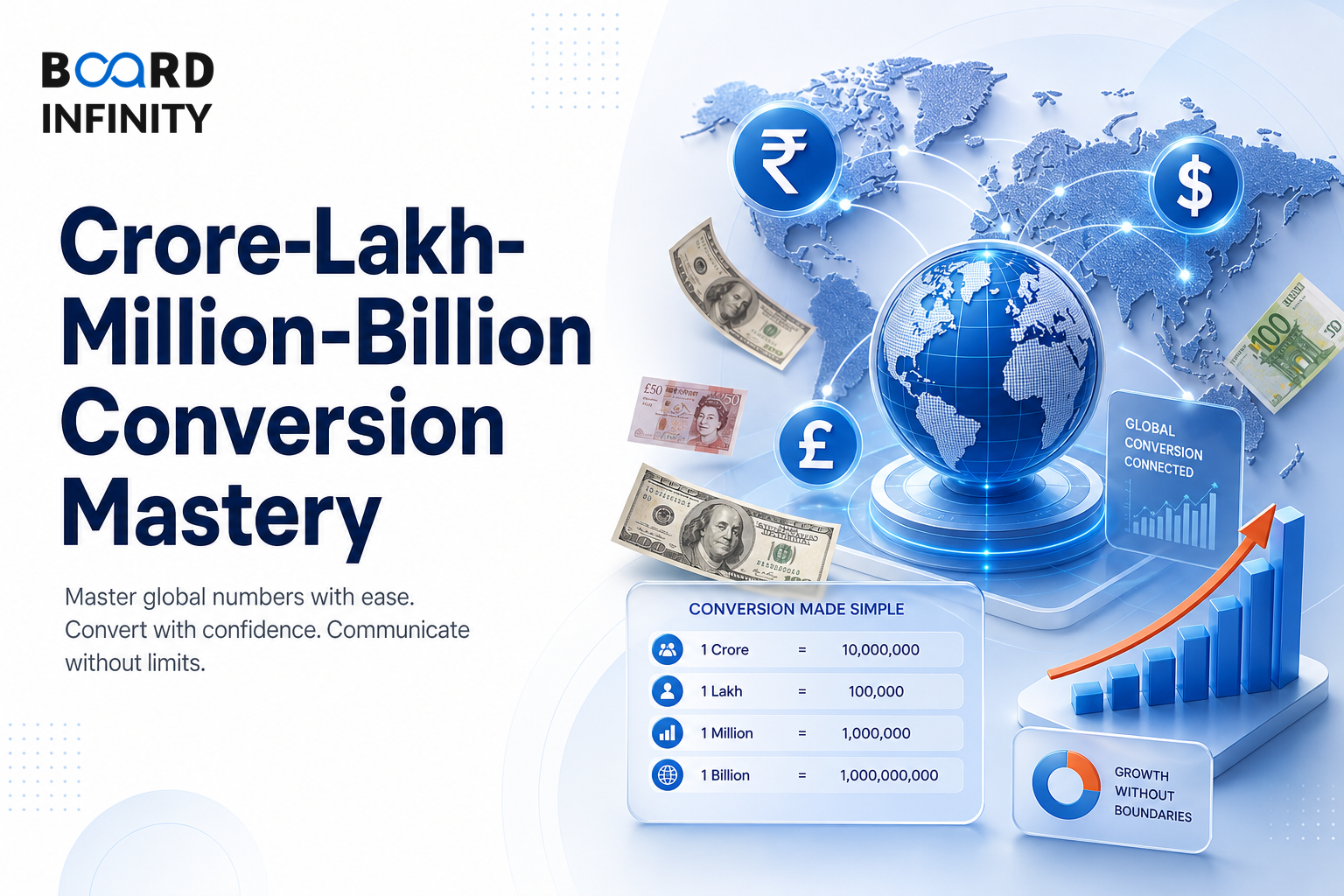
- 1 lakh = 100 thousand = 105, so 10 lakh = 1 million.
- 1 crore = 10 million = 107. Never treat 5 crore as 5 million.
- 100 crore = 1 billion = 109. This is the fastest crore-to-billion checkpoint.
- 1 lakh crore = 1 trillion = 1012. This is essential for GDP and large sector sizes.
- India FY26 nominal GDP is approximately ₹350 lakh crore, which is approximately USD 4.1 trillion in the source anchor.
- For interview arithmetic, convert units first, then calculate. Mixing Indian and Western units mid-way is the main trap.
Use this overview as your mental map before going into examples. Every conversion in this lesson is a variation of moving between Indian place values and Western place values.
Why This Conversion Shortcut Matters
The source calls this table the shortcut that prevents 30% of all unit-conversion errors in interviews. The common trap is simple: a candidate says "5 crore" but mentally treats it as "5 million." Both numbers are valid in isolation, but they are not the same magnitude.
In guesstimates, the final answer is often judged less on perfect precision and more on structure, assumptions, and sanity checks. If your unit is off by 10x, 100x, or 1,000x, the interviewer may lose confidence in the whole approach even if your framework is otherwise sound.
Memorise these three anchors: 1 crore = 10 million, 100 crore = 1 billion, and 1 lakh crore = 1 trillion.
The Indian Numbering System
A lakh means 100 thousand, written as 1,00,000. A crore means 100 lakh, written as 1,00,00,000. In interview settings, lakh and crore usually appear in India-specific data such as population, households, tax filers, UPI transactions, vehicle stock, and market sizes.
For example, the source uses ~9 crore total tax-filers for FY24 ITRs. FY24 means Financial Year 2024, and ITR means Income Tax Return. If you need to explain this to someone using Western units, 9 crore equals 90 million because 1 crore equals 10 million.
The practical rule is to multiply the crore number by 10 to get millions. Do not overthink the commas. If the number is in crore and you want million, add one zero to the crore count.
The Western Numbering System
The Western system uses thousand, million, billion, and trillion. One million is 10 lakh. One billion is 100 crore. One trillion is 1 lakh crore.
This matters because several Indian guesstimate anchors combine both systems. For example, nominal GDP is given as approximately ₹350 lakh crore and approximately USD 4.1 trillion. If you know that 1 lakh crore equals 1 trillion, the rupee-side scale becomes easier to read: ₹350 lakh crore is ₹350 trillion.
Never compare "crore" with "million" or "lakh crore" with "billion" just by reading the label. Convert both numbers into one unit family first, then compare.
The Three Must-Memorise Rules
For speed, do not memorise every possible conversion. Memorise three anchors and derive the rest. These are enough for almost all India guesstimate cases.
UPI means Unified Payments Interface, India’s digital payments rail. GMV means Gross Merchandise Value, the total value of goods sold through a platform before deductions. These terms often appear in market-sizing questions, so your unit conversion should be automatic before you discuss adoption, frequency, or ticket size.
How to Convert Fast Without Decimal Confusion
The fastest approach is to decide which family you want first: Indian or Western. If the interviewer gives you Indian anchors such as population in crore and market sizes in lakh crore, stay Indian until the final answer. If the case compares with global market sizes, convert to million, billion, or trillion early and keep everything there.
The source’s math-shortcut section also warns against false precision. For final answers, it recommends two significant figures plus a range, such as "₹4.2 crore, range ₹3.5-5 crore." The same discipline applies here: be directionally correct, unit-consistent, and transparent.
"I will keep the calculation in crore until the final step; if needed, I will convert using 1 crore = 10 million and 100 crore = 1 billion."
Worked Example: Quick Commerce vs E-Commerce GMV
Suppose you are comparing quick commerce with the broader e-commerce market. The source gives quick commerce as approximately ₹65,000 crore for Blinkit + Zepto + Instamart, and e-commerce GMV as approximately ₹12 lakh crore. The problem is that one number is in crore while the other is in lakh crore, so a direct comparison is risky.
This is exactly the kind of sanity check that improves a guesstimate answer. You are not just calculating; you are proving that your estimate lives in the right order of magnitude.
Large India Anchors You Should Read Correctly
Many FY26 India anchors in the source are large enough that lakh crore and trillion conversions become unavoidable. FY26 means Financial Year 2026. GDP means Gross Domestic Product, the total value of goods and services produced in an economy.
Use these conversions to avoid misreading sector sizes by 100x or 1,000x. The goal is not to memorise every market number, but to know whether a figure is in crore, lakh crore, billion, or trillion.
BFSI means Banking, Financial Services, and Insurance. IT/ITeS means Information Technology and Information Technology-enabled Services. FMCG means Fast-Moving Consumer Goods. These acronyms appear frequently in placement-prep cases, so define them once and then focus on sizing logic.
Use the Shortcut With Population and Usage Anchors
Conversion mistakes are not limited to money. They also affect users, households, passengers, and transactions. For example, smartphone users are approximately 80 crore, internet users are approximately 95 crore, and active mobile connections are approximately 115 crore.
The nuance is that these are not always one-to-one with people. The source notes that internet users are broader than smartphones because they include shared access, and active mobile connections reflect multi-SIM ownership. Convert the unit correctly first, then interpret what the metric actually measures.
Rounding and Unit Discipline
The source’s rounding convention is clear: speed beats decimals. It recommends rounding India population to the nearest 5 crore, using 140 or 145 crore, because the difference is less than 2% and not material for most guesstimates. It also recommends rounding final answers to two significant figures plus a range.
The mistake to avoid is double rounding. Either round inputs once at the start or keep variables exact-ish through the calculation and round the final answer. Mixing both creates rounding error that you cannot trace.
First choose the unit family, then convert all major numbers into that family, then calculate, then round the final answer to two significant figures plus a range where relevant.
Conclusion
Crore-lakh-million-billion mastery is a speed skill, not a memory burden. If you know that 1 crore equals 10 million, 100 crore equals 1 billion, and 1 lakh crore equals 1 trillion, you can keep India guesstimates clean, comparable, and credible under interview pressure.
The most frequent error is treating crore and million as if they are interchangeable. This creates a 10x mistake immediately, and larger errors when the same candidate later compares crore with billion or lakh crore with trillion.