
Penetration Rates and Service Density Ratios for Indian Guesstimates
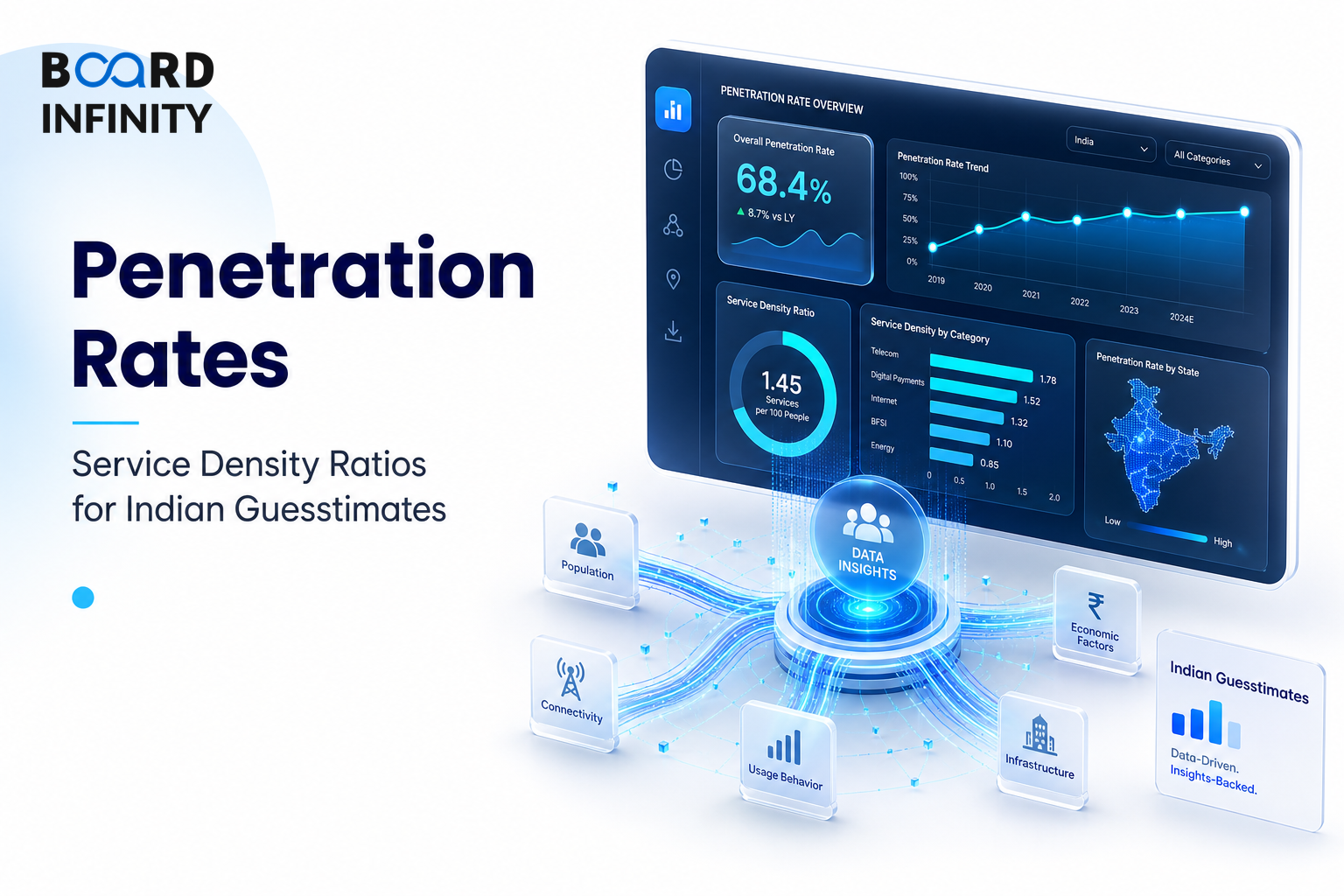
The previous reference sheet gave you India FY26 anchors for digital, mobility and major sector sizes. This lesson answers the next question: once you have a market-size estimate, how do you know whether it is believable? Penetration rates and service density ratios are quick sanity-check anchors that help you defend Indian guesstimates with a second number, not just a final answer.
- Penetration rate means adoption as a percentage of the relevant base, such as households, adults or urban households.
- Service density ratio means availability per 100,000 people, useful for checking estimates of doctors, ATMs, schools, petrol pumps and similar networks.
- The most important interview habit is to state your estimate and then compare it with an established anchor: high, low or in range.
- Always choose the correct base: credit cards are measured against adults, washing machines against households and dentists here against urban population.
- Penetration rates are usually rounded to the nearest 5% or 10% because surveys vary and fake precision does not help.
- Density ratios convert a large national count into an intuitive local benchmark, such as ATMs at ~17 per 100,000 people.
- For India, household and adult filters matter because ownership, income and access are not evenly distributed across urban and rural markets.
Big Picture: How These Anchors Fit Into a Guesstimate
Use penetration and density after your first estimate, not as a replacement for structure. They are the credibility layer that tells the interviewer whether your number passes a basic India-context sanity check.
Penetration rate = users or owning units ÷ relevant base × 100. Service density = count of service points or professionals ÷ population × 100,000.
Why Penetration Rates Matter in Indian Market Sizing
A penetration rate is the share of a relevant population that owns, uses or has access to something. In guesstimates, it prevents a common top-down error: starting with all of India when only a subset is realistic.
The relevant base changes by category. A refrigerator is a household product, so refrigerator penetration is measured as a percentage of households. A credit card is an individual financial product, so the source gives credit card ownership as ~7 cr cards, or ~5% of adults. For urban borrowing behaviour, personal loan or EMI exposure is given as ~25% of urban households.
HH means household, or a group of people living together and sharing consumption. BFSI means Banking, Financial Services and Insurance. EMI means equated monthly instalment, a fixed periodic repayment for a loan or financed purchase.
How to Apply Penetration Rates Without Overclaiming
The safest interview sequence is: define the base, apply the penetration rate, then add a short caveat. For example, if sizing washing-machine households, start with households, not population, because the source gives washing-machine penetration as ~17% of households.
Penetration rates should not be used mechanically. A product can have high access but low usage. Bank account ownership is ~85% of adults, but only ~50% is active. LPG connection is ~98% of households, but the source frames it as Ujjwala-led near-universal connection access, so it should not automatically become a fuel-consumption estimate without an additional usage assumption.
"I will use the relevant base first, then apply the penetration anchor. My estimate is X users or households, which implies Y% penetration, so it is high, low or in range versus the India reference benchmark."
Worked Example: Sanity-Checking Life Insurance Policy Holders
This example shows how to turn a penetration benchmark into a defensible estimate. It is not a full insurance-market valuation; it is a quick sanity check for the number of policy holders.
The key move is not the multiplication. The key move is choosing adults as the base and then using the LIC-dominated nature of life insurance as a context note. That is what makes the answer sound like an Indian market-sizing answer, not a generic global one.
Service Density Ratios: The Per-100,000 Sanity Check
A service density ratio converts a national count into availability per 100,000 people. It is especially useful when the object being sized is a network: doctors, hospital beds, ATMs, bank branches, schools, police personnel, petrol pumps, post offices or pharmacies.
The source method note is simple: make this the second number you say. If your estimate of X comes to Y per 100,000 people versus an established density of Z, you can explain whether it is high, low or in range.
How to Convert a Density Ratio Into a National Count
The per-100,000 format is powerful because it works in both directions. If you have a count, convert it into density. If you have a density, convert it back into a rough national count.
For India, the ATM benchmark in the source is ~17 ATMs per 100,000 people, based on RBI FY25 data of 2.51 L ATMs divided by 145 cr population. Since 145 cr people equals 14,500 blocks of 100,000 people, ~17 ATMs per block gives a national order of magnitude close to the source number.
Estimated count = density per 100,000 × population ÷ 100,000. Estimated density = count ÷ population × 100,000.
Penetration vs Density: Use the Right Anchor
Penetration and density both sanity-check a number, but they answer different questions. Penetration asks, "what share of the relevant base has this?" Density asks, "how many service points or professionals exist for a given population?"
Practical Rules for Interview Sanity Checks
These anchors work best when used as quick checks, not as a substitute for reasoning. In many Indian guesstimates, the interviewer cares less about the exact final number and more about whether you can defend your assumptions under pressure.
- Start with the right base. Adults, households, urban households, children and seniors lead to very different answers.
- Use penetration for adoption. For example, two-wheeler ownership at ~50% of households is a household-level adoption anchor.
- Use density for service networks. For example, bank branches at ~12 per 100,000 people is a network-density anchor.
- Round honestly. The source recommends rounding penetration rates to the nearest 5% or 10% because survey variation makes excessive precision misleading.
- Explain the direction of deviation. Say why your estimate is higher, lower or in range versus the benchmark, instead of just quoting the benchmark.
Conclusion
Penetration rates and service density ratios are simple but high-leverage interview tools. Use penetration to check adoption against the right base, use per-100,000 density to check service availability, and always make the benchmark comparison explicit.
The most frequent error is mixing bases: applying an adult penetration rate to total population, a household penetration rate to individuals or an urban-only density to all India. This costs points because the arithmetic may look clean while the denominator is wrong, making the final answer impossible to defend.