
Math Shortcuts for Guesstimates: Rounding, Percentages and Rule of 72
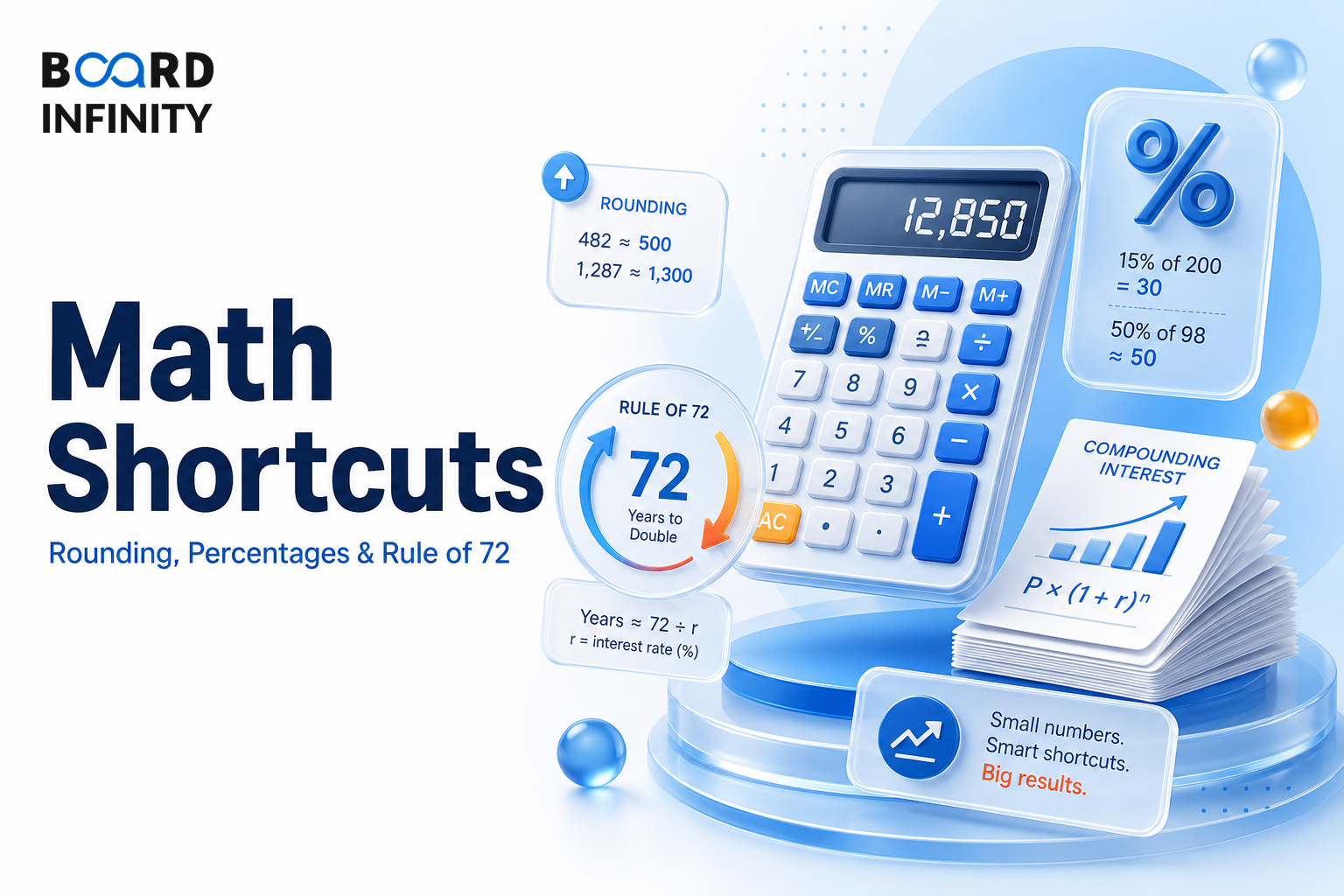
After Crore-Lakh-Million-Billion Conversion Mastery, the next interview bottleneck is speed: can you convert a messy business question into clean mental math without pretending to be exact? In guesstimates, speed beats decimals because most inputs are uncertain anyway. This cheat sheet shows how to round defensibly, use fast percentage and compounding shortcuts, and avoid fake precision while still sounding structured.
- Round uncertain inputs once, either at the start or at the end, but do not round repeatedly through the same calculation.
- Use broad Indian guesstimate anchors such as 140 or 145 crore population, 30 crore households, and 30 lakh sq km area when the source question does not require finer precision.
- Percentage shortcuts like 10 percent, 5 percent, 25 percent, 33 percent, and 75 percent remove most calculator-style arithmetic from interviews.
- The Rule of 72 estimates doubling time: divide 72 by the annual growth rate in percent.
- For final answers, use two significant figures plus a range, for example ₹4.2 cr with a plausible range of ₹3.5-5 cr.
- False precision, such as a 7-digit final answer, signals that the candidate does not understand uncertainty in guesstimates.
Use these shortcuts as a sequence: choose rounded inputs, simplify percentages, apply growth shortcuts if the market compounds, then convert the output into per-person, per-household, or density terms if needed.
Why Mental Math Shortcuts Matter in Guesstimates
A guesstimate interview is not a spreadsheet test. The interviewer is usually checking whether you can structure ambiguity, pick reasonable assumptions, calculate under pressure, and communicate uncertainty honestly.
The source pattern is clear: strong candidates often lose time by chasing decimal accuracy on inputs that are already uncertain. Rounding conventions, percentage tricks, and compounding rules help you finish a guesstimate in 8-10 minutes instead of stretching it to 15.
Round inputs to the level of uncertainty in the assumption, calculate quickly, and end with two significant figures plus a plausible range.
Rounding Conventions: Where to Round and Where Not
Rounding is not laziness. In guesstimates, it is a way to align calculation precision with assumption quality. If an input is inherently uncertain, a decimal-heavy value can make your answer look less credible, not more credible.
For India-focused estimates, population can typically be rounded to the nearest 5 crore, using 140 or 145 crore. The difference is less than 2 percent, which is usually not material in an interview guesstimate.
The main nuance is consistency. Never round in the middle of multiplication and then round again at the end. Either round each input once at the start, or keep variables exact-ish through the working and round only the final output.
Percentage Tricks That Actually Save Time
Percentages appear constantly in guesstimates: market penetration, conversion rates, rural-urban splits, discounting, operating utilization, and growth adjustments. The fastest candidates do not multiply decimals mechanically. They convert percentages into simple fractions or reversible expressions.
One useful rule is symmetry: X percent of Y equals Y percent of X. For example, 16 percent of 25 is the same as 25 percent of 16, which is 4.
When a percentage looks hard, convert it into a familiar operation: 10 percent, 5 percent, 25 percent, one-third, three-fourths, or a flipped percentage.
In interviews, say the shortcut aloud. For example: "I will take 25 percent as divide by 4, so 25 percent of 140 crore is 35 crore." This shows the interviewer that your speed is structured, not guessed.
Compounding and Growth: The Rule of 72
The Rule of 72 estimates how many years a number takes to double at a given annual growth rate. Divide 72 by the annual growth rate in percent. It is used constantly for projection guesstimates because it replaces long compounding calculations with a quick doubling-time estimate.
GDP means Gross Domestic Product, the value of goods and services produced in an economy. FY means Financial Year. UPI means Unified Payments Interface, India's instant digital payments system.
Doubling time in years = 72 divided by annual growth rate in percent. For shrinkage, the same rule estimates halving time.
The reverse use is just as important. If a market shrinks 10 percent a year, it halves in about 7 years. This is useful for declining-segment guesstimates such as landlines or print media.
Worked Example: Using Rule of 72 for a UPI-Style Growth Estimate
CAGR means Compound Annual Growth Rate, the annualized rate at which a number grows over time. In a case interview, the Rule of 72 helps you discuss growth speed without getting trapped in detailed compounding math.
Squares, Cube Roots and Power-of-10 Tricks
Some guesstimates involve per-capita math, area, volume, or scale. You do not need exact square roots and cube roots for most of these. You need memory anchors that keep the calculation directionally correct.
The interview use is simple: do not pause to calculate exact roots when the assumption itself is approximate. Use the memory anchor, explain the approximation, and move the case forward.
Per-Capita and Density Math Shortcuts
Per-capita means "per person." Density means "per unit area," such as people per sq km. HH means households. These shortcuts are useful when the interviewer asks whether a national total feels plausible.
For India estimates, the source uses 145 crore population, 30 crore households, and 30 lakh sq km area as working anchors. These are not meant to be encyclopedic claims in the answer; they are mental-math scaffolds for interviews.
FMCG means Fast-Moving Consumer Goods, everyday products that are bought frequently. In the example above, converting ₹19 L cr FMCG into per-person and per-household numbers helps sanity-check whether the market estimate is plausible.
Precision Is the Enemy
The most common failure mode of high-IQ candidates is chasing decimal accuracy on inputs that are inherently uncertain. The source calls out two anti-patterns: false precision and compounding small over-precisions.
False precision is when a candidate states something like ₹4,73,89,420 annual outlet revenue. A better answer is rounded and honest: ₹4.7 cr, plausible range ₹3.5-5.5 cr.
The interviewer's tell is simple: when a candidate writes a 7-digit final guesstimate, every senior interviewer notes that the candidate does not understand the genre. Always end with a clean two-significant-figure number and a stated range.
Mental Math Drill for Interview Readiness
Practise these in your head, without paper and without a calculator, until they feel automatic. The source says these cover about 80 percent of in-interview arithmetic.
Practise for 10 minutes a day for 2 weeks before interviews. Cover the answer column and compute mentally; the goal is not perfection, but to stop reaching for the calculator app while the interviewer watches.
The biggest mistake is fake precision: calculating with decimals throughout and ending with a long exact-looking number. It costs points because it signals that you do not understand uncertainty, while a two-significant-figure answer with a range shows speed, judgment, and interview maturity.