
Trade-off: Dividend vs Buyback and Organic vs Acquired Growth
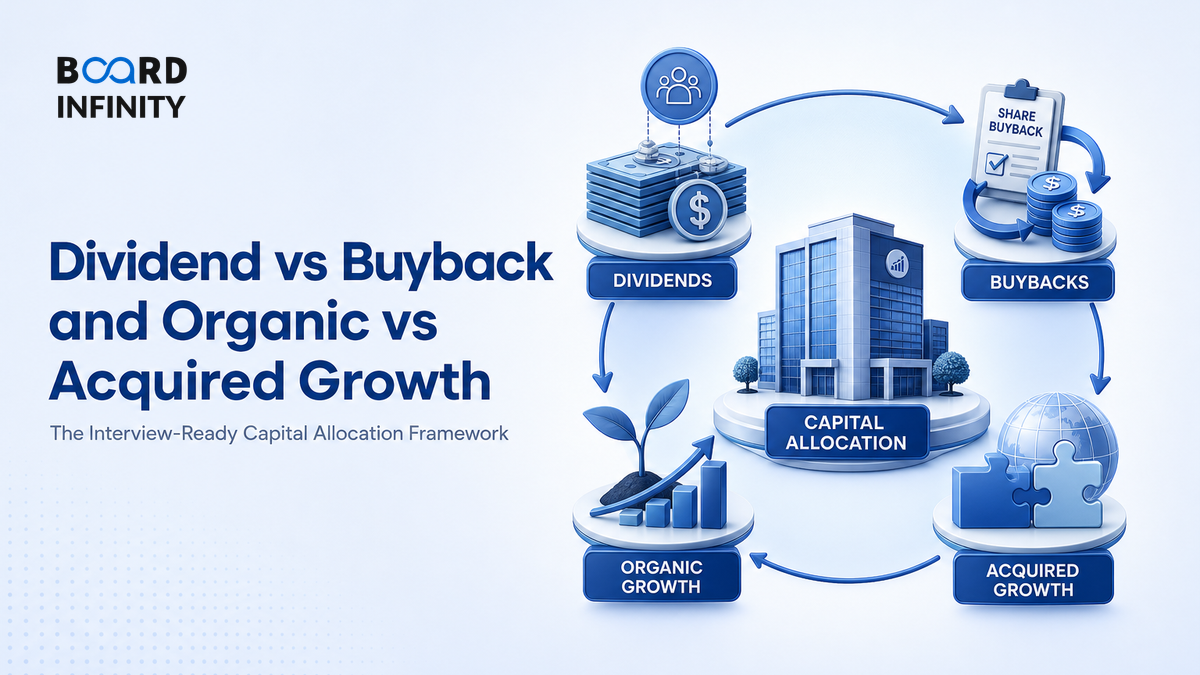
When Wipro bought Capco for $1.45 billion in 2021 and later announced a ₹12,000 crore buyback in 2023, it looked like two opposite instincts: spend aggressively and return cash. It was actually the same question twice: where will one rupee earn the highest risk-adjusted return - inside the business, through a deal, or back in the shareholder's pocket?
- Dividend vs buyback is a payout-form choice: dividends give certain cash to all shareholders; buybacks reduce shares and can be value-accretive if done below intrinsic value.
- Organic vs acquired growth is a reinvestment-mode choice: organic growth builds capability internally; acquired growth buys capability, customers or speed.
- The master test is ROIC above WACC. If reinvestment cannot beat the cost of capital, return cash.
- Use dividends when earnings and cash flows are stable and management wants a repeatable shareholder signal.
- Use buybacks when excess cash exists, leverage is safe, and shares appear undervalued versus intrinsic value.
- Choose organic growth when the company has time, talent, brand and execution capability; choose acquisitions when speed, market access or capability gaps matter.
- The best interview answer never says one option is always better. It compares return, risk, control, flexibility, valuation and strategic fit.
Big Picture: This Is One Capital Allocation Problem
Do not treat these as four separate finance buzzwords. A company first decides whether cash should be reinvested or returned; if reinvested, it chooses organic or acquired growth; if returned, it chooses dividend or buyback.
Core Explanation: The Two Trade-offs and the One Test
The heart of the topic is simple: capital should go where it creates the most value after adjusting for risk. If internal projects or acquisitions earn returns above the cost of capital, reinvest. If not, return cash through dividends or buybacks.
Trade-off 1: Dividend vs Buyback
A dividend distributes cash directly to shareholders, usually on a recurring basis. A buyback uses company cash to repurchase shares, reducing the share count and increasing each remaining shareholder's ownership percentage.
The buyback trap is important: a buyback can improve EPS mechanically while still destroying value if the company pays more than intrinsic value. Good finance answers separate accounting accretion from economic value creation.
Worked Example: Same Cash, Different Shareholder Effect
Assume a company has profit after tax of ₹1,000 crore, 100 crore shares outstanding, EPS of ₹10, and ₹500 crore surplus cash. The share price is ₹100.
Trade-off 2: Organic Growth vs Acquired Growth
Organic growth means expanding through the company's own products, distribution, talent, brand and operations. Acquired growth means buying another company, brand, customer base, technology or capability.
A strong Indian example is Tata Consumer Products, which has used acquisitions such as Soulfull, Capital Foods and Organic India to accelerate its move beyond tea and salt into a broader FMCG platform. The primary driver was strategic category expansion; supporting drivers included brand access, distribution leverage and portfolio premiumisation. The so-what: acquired growth works best when the buyer can plug the acquired brand into a stronger system, not merely when it buys revenue.
The 2x2 Decision Map
The fastest way to answer a case is to map the company on two axes: reinvestment opportunity and cash surplus. The right quadrant usually reveals the sensible default.
Metrics to Track Before Recommending Any Option
Use metrics to avoid sounding opinionated. These are not universal cut-offs, but they are practical interview ranges for non-financial companies; always adjust for industry and business model.
Definitions You Can Say in One Breath
- Dividend: A cash distribution of company profits to shareholders, usually paid per share.
- Buyback: A company repurchases its own shares, reducing shares outstanding and increasing remaining ownership percentage.
- Organic growth: Growth generated internally through existing products, people, channels, customers and capabilities.
- Acquired growth: Growth achieved by purchasing another company, brand, technology, customer base or capability.
- WACC: The blended required return expected by debt and equity providers, weighted by capital structure.
- ROIC: Operating profit after tax divided by invested capital used in the business.
A useful finance principle is the Miller-Modigliani dividend irrelevance idea: in perfect markets, payout form should not affect firm value. Real markets are not perfect, so taxes, signaling, agency issues, liquidity needs, valuation and investor preference make the dividend-versus-buyback choice matter.
Wipro: Buy Capability, Then Return Surplus Cash
Wipro's Capco acquisition and later buyback show how one company can use both acquired growth and capital return when strategic needs and cash position differ.

Situation: Indian IT services companies were trying to move higher up the value chain from execution-heavy outsourcing to consulting-led transformation, especially in banking and financial services. Building that capability organically would take time because consulting trust, client relationships and domain expertise compound slowly.
The move: In 2021, Wipro acquired Capco for $1.45 billion, a large deal aimed at strengthening consulting depth in financial services. The primary driver was capability acceleration in BFSI consulting. Supporting drivers included access to senior consulting talent, client relationships, domain knowledge and the chance to cross-sell technology execution after strategy work.
The capital return angle: In 2023, Wipro announced a ₹12,000 crore buyback. This did not contradict the acquisition logic. It reflected a different capital allocation moment: when surplus cash exists and management does not see enough immediate reinvestment options above the hurdle rate, returning cash can be rational.
Outcome or lesson: The case is memorable because it prevents a one-line answer. Wipro's acquisition thesis depended chiefly on capability and client access, supported by integration and cross-selling. Its buyback logic depended chiefly on capital return discipline, supported by cash generation and balance sheet capacity. The broader lesson: capital allocation is dynamic, not ideological.
How AI Changes Dividend vs Buyback and Organic vs Acquired Growth
AI is changing this topic in practical, CFO-level ways rather than replacing the judgment.
- Better capital allocation simulations: Finance teams can now model multiple scenarios faster - dividend payout, buyback size, leverage impact, EPS sensitivity, ROIC spread and downside cases. The judgment still sits with management, but AI reduces spreadsheet cycle time.
- Sharper acquisition screening: AI tools can scan filings, customer reviews, hiring patterns, patents, product feedback and competitor movements to shortlist acquisition targets. This helps identify capability gaps earlier, but it does not remove integration, culture or overpayment risk.
- Organic growth acceleration: AI can improve sales productivity, pricing analytics, customer service, product development and software engineering velocity. That can make organic growth more attractive if the company can deploy AI into real workflows, not just pilots.
Use NotebookLM: upload a company annual report, investor presentation and recent earnings-call transcript. Ask: “List the company's capital allocation choices, estimate whether reinvestment or payout seems more logical, and generate five interview questions on dividend, buyback, organic growth and acquisitions.” Then verify every number from the original filings.
Interview Relevance
“A cash-rich company has slowing organic growth. Should it pay a dividend, do a buyback, invest organically, or acquire another company?”
Use this sentence in interviews: “I would not choose payout or growth in isolation; I would rank uses of cash by risk-adjusted return, strategic fit and flexibility.” It instantly makes your answer sound like capital allocation, not textbook listing.
Common Mistake
The costly mistake is saying “buybacks increase EPS, so they are good” or “acquisitions increase revenue, so they are good.” EPS accretion and revenue growth can both hide value destruction if the company overpays or earns below WACC. One-line fix: always test every option against intrinsic value, ROIC versus WACC, and execution risk.
What to Revise Next
Once this trade-off is clear, move to the limits of the models behind it. Revise When Frameworks Fail: The Limits of Standard Finance Models next, then apply the same capital allocation discipline to Case: Diagnosing and Fixing a Manufacturer's Falling Margins.