
How to Structure Any Finance Problem With Issue Trees
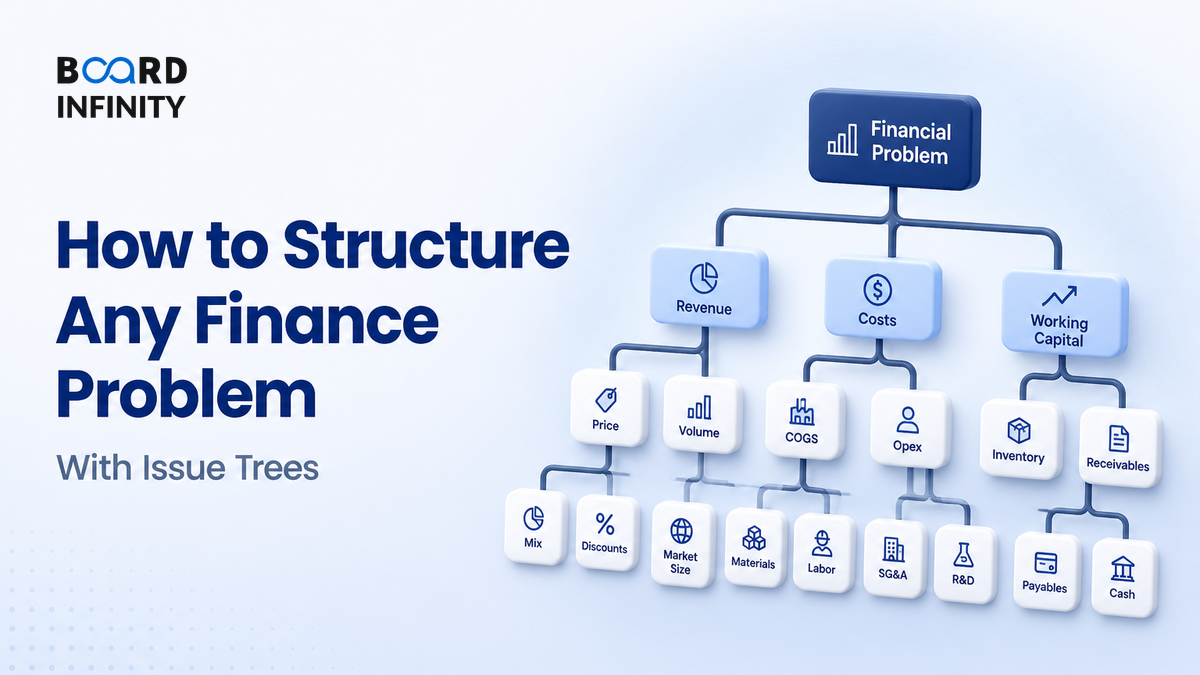
When Trent opens a Zudio store, the finance question is not simply, “Will sales grow?” A store can look busy and still consume cash if markdowns, inventory days and rent-per-square-foot break the economics. An issue tree turns that noise into a map: where exactly can value leak, and which leak is big enough to matter?
- An issue tree breaks one finance problem into MECE drivers - no overlap, no gaps.
- Start with the decision metric: profit, cash flow, ROCE, valuation, solvency or growth.
- Convert the metric into an equation: Profit = Revenue - Cost; ROCE = EBIT / Capital Employed.
- Split the equation into drivers, then into sub-drivers: revenue becomes price, volume, mix and retention.
- Prioritise branches by impact and controllability, not by how many ratios you know.
- Quantify early: even rough numbers beat a beautiful but untested tree.
- The best final answer says: “The issue is mainly here, supported by these drivers, so I recommend this action.”
Big Picture
A finance issue tree is a way to move from a vague business symptom - “margins are falling” or “valuation looks high” - to a precise diagnosis. Think of it as a financial GPS: first choose the destination metric, then break it into routes, then inspect the route where the value is actually leaking.
Core Explanation: The Finance Issue Tree Method
The big idea is simple: every finance problem is a driver problem. Profit changes because price, volume, mix or costs change. Cash stress appears because receivables, inventory, payables, capex or debt service move. Valuation changes because cash flows, growth, risk or capital structure changes.
The mistake is to list random ratios. The better move is to ask: “Which metric defines success here, and what are its drivers?”
The Universal Finance Issue Tree
Most finance cases fall into four buckets. If you are unsure where to start, classify the problem first, then choose the relevant branch.
How to Build the Tree for a Profitability Problem
Profitability is the most common finance issue tree because it appears in pricing, cost reduction, turnaround and growth questions. The base equation is:
Operating Profit = Revenue - Variable Costs - Fixed Costs
Then break each branch into business drivers. Revenue is not just “sales”; it is price, volume, customer mix, product mix, channel mix and repeat purchase. Cost is not just “expense”; it is input cost, fulfilment cost, employee cost, rent, technology, marketing and overhead allocation.
The Ratios and Metrics to Plug Into the Tree
Use ratios as evidence, not as the structure itself. The tree tells you where to look; the metric tells you how big the issue is.
Worked Example: Revenue Grew, Profit Fell
Suppose a consumer company says, “Revenue grew 10%, but EBITDA fell sharply.” A weak answer says, “Maybe costs increased.” A strong issue-tree answer quantifies the bridge.
The issue tree conclusion: the primary driver is gross margin erosion, supported by higher SG&A. Next questions should drill into discounting, input cost inflation, product mix, channel mix and marketing efficiency.
Definitions You Can Say in One Breath
- Issue tree: A visual breakdown of one problem into smaller, testable and collectively complete drivers.
- MECE: Barbara Minto popularised MECE - mutually exclusive, collectively exhaustive; no overlaps, no gaps.
- Value driver: A variable that changes cash flow, growth, risk or capital required in a business.
- EBITDA: Earnings before interest, taxes, depreciation and amortization.
- ROCE: Return on capital employed; EBIT divided by capital employed.
Case Study: Trent’s Zudio and the Finance Issue Tree Behind Retail Growth
Trent used Zudio to scale value fashion in India, showing how growth quality depends on unit economics, inventory discipline and capital-light expansion - not revenue alone.

Situation. India’s apparel market has a huge value-fashion segment: customers want trend-led products, low prices and frequent assortment refreshes. For a retailer, that creates a difficult finance problem. You can grow revenue rapidly, but lose value through markdowns, dead inventory, high rent, weak store productivity or excessive working capital.
The move. Trent scaled Zudio with a tightly focused value-fashion proposition. The primary driver was an operating model built around affordable private-label fashion and disciplined store economics. Supporting drivers included a narrow and fast-moving assortment, rapid store rollout, local market reach, low-friction pricing, and inventory practices that reduce the risk of stale stock.
The lesson. A finance issue tree explains why this story is not just “more stores means more sales.” The right tree asks whether each new store adds operating profit, turns inventory fast enough, and earns returns above the capital it consumes.
So what: the case proves the central rule of finance issue trees - growth is attractive only when margins, working capital and capital employed support value creation.
How AI Changes Finance Issue Trees
AI does not replace the issue tree; it makes the tree faster to build, test and refine. The risk is that AI can produce a neat-looking generic tree, so your job is to force it into company-specific evidence.
- Faster annual-report diagnosis: AI tools can scan management discussion, segment notes and financial statements to identify likely drivers of margin, cash flow or debt movement.
- Quicker branch sizing: With extracted numbers, AI can help build a revenue, margin or working-capital bridge, but you must verify formulas and source line items.
- Scenario generation: AI can create sensitivity cases - for example, what happens to EBITDA if gross margin falls 2 percentage points and marketing cost rises 10%.
Load a company annual report and this lesson into NotebookLM. Ask: “Build a MECE issue tree for why this company’s ROCE changed, cite the annual-report sections, and list five interview questions from the analysis.” Then verify every number manually before using it.
Interview Relevance
“A listed retail company has grown revenue strongly for three years, but its return on capital has fallen. How would you structure the analysis?”
Say the equation aloud before drawing the tree. It signals finance discipline and prevents random ratio dumping.
Common Mistake
The mistake: candidates list every finance ratio they remember - current ratio, debt-equity, ROE, EBITDA margin - without connecting them to the problem. Why it costs them: it sounds like memorisation, not problem solving. Fix: start with the target metric, build the equation, then use only the ratios that size a branch of that equation.
What to Revise Next
Once you can build issue trees, revise the frameworks that tell you which tree to pick, then practise applying them under time pressure with numbers.