
The Improvement Cycle: Define, Measure, Analyse, Improve, Control
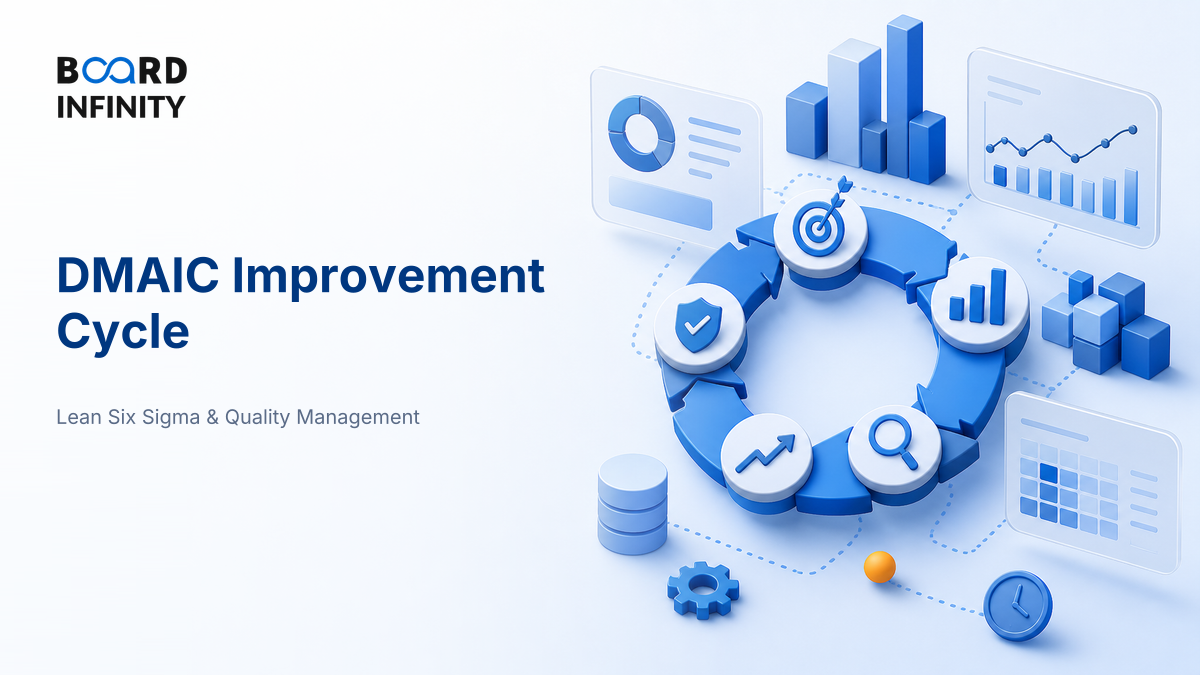
At Toyota, a worker can stop the line when a defect appears - a move that looks slow until you see the logic of the Toyota Production System. The fastest improvement teams do not jump to fixes; they define the problem, measure the truth, analyse the cause, improve the process, and control the new standard.
- DMAIC stands for Define, Measure, Analyse, Improve, Control - a structured cycle for solving process problems with data.
- Define converts a vague pain point into a clear business problem, customer requirement, scope, and goal.
- Measure establishes the baseline: how bad is the problem, how often does it occur, and where does variation enter?
- Analyse finds verified root causes, not opinions. Pareto charts, cause-effect diagrams, hypothesis tests, and process maps often sit here.
- Improve tests and implements countermeasures that remove root causes without creating new bottlenecks.
- Control locks the gain through standard work, visual controls, dashboards, audits, and ownership.
- The biggest interview trap is proposing solutions before proving the baseline and root cause.
Big Picture - DMAIC Is a Problem-Solving Spine
Think of DMAIC as a disciplined journey from pain to proof to permanence. It is usually associated with Six Sigma, but the logic is useful in operations, service, analytics, sales processes, supply chains, and even HR workflows. If you need the broader distinction, revise what Six Sigma is and how it differs from Lean.
Core Explanation - What Each DMAIC Phase Actually Does
The improvement cycle exists because most process problems are deceptive. A late delivery problem may look like poor worker effort, but the root cause may be demand variation, batch release timing, unclear priority rules, supplier delay, or rework. DMAIC slows the team down just enough to stop them from solving the wrong problem quickly.
1. Define - Turn Noise into a Project
Define answers: what exactly are we improving, for whom, and why now? A strong Define phase produces a problem statement, customer need, project scope, goal, business impact, stakeholders, and timeline.
2. Measure - Establish the Baseline
Measure answers: what is the current performance, and can we trust the data? This is where candidates should talk about data definitions, sampling, operational definitions, measurement system checks, and baseline KPIs.
A weak team says, “Customers are unhappy.” A strong DMAIC team says, “In the last four weeks, 3.2% of orders breached the promised delivery window, concentrated in two dispatch waves.” Use this instinct: convert adjectives into numbers.
3. Analyse - Find the Verified Root Cause
Analyse answers: why is the problem happening? This phase separates symptoms from causes. The team may use Pareto analysis, fishbone diagrams, 5 Whys, scatter plots, regression, hypothesis testing, or value-stream mapping. For the toolset, revise statistical tools every improvement project uses.
4. Improve - Test Countermeasures, Then Implement
Improve answers: what change removes the root cause with acceptable cost, risk, and adoption effort? Good teams pilot before scaling. They compare alternatives, run small experiments, update SOPs, train users, and check whether the solution shifts the metric that mattered in Define.
For example, if packing errors come mainly from look-alike SKUs, the fix may not be “train harder.” It may be barcode validation, slotting separation, colour-coded bins, mistake-proofing, and a revised picker path. The primary driver is error-proofed process design, supported by training and visual management.
5. Control - Make the New Process the Default
Control answers: how do we prevent the old problem from returning? This is where DMAIC becomes operational. Control plans define process owners, control charts, audit frequency, escalation rules, dashboards, and standard work. For deeper variation logic, revise process capability, control charts and variation.
Key Measures to Track in a DMAIC Project
Metrics depend on the process, but a placement-ready answer should name specific measures instead of saying “track KPIs.” Pick a few that match the problem: quality, speed, cost, capability, or customer experience.
Worked Example - Measuring Before Improving
Suppose an e-commerce warehouse wants to reduce packing errors. In one month, it processes 20,000 orders. Each order has two CTQ opportunities: correct item and correct shipping label. The team finds 320 total defects, and 260 orders have at least one defect.
If a pilot reduces total defects to 90 with the same volume and opportunities, DPMO becomes 2,250. That is the Measure-Improve link: you do not celebrate activity; you celebrate verified movement in the baseline metric.
Definitions - Say These Cleanly
ASQ defines DMAIC as “a data-driven quality strategy used to improve processes.”
Case Study - Aravind Eye Care System and the Improvement Cycle in Healthcare
Aravind Eye Care System shows how standardised process design, measurement discipline, and tight operating routines can make high-quality eye care scalable in India.
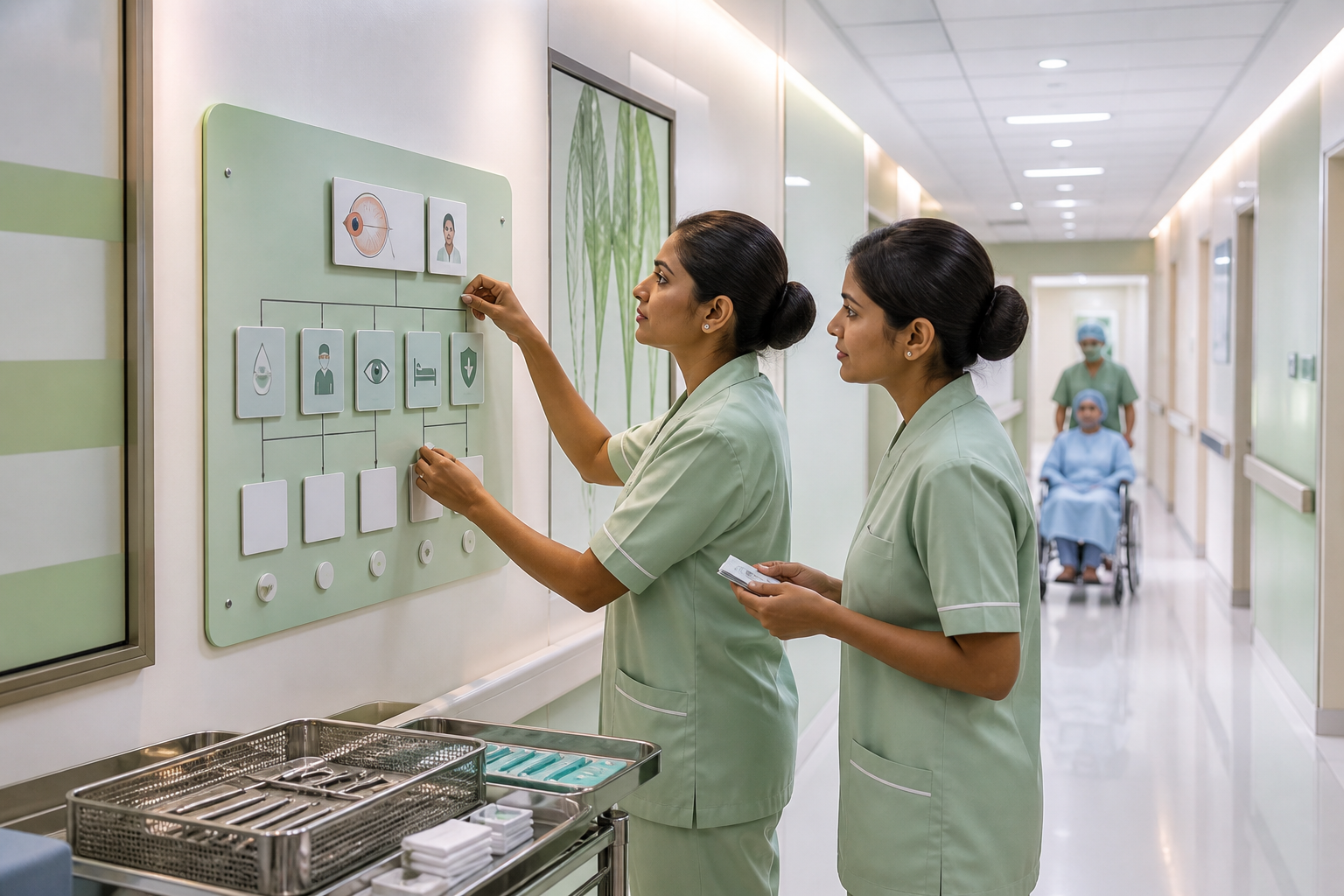
Aravind faced a hard operations problem: cataract care needed to be affordable, reliable, and high-volume without treating patients like units on a factory line. The temptation in such a setting is to say, “Hire more doctors” or “work faster.” The smarter move is to redesign the process around where expert time is most valuable.
Read Aravind through DMAIC. The Define problem is access to dependable eye care at scale. The Measure lens is patient flow, clinical outcomes, waiting time, utilisation of surgeons, and post-operative quality. The Analyse insight is that many tasks around surgery can be standardised and delegated safely, while the surgeon focuses on the step that truly needs specialist skill.
The Improve move is not one magic idea. The primary driver is a highly standardised care pathway that reduces variation. Supporting drivers include trained paramedical staff, repeatable pre-operative and post-operative routines, focused surgical workflow, and strong mission alignment. The Control mechanism is the daily operating discipline that keeps quality and throughput visible.
The lesson for interviews: DMAIC is not paperwork. It is how a team converts a social or business mission into a process that can repeatedly deliver.
How AI Changes DMAIC
AI does not replace DMAIC; it makes each phase faster and more evidence-rich when used carefully. The risk is the same as before: a confident answer based on bad data is still a bad answer.
Practical student workflow: load a company annual report, a short process description, and your DMAIC notes into NotebookLM. Ask it to generate five likely improvement projects, identify possible CTQs, suggest baseline metrics, and draft interview questions. Then cross-check the numbers and logic yourself before using them.
If you want the AI-specific continuation, revise using AI in defect detection and root cause analysis.
Interview Relevance
“Walk me through how you would use DMAIC to reduce late deliveries or defects in a warehouse, branch, plant, hospital, or service process.”
Use one running example throughout your answer. A single coherent warehouse, bank branch, hospital discharge, or sales lead process sounds far stronger than five disconnected definitions.
Common Mistake
The mistake: jumping from Define straight to Improve - “we will train people, automate it, or add manpower.” It costs candidates because it sounds action-oriented but not analytical. One-line fix: say, “Before recommending a solution, I will measure the baseline and verify the root cause.”