
Standard Work, Visual Management & Workplace Organisation
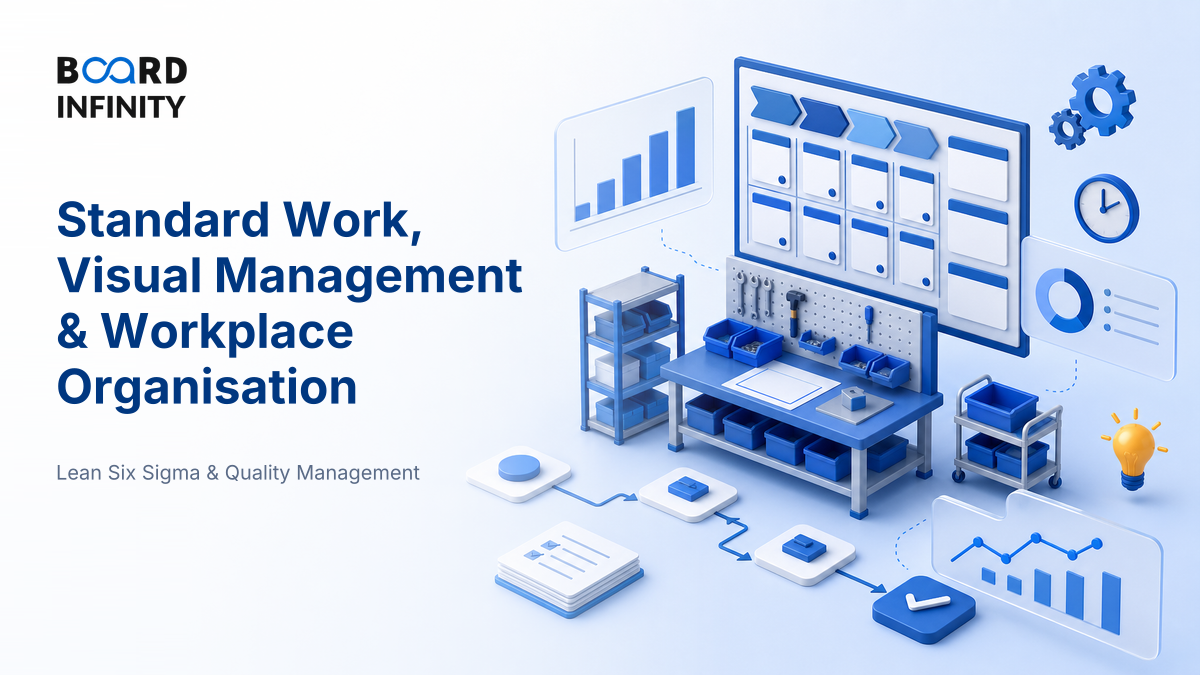
Why would a world-class operation spend time labelling the place for a broom? Because in a disciplined workplace, a missing broom is not housekeeping trivia - it is a signal that the process has already started drifting from control.
- Standard work is the documented best current way to do a task safely, with the right sequence, time and inventory.
- Visual management makes normal versus abnormal obvious at a glance - status, standards, gaps and next actions are visible.
- Workplace organisation, often taught as 5S, removes searching, walking, confusion and unsafe conditions from daily work.
- The three ideas work together: organise the workplace, define the standard, then use visuals to expose deviation.
- Good lean sites do not hide problems with heroic firefighting; they design work so problems surface early.
- Track it through standard work adherence, 5S audit score, first-pass yield, abnormality response time and WIP at the station.
- Interview trap: saying “5S means cleanliness.” Better answer: “5S is a control system that makes waste and abnormality visible.”
Big Picture - The Control Triangle
Standard work, visual management and workplace organisation are not three separate “lean tools.” They are a control system. Workplace organisation removes friction, standard work defines how the process should run, and visual management shows instantly when reality is off-standard.
Core Explanation - How the Three Pieces Fit
Standard work answers: “What is the best known way to perform this task today?” It typically specifies the work sequence, expected cycle time, required quality checks, safety points and standard work-in-process. In an interview, say “current best way,” not “permanent best way” - lean standards are meant to improve.
Visual management answers: “Can a supervisor, operator or visitor see process status without asking five people?” Examples include floor markings, andon lights, production boards, kanban cards, shadow boards, red-tag areas, quality alert boards and takt-versus-actual charts.
Workplace organisation answers: “Is the workplace designed so the right action is the easy action?” This is where 5S comes in: Sort, Set in order, Shine, Standardise and Sustain.
The deeper point: these tools make waste visible. If a tool is missing from a shadow board, if WIP exceeds the marked limit, if a red bin is full, or if the takt board is behind plan, the process is speaking. A strong operations manager listens before the defect reaches the customer. If you need a waste lens, revise the seven wastes and how to spot them on site.
The 2x2 Matrix - Where Visual Management Really Works
Not every visual is useful. A poster that nobody acts on is decoration. A good visual control changes behaviour because it shows a gap and tells people what to do next.
Use this matrix to test a shop-floor visual:
Definitions - Say Them Cleanly
- Standard work: The documented current best method for performing a task safely, consistently and with minimum waste.
- Visual management: A system that makes process status, standards and abnormalities visible at the point of work.
- Workplace organisation: The disciplined arrangement of tools, materials and information so work is safe, fast and error-resistant.
- 5S: A lean workplace method: Sort, Set in order, Shine, Standardise and Sustain.
What to Track - Five Practical Metrics
Do not measure 5S as “the floor looks clean.” Measure whether the workplace helps the process run to standard.
Worked example: Suppose a 5S audit has 50 total points. A workstation scores 8/10 on Sort, 9/10 on Set in order, 7/10 on Shine, 6/10 on Standardise and 5/10 on Sustain. Total score = 35/50 = 70%. The diagnosis is not “clean more.” The weak link is Sustain, so the fix is daily ownership, audit rhythm and supervisor coaching.
How to Apply It on a Real Shop Floor
Use this as a five-step field method when you are asked how you would improve a messy process.
Standard work also connects tightly to workstation design. If the task time, motion and station layout are poor, the standard will only document a bad method. That is where line balancing and workstation design becomes the natural next layer.
In Indian retail, DMart is a useful example of disciplined workplace organisation. The strategic lesson is not simply “low price”; the primary driver is operational simplicity, supported by focused assortment, store-level replenishment discipline, lean staffing and tight control over shelf availability. Visual routines on shelves, backroom storage and replenishment make store execution easier to monitor.
Case Study - IndiGo: Standard Work on the Airport Clock
IndiGo shows how standard work and visual control matter in a service operation where every delay has a cascading cost.

An airline turnaround is a live operations exam. Passengers deboard, cleaning begins, catering checks happen, baggage moves, fuel and safety checks are coordinated, crew prepares, boarding opens and the aircraft must leave safely. If each team works from memory, delay becomes normal.
IndiGo’s operating discipline is a strong case because the work is repetitive, time-bound and cross-functional. The primary driver is standardised execution of routine airport and flight processes. Supporting drivers include a largely common aircraft family, clear role handoffs, crew and gate scheduling discipline, visible departure-status information and a culture that treats on-time execution as an operating habit rather than a slogan.
The lesson: operational consistency rarely comes from one heroic employee. It comes from a system where the normal way of working is clear, visible and repeatable - and where abnormality is detected early enough to act.
How AI Changes Standard Work, Visual Management & Workplace Organisation
AI does not remove the need for standards. It makes weak standards easier to detect and good standards easier to scale.
- Computer vision for 5S and safety: Cameras can flag blocked aisles, missing PPE, wrong material placement, overflowing bins or tools not returned to marked locations. The practical caveat is governance - workers must know what is being monitored and why.
- AI-assisted work instructions: Teams can convert long SOPs into role-specific checklists, multilingual instructions or short training scripts. This helps frontline consistency, especially in high-attrition service and warehouse roles.
- Pattern detection in abnormalities: AI can cluster andon calls, downtime notes, defect comments or audit remarks to reveal recurring causes that supervisors may miss manually.
Use NotebookLM or ChatGPT like an operations analyst: upload a process SOP, a 5S audit sheet and a sample shift report, then ask, “Identify unclear standards, missing visual controls, likely wastes and five interview questions a plant manager may ask me about this process.”
Interview Relevance
“You visit a factory cell or warehouse zone where operators often search for tools and supervisors keep expediting work. How would standard work, visual management and 5S help?”
Use the phrase “standard work is the baseline for kaizen.” It shows you understand lean as continuous improvement, not rule enforcement. For the broader culture behind this, revise continuous improvement, kaizen and problem-solving culture.
Common Mistake
The biggest mistake is treating 5S as a cleanliness campaign. That sounds superficial because clean floors alone do not improve flow, quality or safety. The fix: explain 5S as a visual control system that reduces waste, exposes abnormality and supports standard work.
What to Revise Next
Once you understand how standards and visuals stabilise work, the next question is how material and information should move through the system. After that, revise Quick Changeover and Total Productive Maintenance to see how equipment reliability and faster changeovers protect the standard. Start next with Kanban and Pull-Based Replenishment.