
Essential Marketing Frameworks: The Interview-Ready Map for Solving Any Marketing Case
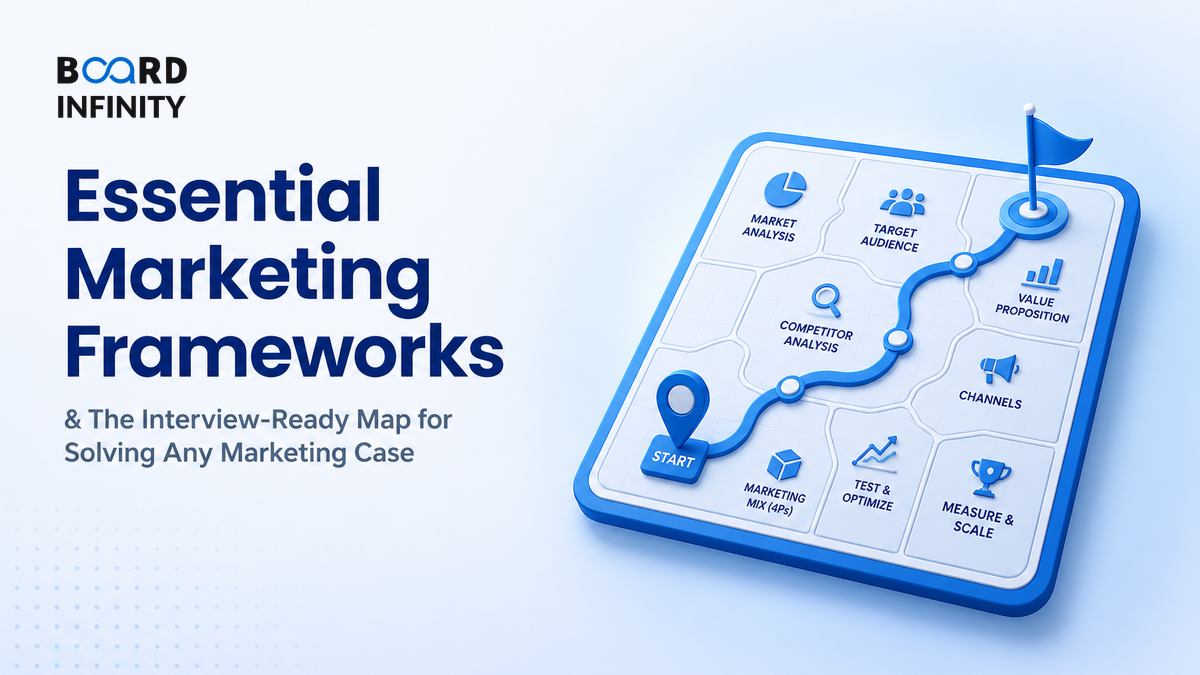
Why do some brands make marketing look effortless while others spend heavily and still feel invisible? The difference is rarely one clever campaign - it is whether the marketer knows which framework to use at which moment.
- Use 5C before 4P. Diagnose Company, Customers, Competitors, Collaborators and Context before jumping to tactics.
- STP is the strategic heart. Segment the market, choose the target, then position the brand in one sharp promise.
- 4Ps turn strategy into execution. Product, Price, Place and Promotion must fit the chosen target and positioning.
- Funnels explain customer movement. Track Awareness, Consideration, Conversion and Loyalty to find the real leakage point.
- SWOT is useful only when it leads to action. Convert it into TOWS - Strengths, Weaknesses, Opportunities and Threats matched to moves.
- Metrics prevent vague marketing. Track CAC, LTV:CAC, conversion rate, ROAS, retention and NPS.
- The best interview answers do not list frameworks. They start with the business objective, then pick the right 2-3 frameworks.
Big Picture
Think of marketing frameworks as an operating system. They help you move from diagnosis to choice to execution to learning - instead of randomly suggesting ads, discounts or influencer campaigns.
Core Explanation: The Frameworks That Actually Matter
The fastest way to sound structured is to know what each framework is for. A framework is not an answer by itself. It is a thinking tool that helps you ask better questions and make sharper choices.
1. 5C Analysis - diagnose the battlefield
5C Analysis scans the five forces around a marketing decision: Company, Customers, Competitors, Collaborators and Context.
Use it when: you are entering a market, launching a product, fixing a decline or explaining why a brand is winning.
2. STP - decide whom to serve and what to stand for
STP stands for Segmentation, Targeting and Positioning. It is the most important marketing strategy framework because it forces choice.
A weak STP answer says, “target young people.” A strong STP answer says, “target urban first-jobbers who want affordable style, shop on mobile, and need low-risk trials before purchase.”
3. 4Ps and 7Ps - convert strategy into the market offer
4Ps are Product, Price, Place and Promotion. For services, extend them to 7Ps by adding People, Process and Physical evidence.
Use 4Ps after STP. If you have not chosen the target and positioning, your 4Ps become a random checklist.
4. Funnel and customer journey - find where growth is leaking
The marketing funnel tracks how customers move from first noticing a brand to buying and returning. It is useful when a business asks, “Why are sales not growing despite marketing activity?”
5. SWOT and TOWS - turn diagnosis into moves
SWOT lists Strengths, Weaknesses, Opportunities and Threats. But interviews reward TOWS thinking - matching those factors to actions.
6. The framework selector - choose the tool, do not force it
When you get a marketing problem, do not mechanically say “I will use STP and 4Ps.” First identify the type of problem.
Definitions You Should Be Able to Say Cleanly
- Marketing - Philip Kotler: “Marketing is the science and art of exploring, creating, and delivering value to satisfy the needs of a target market at a profit.”
- Strategy - Michael Porter: “Strategy is the creation of a unique and valuable position, involving a different set of activities.”
- Customer-based brand equity - Kevin Lane Keller: “The differential effect that brand knowledge has on consumer response to the marketing of that brand.”
Marketing Metrics: What to Track So Your Answer Sounds Commercial
Frameworks show structure. Metrics show business maturity. Use these as practical rules of thumb, then always add: “I would compare this against category benchmarks and cohort trends.”
Case Study - Lenskart: Frameworks in an Indian Omnichannel Business
Lenskart shows how 5C, STP, 4Ps and funnel thinking can work together in a high-trust, high-fit Indian consumer category.

Situation: Eyewear in India is a large need-based category, but the purchase journey has friction. Customers need eye tests, frame trials, prescription accuracy, fit, style confidence and after-sales reassurance. Pure online selling struggles because eyewear is personal and risk-sensitive; pure offline retail struggles with range, convenience and scale.
The move: Lenskart built an omnichannel model around affordable eyewear, digital discovery and physical trust. Its primary driver was reducing purchase risk - customers could discover online, try frames through digital tools or stores, access eye-testing support, and complete purchase with more confidence. Supporting drivers included private-label control, a wide assortment, store expansion, technology-led customer experience and supply-side integration.
The result or lesson: The lesson is not “online plus offline wins.” The sharper lesson is that the right channel mix must match category risk. In eyewear, the winning marketing design connects convenience, trust, trial and service - all aligned to the same positioning.
Interview takeaway: A shallow answer says Lenskart grew because it used omnichannel. A strong answer says it matched its marketing system to the category's core risk - customers needed convenience plus reassurance.
How AI Changes Essential Marketing Frameworks
AI does not replace frameworks. It makes them faster, more granular and more testable - but only if the marketer still asks the right strategic question.
Practical student workflow: Use Perplexity to gather recent company and category facts, then use ChatGPT to map them into 5C, STP, 4Ps and funnel leakage. Finally, ask: “What assumptions in this framework need validation before recommending a campaign?” That last question is what keeps the answer strategic.
Interview Relevance
“Pick a consumer brand you like. If sales have slowed, which marketing frameworks would you use to diagnose and fix the problem?”
Say “I will not use every framework. I will first identify whether this is a diagnosis, segmentation, execution or measurement problem.” That single sentence makes you sound structured.
Common Mistake
The biggest mistake is reciting frameworks instead of applying them. Candidates say “I will use STP, 4Ps, SWOT and Porter” but never connect them to the business issue. Fix: start with the objective, pick only the relevant frameworks, and end with metrics that prove whether your recommendation worked.
What to Revise Next
Once you know the core marketing frameworks, move from “which framework?” to “how do I structure messy problems?” Revise Structuring Problems: Issue Trees & MECE Thinking next, then deepen your judgement with Marketing Trade-offs: Brand vs Performance, Reach vs Frequency, CAC vs LTV.