
Guesstimates & Market Sizing - Step-by-Step Interview Framework
Airbnb was never really sizing the market for “air mattresses on floors.” The sharper question was: how many paid nights of accommodation could shift from hotels to homes if trust, payments and discovery were solved?
- A guesstimate is a structured approximation - not a hunt for the exact number.
- Always start by clarifying scope: geography, time period, customer segment, unit of measure and whether you need value or volume.
- Use a driver tree: break the problem into population, penetration, frequency, price, capacity or usage drivers.
- Pick one main approach: top-down for population-led markets, bottom-up for outlet or capacity-led markets, supply-side for constrained categories.
- State assumptions out loud and keep them round, defensible and easy to calculate.
- Sanity-check the answer using per-capita logic, market comparables or capacity limits.
- The best answers are not the most accurate; they are clear, consistent, testable and business-relevant.
Think of guesstimates as business arithmetic under uncertainty. You are converting a vague question into a set of visible assumptions, then using logic to reach a directionally useful number.
The Core Idea: Convert Fog into Drivers
A market-sizing question sounds like one big question: “How many electric scooters will be sold in India next year?” But the answer becomes easier when you split it into smaller drivers: eligible buyers, adoption, replacement, price, distribution and constraints.
There are three common paths. Choose the one that matches the market.
The trick is not to memorize templates. The trick is to see what the market is “made of”: people, occasions, locations, devices, transactions, capacity or price.
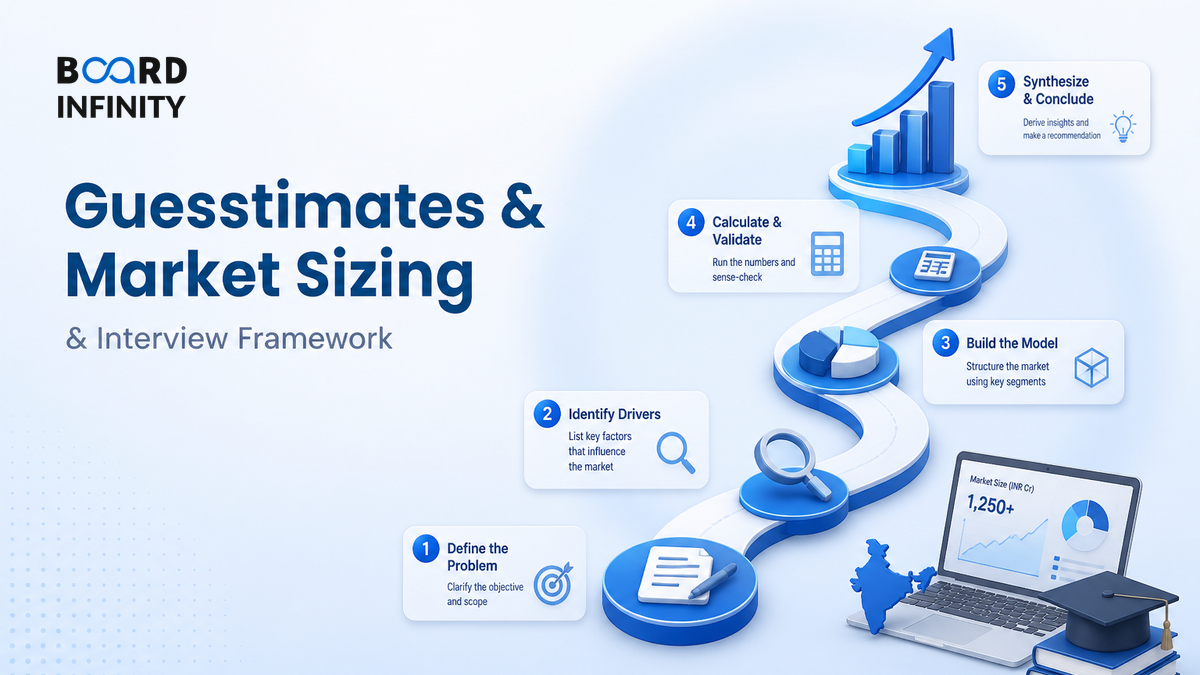
A Five-Step Process You Can Use in Any Guesstimate
Notice the order: structure first, numbers second. Weak candidates jump into population numbers. Strong candidates first define exactly what is being counted.
Worked Example: Estimate Daily Tea Sales Near a Large Indian College
Question: Estimate the number of cups of tea sold per day by stalls around a large MBA college campus in India.
Clarify: We are estimating cups sold by nearby tea stalls, not the college cafeteria, on a normal working day.
Answer: I would estimate roughly 2,000 cups of tea per day sold by stalls around the campus.
Sanity check: If there are 5 stalls, each sells about 400 cups per day. At peak morning and evening hours plus steady day demand, that feels plausible for a high-footfall student zone. If the interviewer says there are only 2 stalls, revise using capacity logic.
Definitions You Should Be Able to Say in One Breath
- Guesstimate: A reasoned approximation using explicit assumptions when exact data is unavailable.
- Market sizing: Estimating the potential volume or value of a defined market over a defined period.
- TAM: Total addressable market - total demand if the product could serve the entire relevant market.
- SAM: Serviceable available market - the portion of TAM reachable with the current business model and geography.
- SOM: Serviceable obtainable market - the realistic share a company can capture given competition and constraints.
The Sanity Checks That Separate Good Answers from Guesswork
A guesstimate becomes credible when you test it from another angle. Use at least one sanity check before giving the final answer.
For “good number” thinking, do not memorize universal ranges. A strong answer is one where the implied behavior is plausible: daily tea consumption can be high, daily refrigerator purchases cannot; monthly OTT viewing can recur, monthly car replacement cannot.
Mini Case Study: Ather Energy and the EV Two-Wheeler Market
Ather Energy shows why market sizing must move from big national potential to the serviceable, city-by-city market a company can actually capture.

Situation: India has a very large two-wheeler market, but that does not automatically mean every electric scooter company can target the entire market on day one. EV adoption depends on buyer income, commute patterns, charging access, state-level incentives, dealership/service presence and trust in battery performance.
The move: Ather did not just treat India as one giant TAM. Its practical opportunity had to be sized through premium urban scooter buyers first - people with predictable commutes, higher willingness to pay, access to charging and comfort with connected products. That is a SAM/SOM problem, not just a TAM problem.
Outcome or lesson: The primary driver was not only “EVs are growing.” The stronger explanation is: a focused premium urban segment, supported by charging ecosystem development, product experience, service network expansion and policy tailwinds. In an interview, this is exactly how you should think: big category potential is useful, but strategy is built on reachable and winnable demand.
How AI Changes Guesstimates & Market Sizing
AI does not remove the need for structure. It makes weak structure more dangerous because a polished answer can still be logically wrong. Use AI to improve inputs, comparables and critique - not to outsource the thinking.
- Faster secondary research: Tools such as Perplexity can help find credible sources for population, category reports, annual reports and regulator data. Always verify the original source before using any number.
- Assumption stress-testing: ChatGPT or Claude can challenge your driver tree: “What assumptions am I missing for sizing the used smartphone market in India?” This helps surface frequency, replacement and channel factors.
- Scenario sizing: AI can quickly create base, optimistic and conservative cases once you provide the equation and assumption ranges.
Load a company annual report, investor presentation and this lesson into NotebookLM. Ask: “Generate five market-sizing questions relevant to this company, list the driver tree for each, and challenge the riskiest assumptions.” Then solve the questions yourself without looking at the generated answer.
Interview Relevance
“Estimate the annual market size for quick-commerce grocery delivery in a large Indian metro. Walk me through your approach.”
Before calculating, say: “I will use a top-down household approach and then sanity-check with order capacity.” That one sentence makes your answer sound structured immediately.
Common Mistake
The mistake: jumping into numbers before defining the market. It costs candidates because the interviewer cannot tell what is being counted, so even correct arithmetic looks random. Fix: spend the first 30 seconds clarifying geography, time period, unit, segment and value-versus-volume.
What to Revise Next
Once you can size a market, move to what a manager should do with that number. Revise How to Answer “Improve This Metric” Questions: A Toolkit next, then Applying Frameworks to Real Business Situations so your estimates translate into business recommendations.