
Structure Any Case Problem with Issue Trees and MECE Thinking
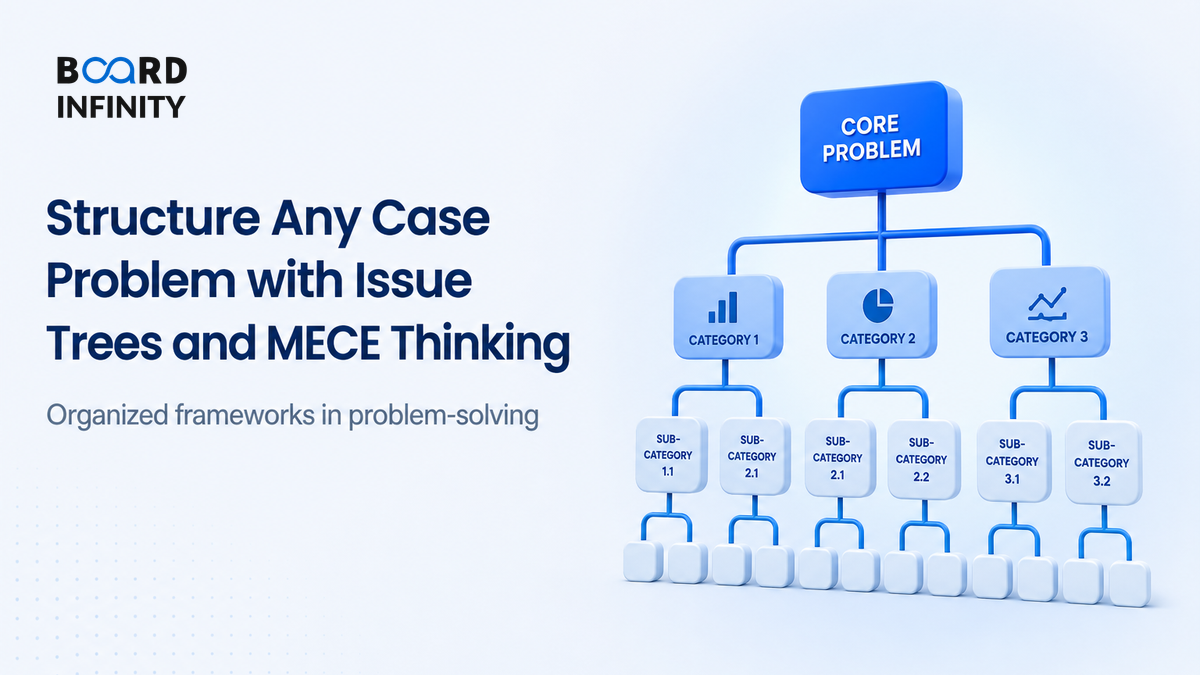
A quick-commerce city manager sees late-night orders slipping: some riders wait outside stores, some stores run out of fast-moving SKUs, and some customers cancel after seeing a long ETA. A weak team says, “Hire more riders.” A structured team first asks, “Which part of the system is actually broken?”
- Issue trees break one messy problem into smaller questions that can be analyzed and solved.
- MECE means branches are non-overlapping and collectively cover the relevant problem space.
- Start with the decision question, not a random list of ideas.
- For business cases, first split by math drivers where possible: profit = revenue - cost; revenue = price x volume.
- Each branch should be testable: you should know what data would prove or disprove it.
- A good structure is not “perfectly pretty”; it is complete enough to locate the real bottleneck fast.
- The biggest interview win: say your structure out loud before solving, then prioritize the branch with the highest business impact.
Big Picture
Problem structuring is the bridge between panic and progress. Instead of jumping from a vague symptom to a fashionable solution, you convert the symptom into a decision question, split it into MECE drivers, test the most important branches, and synthesize an answer.
Core Explanation: How Issue Trees and MECE Thinking Actually Work
An issue tree is a disciplined way to ask, “What must be true for this problem to happen?” Each level breaks the problem into smaller, cleaner pieces. MECE thinking is the quality standard: no double counting, no missing buckets.
The simplest rule: start with arithmetic where arithmetic exists. If the problem is profit, split it into revenue and cost before discussing brand, operations, or competition. If the problem is market share, split it into category size, company sales, penetration, purchase frequency, and retention where relevant.
For a platform like Blinkit, Zepto, or Swiggy Instamart, “delivery is late” should not become one bucket called operations. A cleaner tree separates demand spikes, store picking time, inventory availability, rider assignment, route travel, and customer handoff. The so what: the same symptom can require very different actions - better forecasting, store layout changes, rider incentives, or ETA communication.
The Two Main Types of Issue Trees
A Clean Five-Step Process
The MECE Test: Four Checks Before You Present a Structure
How to Judge Tree Quality: Five Practical Measures
These are not accounting ratios; they are practical quality checks consultants use mentally while structuring. A strong tree scores well on completeness, separation, testability, and decision usefulness.
Definitions
Issue tree: A hierarchical breakdown of a problem into smaller questions that can be analyzed independently and recombined into an answer.
MECE: A grouping is MECE when categories do not overlap and together cover the entire relevant universe.
Hypothesis: A tentative answer tested against evidence before being accepted, rejected, or refined.
Barbara Minto popularized MECE thinking in consulting communication through The Pyramid Principle. In practice, MECE is less about sounding clever and more about making sure your reasoning is complete, clean, and usable.
Ather Energy: Structuring the EV Adoption Problem
Ather Energy treated electric-scooter adoption as a multi-driver ecosystem problem, not just a vehicle design or pricing problem.

Situation: In India, electric two-wheelers had strong promise but real adoption barriers: upfront price concerns, range anxiety, charging access, product trust, service confidence, and customer education. A shallow structure would say, “EV sales depend on price.” That is true, but incomplete.
The move: Ather approached the market like an ecosystem issue tree. The primary driver was to reduce perceived ownership risk through a tightly controlled product and charging experience. Supporting drivers included experience-led retail, a visible charging network, software-led scooter features, after-sales service, financing options, and a premium brand community.
Outcome or lesson: The strategic lesson is not “Ather grew because it had charging.” The primary driver was reducing EV ownership uncertainty; charging infrastructure, retail education, product design, software, financing, and service all supported that driver. That is exactly what MECE thinking protects you from: mistaking one visible lever for the whole system.
How AI Changes Structuring Problems: Issue Trees & MECE Thinking
AI does not replace problem structuring; it makes weak structuring more visible. In 2026, the best students use AI as a sparring partner, not as an answer machine.
- First-pass issue trees: ChatGPT or Claude can generate multiple ways to break a case: revenue-cost, customer journey, value chain, or stakeholder lens. Your job is to choose the cleanest logic.
- MECE stress-testing: LLMs are useful for asking, “What branches overlap?” and “What major drivers are missing?” They often catch blind spots, but they can also invent irrelevant branches.
- Evidence mapping: Perplexity can help find public evidence for each branch - annual reports, investor presentations, regulatory filings, industry articles - with citations you can verify.
Use ChatGPT to draft three alternative issue trees for one case prompt, then ask Perplexity to find public evidence for the top two branches. Finally, paste your refined structure into NotebookLM with the company annual report or investor deck and generate likely interview follow-up questions.
Interview Relevance
“Our quick-commerce client is growing orders rapidly, but contribution margin per order is worsening. How would you structure the problem?”
In a case interview, do not just draw the tree. Explain the logic of the first split in one sentence: “I am starting with contribution margin because it separates monetization issues from cost-to-serve issues.”
Common Mistake
The biggest mistake is presenting a brainstorm list as a structure: “marketing, pricing, operations, competition, technology.” It sounds broad but mixes causes, functions, and solutions, so the interviewer cannot see your logic. The fix: define the metric first, split it into MECE drivers, and only then add business judgment.
What to Revise Next
Once you can structure a messy problem, revise the trade-offs that make the final recommendation sharp. Move next to marketing trade-offs - brand vs performance, reach vs frequency, CAC vs LTV - and then decision-making under uncertainty for marketers.