
Marketing Trade-offs for Interviews: Brand vs Performance, Reach vs Frequency, CAC vs LTV
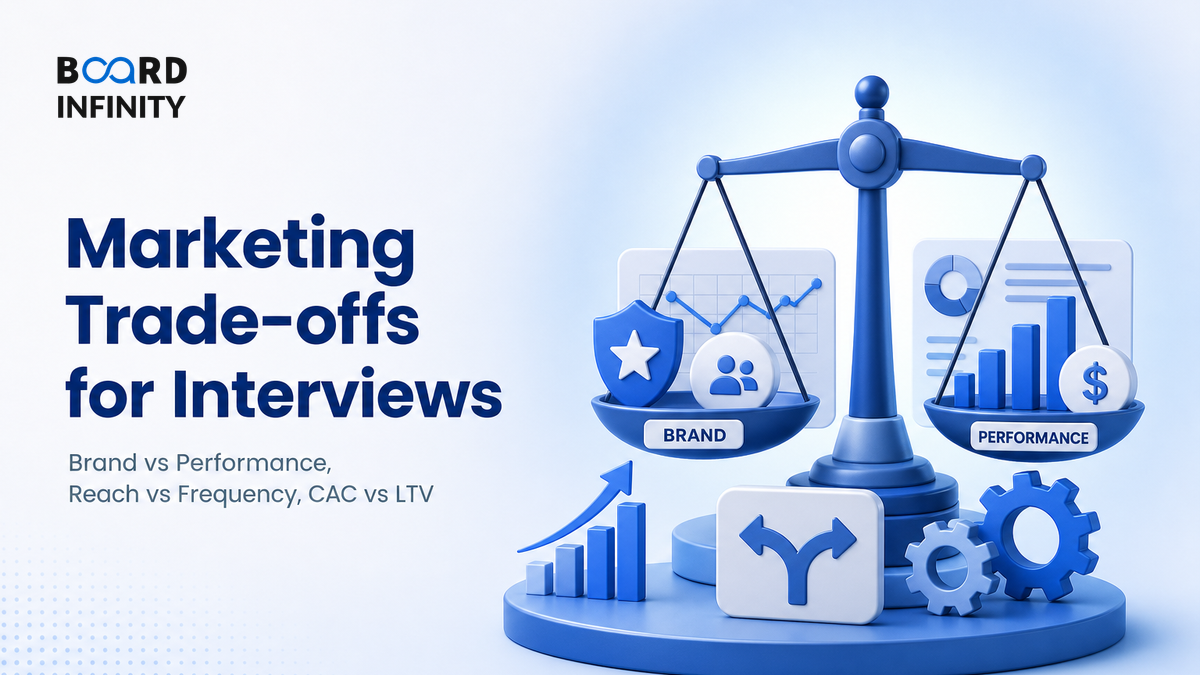
The biggest misconception in marketing is that growth comes from choosing the “right” side - brand or performance, reach or frequency, acquisition or retention. In reality, strong marketers do not pick a side; they manage the tension like a set of dials, because over-rotating one dial quietly damages the others.
- Brand vs performance is a time-horizon trade-off: brand builds future demand; performance captures existing demand.
- Reach vs frequency is an exposure trade-off: reach finds more people; frequency makes fewer people remember and act.
- CAC vs LTV is a unit economics trade-off: acquisition is healthy only when customer lifetime value justifies the cost.
- The right answer depends on category maturity, buying cycle, margin, repeat rate, and business objective.
- Use metrics together: reach without conversion is waste, CAC without LTV is incomplete, and ROAS without brand lift can mislead.
- The best interview answer is not “brand is better” or “performance is better”; it is “here is the condition under which each should dominate.”
Big Picture: Marketing Trade-offs Are Dials, Not Switches
Think of a marketing plan as a control panel. Every rupee of budget, every impression, and every campaign objective moves one dial up and another dial down. The manager’s job is to find the mix that maximizes profitable growth - not vanity visibility, not cheap clicks, and not short-term sales at the cost of future demand.
Core Explanation: The Three Trade-offs That Decide Marketing Quality
1. Brand vs Performance
Brand marketing creates mental availability, trust, distinctiveness, and long-term preference. Performance marketing uses measurable channels - search, paid social, affiliates, marketplaces, retargeting - to drive near-term actions such as leads, installs, purchases, or sign-ups.
The trap is to treat them as enemies. Performance works best when brand has already created trust; brand becomes commercially useful when performance captures demand efficiently. A strong marketer asks: Are we creating future demand, capturing current demand, or both?
CRED used distinctive, high-recall brand campaigns to make a niche credit-card bill payment proposition feel culturally visible, while also using app performance channels to drive installs and engagement. The strategic lesson: in low-frequency or trust-heavy categories, brand reduces friction before performance tries to convert.
2. Reach vs Frequency
Reach means how many unique people in the target audience see the message. Frequency means how many times, on average, each reached person sees it. With a fixed budget, more reach usually means lower frequency; higher frequency usually means fewer unique people reached.
Use more reach when the category is broad, awareness is low, the message is simple, or you need penetration. Use more frequency when the message is new, the purchase is high-involvement, the audience needs reassurance, or the campaign has multiple creatives in a sequence.
3. CAC vs LTV
Customer Acquisition Cost or CAC is the average cost of acquiring one new customer. Lifetime Value or LTV is the expected gross profit from a customer over the relationship. This trade-off is the marketer’s bridge to finance: growth is not good just because revenue rises; it is good when customers are worth more than they cost to acquire and serve.
For a D2C beauty brand, a high first-order CAC may be acceptable if customers reorder frequently with healthy gross margins. For a low-margin, one-time purchase category, the same CAC may be dangerous. The decision is not “lower CAC at all costs”; it is profitable acquisition at the right payback speed.
The Operating Loop: How the Three Trade-offs Reinforce Each Other
In the best companies, the three trade-offs form a loop. Brand improves trust and direct traffic, performance converts demand, customer data improves targeting, retention lifts LTV, and higher LTV allows the company to spend more confidently on acquisition.
Metrics You Must Be Able to Name
Interviewers like this topic because it exposes whether you can connect marketing creativity to business economics. Use these measures as your minimum dashboard.
Small Worked Example: When a High CAC Is Still Rational
Assume a subscription snack brand spends ₹900 to acquire one customer. The customer pays ₹500 per month, gross margin is 40%, and average retention is 8 months.
LTV = ₹500 x 40% x 8 = ₹1,600. CAC is ₹900, so LTV:CAC = 1.8:1. This may be acceptable if the company is still learning and retention is improving, but it is not yet a comfortable scale position. If retention rises to 15 months, LTV becomes ₹3,000 and LTV:CAC becomes 3.3:1 - now acquisition can scale more confidently.
The lesson: marketers should not celebrate lower CAC alone. Sometimes the bigger unlock is better onboarding, retention, cross-sell, or repeat purchase - because that raises LTV and allows smarter acquisition.
Definitions: Say These Cleanly
- Marketing - AMA: “Marketing is the activity, set of institutions, and processes for creating, communicating, delivering, and exchanging offerings that have value.”
- Brand - AMA: “A name, term, design, symbol, or any other feature that identifies one seller’s good or service as distinct.”
- Brand equity - Kevin Lane Keller: Customer-based brand equity is the differential effect brand knowledge has on consumer response to marketing.
- CAC: Average sales and marketing cost required to acquire one new customer.
- LTV: Expected gross profit a customer generates over the full relationship with the firm.
Nykaa: Balancing Beauty, Trust, Performance, and Repeat Purchase
Nykaa shows how an Indian consumer platform can combine brand trust, content-led education, performance marketing, and repeat purchase economics in a category where discovery and replenishment both matter.

Situation: Beauty and personal care in India is a high-discovery category. Customers want tutorials, shade guidance, authenticity, reviews, offers, and access to multiple brands. That creates a classic trade-off: spend only on performance and you may get transactions, but not trust; spend only on brand and you may miss measurable conversion.
The move: Nykaa built a content-and-commerce model. Its brand-building came from beauty education, influencer-led discovery, assortment credibility, and trust around authentic products. Its performance engine came from app and website conversion, personalized offers, search-led demand capture, marketplace-style discovery, and retargeting. Its CAC vs LTV logic was supported by the natural repeat-purchase behavior of beauty categories, cross-sell across skincare, makeup, personal care, and its offline stores that added reassurance and trial.
Outcome and lesson: Nykaa’s strength was not one magic channel. The primary driver was category trust in a fragmented beauty market, supported by content-led discovery, broad assortment, performance conversion, repeat purchase, and omnichannel presence. The marketing lesson is sharp: when the category has both emotional discovery and repeat economics, brand and performance are not rivals - they are two halves of the same growth system.
How AI Changes Marketing Trade-offs
AI does not remove these trade-offs; it makes them more measurable and faster to test. By 2026, the stronger marketer is not the one who says “AI will personalize everything,” but the one who knows where AI changes the decision.
Use Perplexity to gather recent public information on a company’s marketing channels, then use ChatGPT to build a one-page trade-off diagnosis: brand objective, performance objective, likely CAC drivers, likely LTV drivers, and three interview questions. Always verify facts from company filings, investor presentations, or credible news sources before quoting them.
Interview Relevance
“A D2C brand’s performance marketing CAC is rising, but the founder still wants aggressive growth. How would you decide whether to spend more on brand, performance, reach, frequency, or retention?”
Use this sentence when stuck: “I would not optimize for the cheapest customer; I would optimize for the most profitable customer cohort we can acquire repeatedly.” It signals marketing maturity immediately.
Common Mistake
The biggest mistake is giving a binary answer - “choose brand” or “choose performance” - without stating the business condition. It costs candidates because real marketing decisions are constrained by margin, repeat rate, cash flow, category awareness, and time horizon. One-line fix: always answer with “If the constraint is X, prioritize Y; if the constraint is Z, prioritize W.”
What to Revise Next
Now move from marketing trade-offs to structured decision-making. Revise Decision-Making Under Uncertainty for Marketers to handle incomplete data, then Case-Based Thinking: How to Break Down Any Marketing Problem so you can turn any vague marketing prompt into a clear, MECE answer.