
Government Borrowing, Deficits & Crowding Out - Interview-Ready Macro Framework
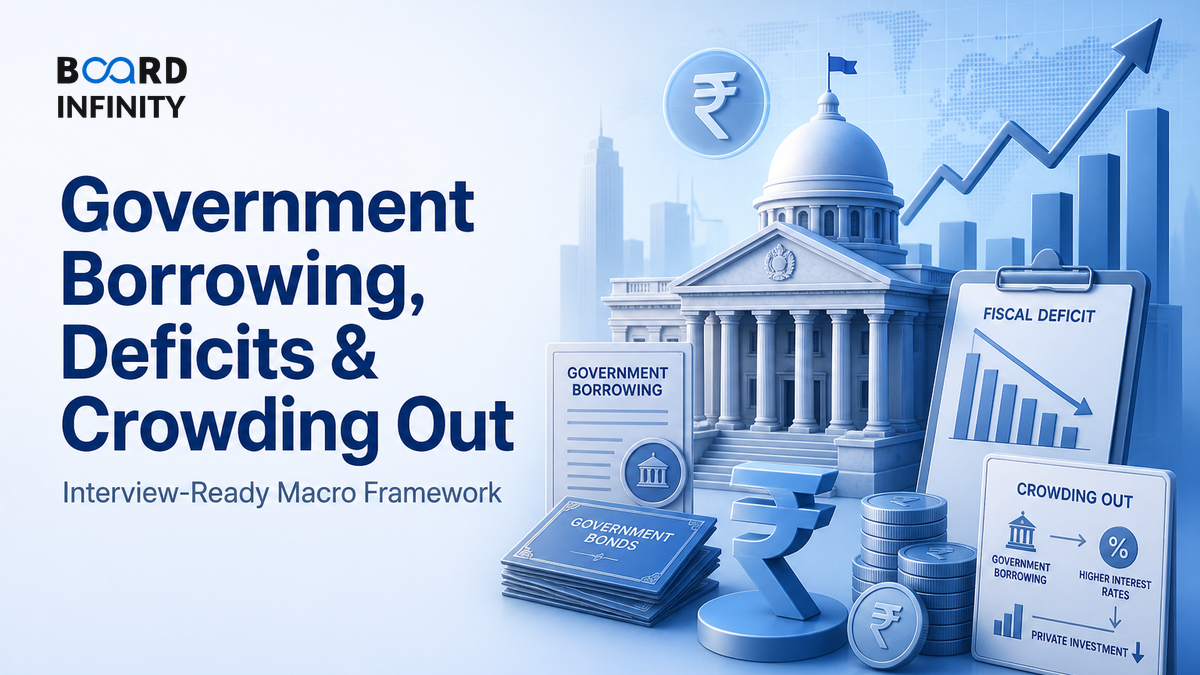
In the 2024 Budget season, one small line on government borrowing was enough to move India’s bond market before most consumers noticed anything. That is the quiet power of deficits - a fiscal number in Delhi can travel through G-sec yields into corporate loans, NBFC funding costs, housing EMIs and investment decisions.
- Fiscal deficit is the gap the government must finance through borrowing after non-debt receipts are counted.
- Government borrowing usually happens through dated securities and treasury bills; in India, the 10-year G-sec yield becomes a benchmark for many rates.
- Crowding out happens when government borrowing absorbs savings or pushes yields up, making private investment costlier.
- It is not automatic: in a slowdown, public spending can crowd in private investment by creating demand and infrastructure.
- The key interview answer is conditional: check economic slack, inflation, RBI stance, savings, capital inflows and quality of spending.
- The most watched metrics are fiscal deficit/GDP, primary deficit/GDP, debt/GDP, interest-to-revenue ratio, gross borrowing and the 10-year G-sec yield.
- For India, always connect the topic to the Union Budget, RBI liquidity, G-sec auctions and corporate borrowing costs.
Think of government borrowing as a pipe, not a headline. The deficit is the water entering the pipe; bond markets price that water; interest rates transmit the pressure to banks, NBFCs and companies; the final effect is either private investment being squeezed or encouraged.
The Core Idea: Deficits Are Flows, Debt Is the Stock, Borrowing Is the Bridge
A deficit is a one-period gap: this year’s spending exceeds this year’s receipts. Public debt is the accumulated stock of past borrowings. Government borrowing is the financing bridge between the two.
In India, the Union Government borrows mainly through dated government securities and treasury bills, with the RBI acting as debt manager for the government. These securities are bought by banks, insurance companies, mutual funds, pension funds, foreign portfolio investors and other institutions.
The important part for placements: government borrowing is not just a public finance topic. It affects valuation discount rates, NBFC cost of funds, infrastructure financing, bank treasury gains or losses, working capital rates and the appetite for corporate bonds.
Definitions You Must Be Able to Say Cleanly
- Fiscal deficit: Total expenditure minus total receipts excluding borrowings.
- Revenue deficit: Revenue expenditure minus revenue receipts.
- Primary deficit: Fiscal deficit minus interest payments.
- Public debt: The outstanding stock of government liabilities accumulated from past borrowing.
- Crowding out: A fall in private investment caused by government borrowing raising rates or absorbing available savings.
The Four Deficits: Do Not Mix Them Up
Interviewers often test this with a trap: “If fiscal deficit falls, does government debt automatically fall?” No. Fiscal deficit is the new borrowing requirement; debt falls only if the stock grows slower than GDP or is repaid.
A Small Worked Example: Calculate the Deficits
Use simple arithmetic. Suppose a government has:
- Total expenditure = ₹100
- Total receipts excluding borrowings = ₹82
- Revenue expenditure = ₹70
- Revenue receipts = ₹60
- Interest payments = ₹8
The interview insight: the same fiscal deficit looks healthier if it funds roads, ports and digital infrastructure than if it mainly funds recurring consumption without future growth.
The Crowding-Out Question: When Does Government Borrowing Hurt Private Investment?
Crowding out is not a moral judgment on deficits. It is a market mechanism. If the government borrows heavily in a system with limited savings, high inflation and tight monetary policy, lenders demand higher yields. Corporate borrowers then face higher borrowing costs, and some projects no longer clear their hurdle rate.
But the reverse can also happen. If the economy has idle capacity and weak demand, government spending can raise sales expectations, improve infrastructure and attract private capex. That is called crowding in.
What to Track: Six Metrics That Make Your Answer Sound Like a Market Professional
There is no single “good” deficit number for every economy. A high-growth country with credible institutions and productive capex can sustain more borrowing than a low-growth country with weak revenue and high interest costs. Still, these six indicators give you a practical dashboard.
When the Union Budget signals a lower-than-feared borrowing requirement, Indian bond yields can soften because investors expect less supply of G-secs. The strategic point: markets price the difference between expected and announced borrowing, not just whether the deficit is large in absolute terms.
How Government Borrowing Reaches Companies
Bajaj Finance: Government Yields Inside an NBFC Business Model
Bajaj Finance shows how sovereign borrowing conditions flow into a private lender’s cost of funds, pricing discipline and growth choices.

Situation. Bajaj Finance, like other large NBFCs, depends on market and institutional funding - including bank lines, non-convertible debentures, commercial paper, deposits and securitisation. Its lending book may be granular and retail-heavy, but its liability side is linked to India’s interest-rate environment. When government securities yield more, investors typically demand higher yields from corporate and NBFC paper as well.
The move. The company has not relied on one funding channel. Its primary defence is liability diversification: mixing borrowings, deposits and capital-market instruments. Supporting drivers include asset-liability management, risk-based pricing, portfolio diversification across consumer, SME and commercial loans, and maintaining lender/investor confidence through credit discipline.
Outcome and lesson. Government borrowing does not mechanically crush every private borrower. Strong financial firms can absorb and pass through some rate pressure if they have diversified liabilities, pricing power and good asset quality. But the sovereign yield curve still sets the floor: when the government’s borrowing cost rises, private lenders must work harder to protect spreads and growth.
The case proves the core idea: crowding out is strongest for weaker borrowers with limited funding options; stronger firms manage it through funding mix, pricing and balance-sheet credibility.
How AI Changes Government Borrowing, Deficits & the Crowding-Out Question
1. Faster budget and borrowing analysis. AI tools can parse Union Budget documents, RBI borrowing calendars, state borrowing notifications and speeches to identify changes in fiscal deficit, gross borrowing, capex mix and subsidy pressure. The analyst’s edge is no longer finding the document; it is asking the right macro question.
2. Better yield-curve and sentiment monitoring. Bond desks increasingly combine macro data, auction results, inflation releases, crude prices, RBI commentary and news sentiment to assess yield direction. AI helps summarize what changed, but the human must still judge whether the change is fiscal, monetary or global.
3. Company impact mapping. For banks, NBFCs, infrastructure firms and real estate companies, AI can connect sovereign yield changes to cost of debt, treasury portfolios, valuation discount rates and capex plans. This is useful in equity research, credit analysis and consulting diagnostics.
Use NotebookLM: upload the latest Union Budget speech, RBI monetary policy statement and a company annual report. Ask: “How could government borrowing and 10-year G-sec yields affect this company’s cost of funds, capex and valuation?” Then convert the answer into a 60-second interview response.
Interview Relevance
“Does a high fiscal deficit always crowd out private investment? Explain with reference to India.”
Use the phrase “It depends on the macro context and the quality of spending”. That one line prevents an oversimplified answer and signals maturity.
Common Mistake
The costly mistake is saying “fiscal deficit is bad because it always crowds out private investment.” That loses marks because it ignores slack, monetary policy and productive public capex. Fix: say “deficits crowd out mainly when borrowing pressure meets tight savings, high inflation and full-capacity conditions.”
What to Revise Next
Now connect this fiscal side of macro to the two indicators that markets immediately watch after borrowing: inflation and growth. Revise Inflation: Consumer Prices, Wholesale Prices & the Inflation Target to understand why RBI may tighten when deficits add demand pressure. Then revise Growth, Output & the Macro Indicators That Move Markets to judge whether borrowing is sustainable because GDP is expanding fast enough.