
India's Key Financial Players by Sector: Interview-Ready Financial System Map
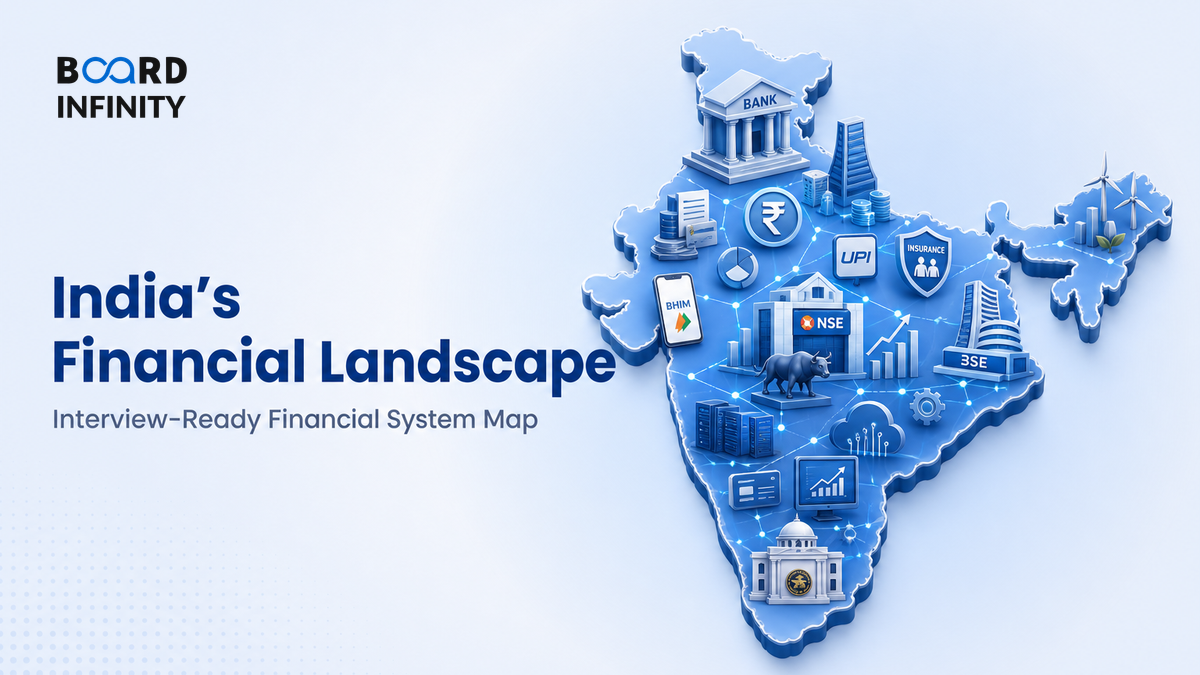
A salary credit looks like one neat bank notification. Behind it sit RBI-supervised banks, NPCI payment rails, card networks, fintech apps, settlement systems, and sometimes a mutual fund SIP or insurance auto-debit pulling the next rupee into another regulated universe.
The before-after contrast is the point: before you understand India’s financial system, you see company names; after you understand it, you see functions, regulators, risk and money flows.
- India’s financial system has five big regulated zones: banking and NBFCs, capital markets, insurance, pensions, and payments.
- The core regulators are RBI for banks, NBFCs and payments; SEBI for securities markets; IRDAI for insurance; PFRDA for pensions; and IFSCA for GIFT City financial services.
- The best way to classify any player is: Does it take deposits, lend, underwrite risk, manage investments, provide market infrastructure, or move money?
- Banks and NBFCs are balance-sheet intermediaries; they lend from their own balance sheet. Brokers, exchanges and depositories are market infrastructure or access players.
- Insurance and pensions are not just “products”; they are long-term pools of household savings that invest back into the economy.
- The safest interview answer maps each sector to role + regulator + examples + risk being managed.
- The common mistake is listing brands like SBI, Zerodha, LIC and PhonePe without explaining what each one actually does in the financial system.
Big Picture: The Financial System Is a Money-Risk-Information Network
Think of India’s financial system as a network that moves surplus money from households, companies and government bodies to users of capital, while managing credit risk, market risk, insurance risk, operational risk and trust.
The Core Map: India’s Key Financial Players by Sector
Use this table as your master map. In interviews, do not memorise every company; memorise the function-regulator-example logic.
The One Distinction That Makes the Map Click: Balance Sheet vs Market Intermediation
Many students confuse “financial company” with “bank-like company”. The sharper distinction is this: who carries the risk? A bank or NBFC usually lends from its own balance sheet. A broker, exchange, depository or mutual fund platform connects investors and issuers but does not take ordinary loan risk like a bank.
Sector-by-Sector Explanation: What Each Player Actually Does
Banks are the core credit-and-deposit institutions. They accept deposits, lend to households and businesses, provide current and savings accounts, and connect customers to the payment system. Public sector banks bring reach and government-linked trust; private sector banks often compete strongly on technology, service and cross-sell; small finance banks focus on underserved segments; payments banks widen access but have restricted lending ability.
NBFCs fill credit gaps where banks may be slower or more conservative. Their advantage often comes from specialised underwriting, distribution depth, faster turnaround and segment knowledge. A gold-loan NBFC, a vehicle financier and a consumer durable lender are all very different even if all sit under the NBFC umbrella.
Capital market players help companies and governments raise capital and help investors buy, sell, hold and value securities. NSE and BSE provide trading platforms; clearing corporations manage settlement; NSDL and CDSL hold securities in demat form; brokers provide access; mutual funds pool money; rating agencies assess credit risk; investment bankers help issuers raise funds.
Insurance companies pool risk. Life insurers protect against mortality and longevity risk; general insurers cover motor, health, fire, marine and other risks; reinsurers absorb risk from insurers. The strategic point: insurers also become large institutional investors because premiums are invested until claims are paid.
Pension players manage long-term retirement savings. NPS involves pension fund managers, central recordkeeping agencies and points of presence. EPFO serves organised-sector provident fund savings. In the economy, pensions matter because they create patient, long-duration capital.
Payment and fintech players sit on the access layer. NPCI operates key retail payment systems such as UPI and RuPay. Apps, wallets and payment aggregators create customer interfaces. Account aggregators enable consent-based financial data sharing under the RBI-regulated framework.
Definitions You Should Say Cleanly
- Banking - Banking Regulation Act, 1949: “Accepting, for the purpose of lending or investment, deposits of money from the public, repayable on demand or otherwise.”
- Financial intermediary: An institution that channels funds from savers to users of capital while transforming risk, maturity, liquidity or information.
- Capital market: A market where long-term securities are issued, traded and priced through investors, issuers and market infrastructure.
- Insurance: A risk-pooling contract where many policyholders pay premiums so covered losses of some can be compensated.
- Payment system: The rules, technology and institutions that transfer money between payers and payees safely and finally.
How to Judge Financial Players: Metrics That Interviewers Like
If the question moves from “map the players” to “compare the players”, use a few sector-appropriate metrics. Do not apply one metric to every institution; a bank, insurer, exchange and mutual fund are judged differently.
Mini Case Study: CAMS and the Invisible Rails of Indian Mutual Funds
CAMS shows that a key financial player need not be a bank or insurer; it can be the trusted operating infrastructure that makes a whole market scalable.

Situation. As Indian mutual fund participation widened beyond traditional urban investors, asset management companies needed reliable processing for folios, SIPs, redemptions, KYC-linked servicing, distributor transactions and investor records. Building this separately inside every AMC would have created duplicated cost and inconsistent customer experience.
The move. Computer Age Management Services, widely known as CAMS, became a major registrar and transfer agent for mutual funds. Its role is not to manufacture the mutual fund scheme or take market risk like an AMC. Instead, it manages the operational rails: investor records, transaction processing, service requests, distributor interfaces and digital access. It also operates in adjacent financial infrastructure areas such as account aggregation through CAMSfinserv.
Outcome and lesson. CAMS demonstrates a powerful idea: in finance, trust is not created only by the institution that sells the product. It is also created by the recordkeeper, processor, custodian, clearing system and data-consent layer. The primary driver of its relevance is shared infrastructure for a fast-growing investment market, supported by regulatory compliance, AMC relationships, digital servicing and operational reliability.
How AI Changes India’s Key Financial Players by Sector
1. AI is changing credit underwriting. Banks, NBFCs and fintech lenders increasingly use machine learning to support credit scoring, fraud detection, collections prioritisation and early warning signals. The interview caveat: regulated lenders still need explainability, fairness, auditability and compliance with RBI expectations on model risk and customer protection.
2. AI is changing market intelligence and compliance. Brokers, AMCs, rating agencies and research teams can use LLMs to summarise annual reports, earnings calls, scheme documents and regulatory filings. But final recommendations still require human judgement because hallucinated facts, missing disclosures and stale data can create serious risk.
3. AI is changing payments and customer protection. Payment companies use AI for transaction monitoring, mule-account detection, phishing pattern recognition and dispute triage. The strongest use case is not “chatbots”; it is real-time anomaly detection across massive transaction flows.
Use NotebookLM before a finance interview: upload the latest annual report of one bank, one NBFC and one insurer, plus regulator pages from RBI, SEBI, IRDAI and PFRDA. Ask: “Create a sector map, list the regulator for each entity, and generate 10 interview questions comparing their business models.”
Interview Relevance
“Give me a complete map of India’s financial system. Where would you place banks, NBFCs, mutual funds, insurance companies, payment companies and regulators?”
If you forget a company name, do not panic. Say the function first: “This player is a market infrastructure institution” or “This player is a balance-sheet lender.” Function-led answers sound more mature than name-led answers.
Common Mistake
The mistake: giving a laundry list of brands without explaining their role. Saying “SBI, LIC, Zerodha, PhonePe, NSE” is not a map; it is a memory dump. The fix: for every player, add four words in your head - function, regulator, risk, example.
What to Revise Next
Now that you can map India’s financial players, move one layer deeper into two areas that interviewers often test through practical questions: protection products and taxation.