
Inflation Interview Guide: CPI, WPI and India’s Inflation Target
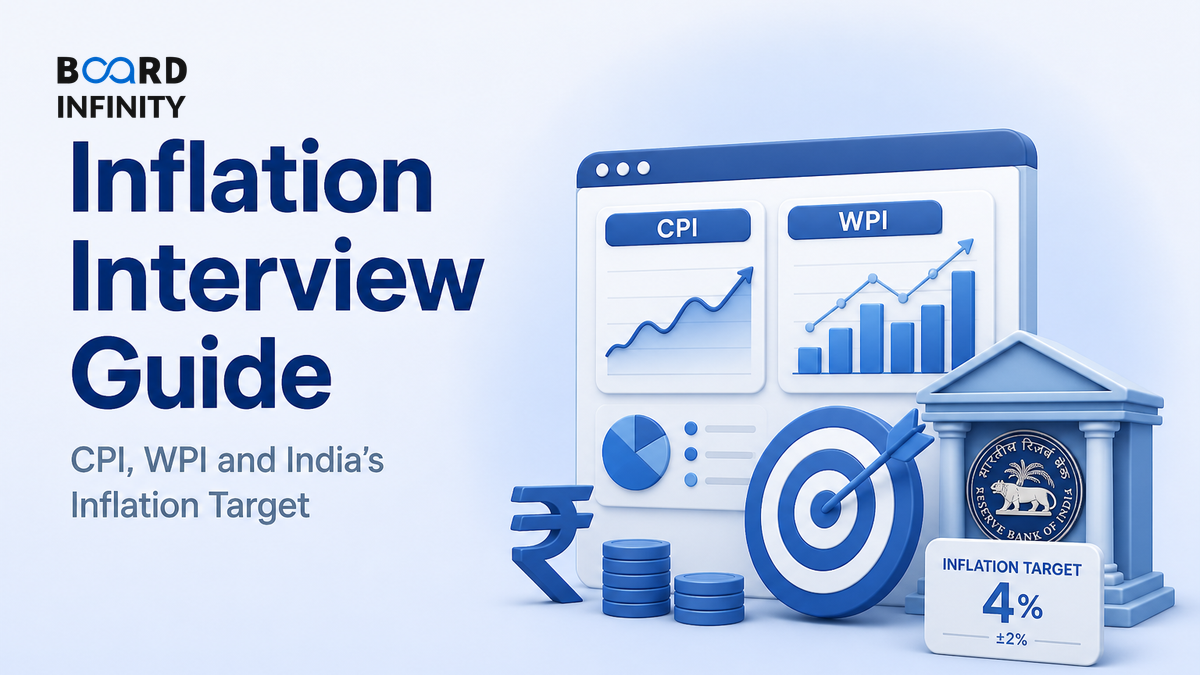
If your grocery bill jumps, petrol softens, rent rises and your phone becomes cheaper, is inflation high or low? That one question is why inflation is not “prices going up” - it is a measured story about whose basket, which prices, and what the central bank is trying to control.
- Inflation is the rate at which the general price level rises over time, reducing purchasing power.
- CPI tracks prices paid by consumers; in India, it is the key inflation measure for RBI policy.
- WPI tracks wholesale-level goods prices; it is useful for input-cost trends but excludes services.
- India’s inflation target centers on CPI inflation at 4%, with a tolerance band of 2%-6% under flexible inflation targeting.
- Headline inflation includes food and fuel; core inflation usually excludes volatile food and fuel to show underlying pressure.
- RBI reacts more to persistent CPI and expectations than to one-off WPI shocks.
- Interview trap: never say “WPI is falling, so inflation is not a problem” without checking CPI, core inflation and expectations.
Big Picture: Inflation Is a Transmission Story
Think of inflation as a chain. A shock begins somewhere - food, fuel, wages, demand, currency depreciation or supply bottlenecks. It then appears in price indices, changes expectations, influences RBI policy, and finally hits household budgets, company margins and market valuations.
Core Explanation: CPI, WPI and the Inflation Target
The big idea is simple: CPI tells you what consumers feel, WPI tells you what producers face, and the inflation target tells you what the central bank is accountable for. A strong answer connects all three instead of treating them as interchangeable numbers.
CPI: The Consumer’s Inflation Meter
Consumer Price Index measures the change in prices of a representative basket purchased by households. It includes categories such as food, fuel, housing, clothing, transport, education, health and other services.
For India, CPI is crucial because household welfare and RBI monetary policy are tied more directly to consumer prices than to wholesale prices. Food has a large role in India’s inflation experience, so a vegetable, cereal or edible-oil shock can move public perception quickly.
WPI: The Producer-Side Cost Signal
Wholesale Price Index measures price changes at the wholesale level for goods. It is useful for reading input costs in manufacturing, commodities, energy and intermediate goods.
But WPI is not a complete cost-of-living measure. It excludes services, which are a major part of household consumption and modern GDP. That is why WPI can be low or even negative while consumers still feel inflation in food, rent, healthcare, education or transport services.
The Inflation Target: Why RBI Watches CPI
India follows a flexible inflation-targeting framework. The standard interview benchmark is 4% CPI inflation with a tolerance band of 2%-6%. The word “flexible” matters: RBI is not supposed to crush growth for every temporary food-price spike, but it must prevent persistent inflation and expectations from becoming unanchored.
The Monetary Policy Committee uses tools such as the repo rate, liquidity management and policy communication. Higher rates work by cooling credit demand, reducing excess spending, supporting the currency at times, and signaling seriousness about inflation. The effect is not instant - monetary policy works with lags.
Headline, Core and Expectations
Headline inflation is the inflation number including all basket items. It is what households feel most directly.
Core inflation usually excludes volatile food and fuel. It helps analysts judge whether inflation is broad-based and persistent. If food inflation is high but core inflation is stable, the policy response may be more cautious. If core inflation and expectations rise together, RBI has a stronger reason to tighten or stay restrictive.
Diagnosing Inflation: The 2x2 Matrix
Inflation is dangerous not merely when it is high, but when it is persistent and broad-based. Use this matrix to move beyond textbook labels like “demand-pull” and “cost-push.”
Key Measures and How to Read Them
Use these measures when you discuss inflation in interviews, market commentary or a company analysis. The formula matters because many candidates talk vaguely about “prices increasing” without showing how inflation is actually measured.
Worked Example: CPI Up, WPI Down
Suppose the CPI index rises from 180 to 189 over one year. CPI inflation is:
((189 / 180) - 1) x 100 = 5%
Now suppose the WPI index falls from 155 to 152 over the same year. WPI inflation is:
((152 / 155) - 1) x 100 = -1.94%
The correct interpretation is not “inflation is negative.” It is: consumer inflation is 5%, while wholesale goods prices are falling. RBI will care more about CPI, core inflation and expectations, while companies will examine whether lower input costs can protect margins.
Definitions You Can Say in One Breath
- Inflation: the sustained rise in the general price level, reducing the purchasing power of money.
- CPI: an index measuring price changes in a representative basket bought by consumers.
- WPI: an index measuring price changes of goods at the wholesale transaction level.
- Headline inflation: total basket inflation including volatile food and fuel items.
- Core inflation: inflation excluding volatile items, commonly food and fuel, to reveal underlying price pressure.
- Flexible inflation targeting: a policy framework targeting inflation while considering output, growth and financial stability.
Case Study: Britannia and Food Inflation in India
Britannia shows how an FMCG company manages consumer-price inflation when wheat, dairy, edible oils, packaging and household affordability all move together.

Situation: During the recent food and commodity inflation cycle, Indian packaged-food companies faced pressure from wheat, milk, edible oils, fuel-linked logistics and packaging costs. For Britannia, the challenge was sharper because biscuits and bakery products are high-frequency, price-sensitive purchases, especially at popular small pack sizes.
The move: Britannia did not rely on one lever. The primary driver was calibrated pricing architecture - balancing price increases, grammage adjustments and pack-size discipline so that key consumer price points remained accessible. Supporting drivers included premiumization in higher-margin products, distribution strength, cost-control programs, procurement discipline and portfolio mix management.
Outcome and lesson: The lesson is not “raise prices when inflation rises.” The real lesson is that in mass FMCG, inflation strategy is a trade-off between margin protection, volume retention and consumer affordability. A company that passes through costs too aggressively can lose volume; a company that absorbs everything can damage margins.
So what: Inflation is not just a macro statistic. For a consumer company, CPI affects demand, WPI-linked inputs affect margins, and pricing power determines whether the company can defend both.
How AI Changes Inflation
AI is changing inflation analysis in 2026 in three concrete ways:
- High-frequency price nowcasting: Analysts can use scraped online prices, mobility data and commodity feeds to estimate inflation pressure before official CPI releases. This is especially useful for food, fuel and fast-moving retail categories.
- Input-cost intelligence from text: LLMs can scan earnings calls, management commentary and annual reports to detect phrases such as “raw material pressure,” “price hikes,” “grammage reduction” or “margin recovery.” This connects WPI-style cost movements to company strategy.
- Central-bank communication analysis: AI tools can compare RBI policy statements over time and highlight changes in tone around growth, inflation, liquidity and expectations. The caveat: AI can summarize stance, but you must verify the actual policy rate, CPI data and official wording from primary sources.
Use NotebookLM or Perplexity like this: upload the latest RBI MPC statement, a recent CPI release and one FMCG annual report; ask, “Separate CPI demand impact, WPI input-cost impact and management pricing response, then generate five interview questions.” Verify every number from the official document before using it.
Interview Relevance
Question: “If India’s WPI inflation is low but CPI inflation is near the upper end of the target band, how should RBI and an FMCG company interpret it?”
In a finance or consulting interview, add one market link: higher expected CPI can push bond yields up, affect equity valuations through discount rates, and pressure rate-sensitive sectors such as banks, autos, real estate and NBFCs.
Common Mistake
The mistake: Treating WPI as India’s inflation target and concluding that low WPI means inflation is solved. Why it costs you: it shows you do not understand the policy anchor, services inflation or household purchasing power. One-line fix: always answer in this order - CPI for policy, WPI for input costs, core inflation for persistence, expectations for RBI reaction.
What to Revise Next
Next, connect inflation to the broader macro map. Revise Growth, Output & the Macro Indicators That Move Markets to understand how inflation interacts with GDP, employment and demand. Then move to The External Sector: Current Account, Reserves & the Rupee, because oil prices, imported inflation and currency movements often decide how inflation behaves in India.