
India's Financial Regulators: Know Who Governs What Before Your Interview
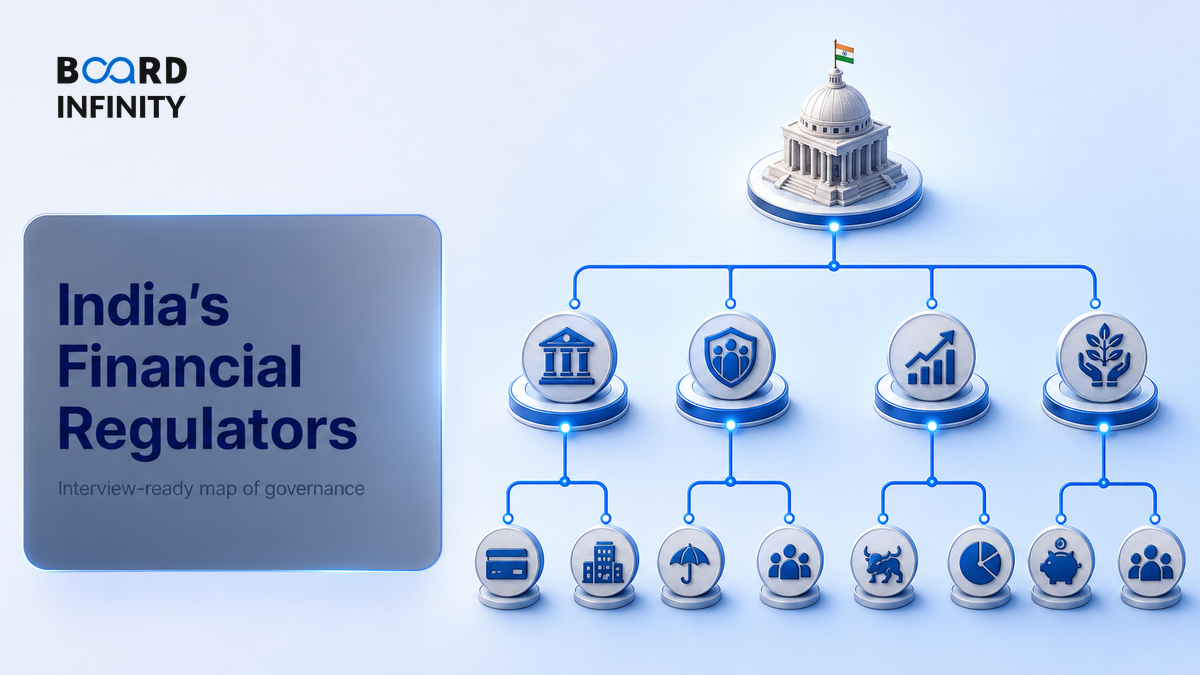
A UPI app, a stock trading app and an insurance marketplace may all sit on the same phone screen, but they do not report to the same regulator. The biggest misconception is simple: India does not have one giant “finance regulator” watching everything that involves money.
- Start with the product, not the company: banking or payments means RBI; securities means SEBI; insurance means IRDAI; pensions means PFRDA.
- RBI governs monetary policy, banks, NBFCs, payment systems, forex management and systemic financial stability.
- SEBI governs securities markets - listed companies, stock exchanges, brokers, mutual funds, investment advisers and market conduct.
- IRDAI governs insurers and insurance intermediaries; PFRDA governs NPS and pension intermediaries.
- IFSCA governs financial services inside India’s International Financial Services Centres, especially GIFT City.
- NPCI, AMFI and stock exchanges are not the same as statutory regulators: they operate infrastructure or industry functions under regulatory oversight.
- Interview shortcut: ask “What risk is being created - credit, market, insurance, pension, payment, insolvency or disclosure?” The risk usually reveals the regulator.
Big Picture: India Regulates by Activity, Not by App Logo
The cleanest way to remember India’s financial regulatory system is this: a company may be one brand, but regulation follows the activity it performs. The same fintech can touch RBI for payments, SEBI for investments and IRDAI for insurance distribution.
Core Explanation: What Each Regulator Actually Governs
India’s financial system is regulated through a mix of statutory regulators, government ministries, market infrastructure institutions and self-regulatory or industry bodies. For interviews, do not memorise only full forms. Memorise the regulatory perimeter - the boundary of what each authority can supervise.
The One-Line Logic for Each Major Regulator
RBI - Reserve Bank of India: If the activity involves accepting deposits, lending, operating payment systems, issuing payment instruments, managing forex or protecting monetary stability, think RBI.
SEBI - Securities and Exchange Board of India: If the activity involves securities issuance, trading, investment products, market intermediaries, insider trading, mutual funds or listed-company disclosures, think SEBI.
IRDAI - Insurance Regulatory and Development Authority of India: If the activity involves selling, underwriting or servicing insurance products, think IRDAI.
PFRDA - Pension Fund Regulatory and Development Authority: If the activity involves NPS architecture, pension fund managers or pension intermediaries, think PFRDA.
IFSCA - International Financial Services Centres Authority: If the activity is taking place inside an Indian IFSC such as GIFT City, IFSCA acts as the unified regulator for those IFSC financial services.
MCA, NFRA and IBBI: These are not “market regulators” in the same way RBI or SEBI are, but they matter in finance interviews because company law, audit quality and insolvency resolution shape financial trust.
NPCI is not RBI. NPCI operates retail payment infrastructure such as UPI under the payment system framework. RBI is the regulator and overseer.
The Regulatory Cycle: How Rules Become Market Trust
A regulator does more than issue circulars. It licenses players, writes rules, supervises behaviour, enforces penalties and uses the resulting trust to deepen the market. This loop is why regulation is both a compliance topic and a growth topic.
Product-to-Regulator Decision Tree
When you are unsure, do not guess from the brand name. Ask what the product does to the customer’s money. That gives you a reliable interview answer.
Common Confusions You Must Avoid
Definitions You Can Say in One Breath
- Financial regulator: A statutory authority that licenses, supervises and enforces rules for financial institutions, markets or products.
- Regulatory perimeter: The boundary of activities, entities and risks that a regulator is legally empowered to oversee.
- Prudential regulation: Rules that protect institutional safety, solvency, capital adequacy and systemic stability.
- Conduct regulation: Rules that protect customers and investors from unfair selling, fraud, mispricing and disclosure failures.
- Systemic risk: The risk that failure in one institution or market can destabilise the wider financial system.
Key Regulatory Health Measures to Mention
If an interviewer asks how regulators know a system is healthy, name concrete measures. Use the metric that matches the regulator’s mandate.
Case Study: PhonePe and the Myth of One Fintech Regulator
PhonePe shows why a modern fintech is governed product by product: payments, insurance distribution and investing can sit inside one consumer brand but fall under different regulatory regimes.

Situation: PhonePe became widely associated with UPI payments in India. A casual answer would say, “PhonePe is regulated by RBI.” That is only partly right.
The move: As PhonePe expanded from payments into adjacent financial services such as insurance distribution and investing through separate regulated structures, the relevant regulator changed with the product. UPI payments operate within the RBI-overseen payments ecosystem, with NPCI running UPI infrastructure. Insurance distribution brings IRDAI rules into the picture. Securities or wealth products bring SEBI-regulated entities, disclosures and conduct rules into focus.
Outcome and lesson: The strategic point is not that one regulator “owns” PhonePe. The primary driver is product expansion across financial categories; supporting drivers include partnership-led distribution, regulated entity structures, consumer protection requirements and data-security obligations. The case proves the most useful rule for interviews: follow the financial activity, then identify the regulator.
How AI Changes India's Financial Regulators
1. Supervisory technology is becoming more data-driven. Regulators increasingly use data submissions, anomaly detection and analytics to spot unusual trades, suspicious transactions, cyber incidents or weak compliance patterns. For example, AI can help flag market-abuse patterns for securities supervision or unusual transaction flows for payment and banking oversight.
2. RegTech is changing compliance inside firms. Banks, brokers, insurers and fintechs now use AI-assisted tools for KYC checks, transaction monitoring, surveillance alerts, customer communication review and regulatory reporting. The benefit is faster detection; the risk is false positives, opaque models and biased customer treatment.
3. The regulatory perimeter is getting harder to draw. AI credit scoring, robo-advisory, algorithmic trading, personalised insurance pricing and generative-AI customer support can create cross-regulator questions. A chatbot recommending a stock is not the same risk as a chatbot explaining account balance.
Use Perplexity or NotebookLM before an interview: load the company annual report, product pages and recent regulatory news, then ask, “List every financial activity this company performs and map each to RBI, SEBI, IRDAI, PFRDA, IFSCA, MCA or IBBI with reasons.”
Interview Relevance
“Suppose a fintech app offers UPI payments, personal loans through partner NBFCs, mutual funds and insurance. Which Indian regulators are relevant, and why?”
Use this sentence to sound structured: “I would classify the product by the risk it creates - credit, payment, market, insurance, pension or disclosure risk - and then identify the regulator.”
Common Mistake
The mistake: saying “RBI regulates everything related to finance.” It costs candidates because it shows they cannot distinguish credit risk from securities-market conduct or insurance solvency. One-line fix: classify the financial activity first, then name the regulator and the risk it controls.
What to Revise Next
Next, revise Monetary Policy: The Committee, the Policy Rate, Liquidity & Transmission to understand RBI’s macro role, then Fiscal Policy & Reading the Union Budget Like an Analyst to connect regulation with government finance and policy priorities.