
In-House vs Agency vs Hybrid Marketing Teams
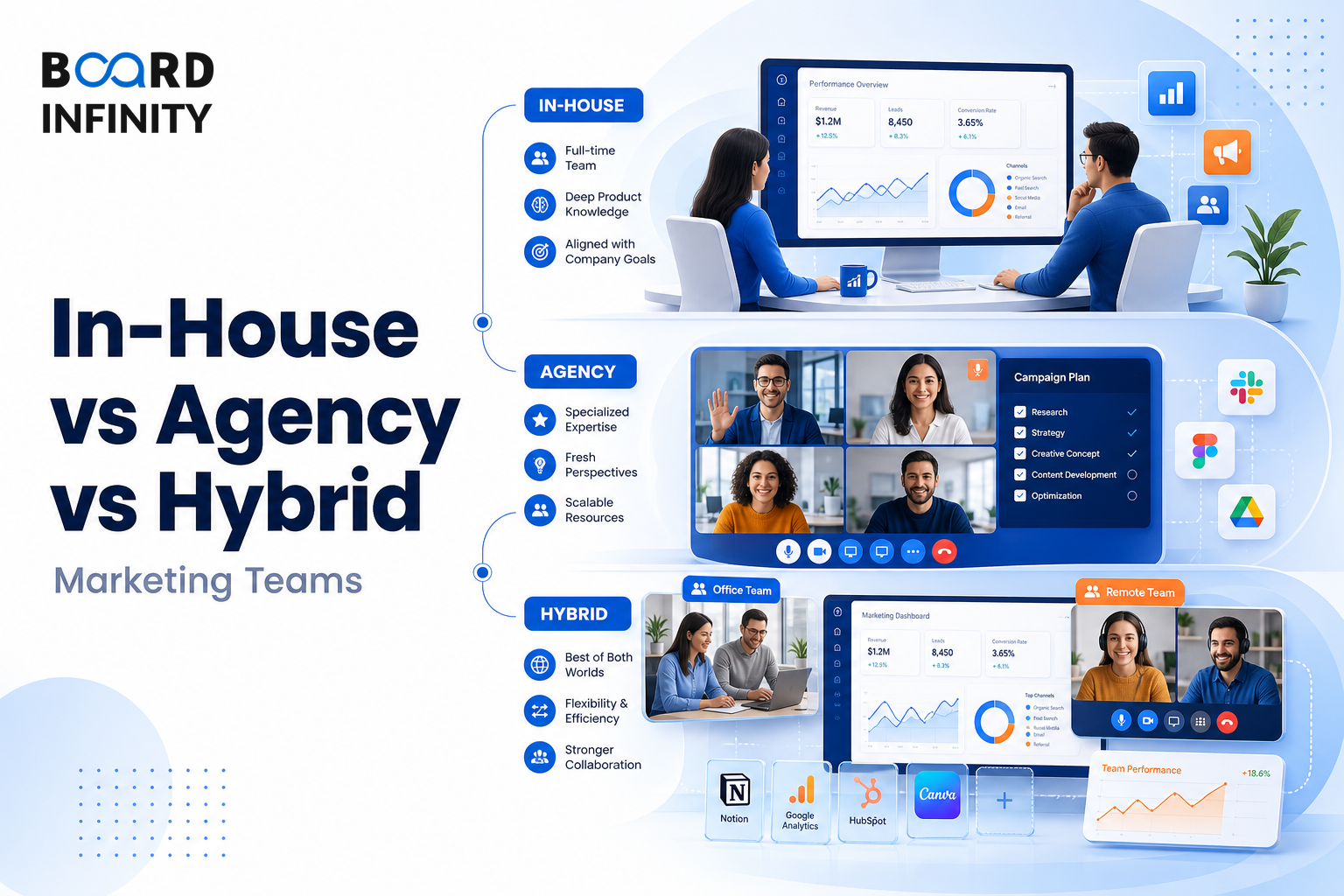
After Short-Term Sales vs Long-Term Brand Equity, another common interview question is: Should a brand build in-house marketing capabilities or use agencies? This matters because the answer is not simply in-house or agency - it is a trade-off across speed, cost, expertise and control, with hybrid teams often becoming the pragmatic default.
- In-house teams offer faster iteration and real-time execution.
- Agencies involve briefing and review cycles, which can make execution slower.
- In-house teams have higher fixed cost and lower variable cost.
- Agencies have variable cost, with higher cost for premium agencies.
- In-house teams bring deep brand knowledge but narrower skills.
- Agencies bring broad expertise and cross-industry learning.
- Hybrid is recommended because it keeps the core team in-house and uses specialists via agency.
The Core Decision
Marketing decisions are rarely "do X or Y" - they are "given these constraints, what is the best allocation of limited resources?" For in-house vs agency decisions, the useful comparison is across speed, cost, expertise, control and best fit.
Should a brand build in-house marketing capabilities or use agencies? Compare speed, cost, expertise and control before recommending in-house, agency or hybrid.
In-House Marketing Teams
An in-house team is strongest when the brand needs faster iteration and real-time execution. It also gives full creative + data control, which matters when the brand wants to retain close ownership of creative and data decisions.
The trade-off is cost and skill range. In-house has higher fixed cost and lower variable cost, and it offers deep brand knowledge but narrow skills. It is best for tech companies and D2C brands with strong culture.
Agency Marketing Teams
An agency model works differently. It brings broad expertise and cross-industry learning, but it usually involves briefing + review cycles, making it slower than a fully in-house team.
The cost structure is variable, with higher cost for premium agencies. The control trade-off is also important: agencies can create data sharing concerns and may give the brand less control. This model is best for traditional FMCG and brands needing multi-market expertise.
Hybrid Marketing Teams
Hybrid is the recommended option in this comparison. The core team stays in-house, while specialists are brought in via agency.
This model is optimised for both fixed and variable cost. It also keeps brand owners in-house and specialists outside, while strategic control is retained in-house. It is best for most mid-to-large companies and is the pragmatic default.
Structuring a In Interview Answer
"Should a brand build in-house marketing capabilities or use agencies?"
Do not treat the answer as simply "do X or Y". Strong answers state the trade-off and then recommend the model that best fits the brand's constraints.
The common mistake is recommending in-house or agency in absolute terms without comparing speed, cost, expertise and control. That costs points because the interviewer is testing trade-off thinking, not preference for one operating model.
Conclusion
The in-house vs agency decision is best answered as a structured trade-off. In-house gives speed and control, agencies bring broader expertise, and hybrid keeps strategic control in-house while using outside specialists where needed.