
Short-Term Sales vs Long-Term Brand Equity
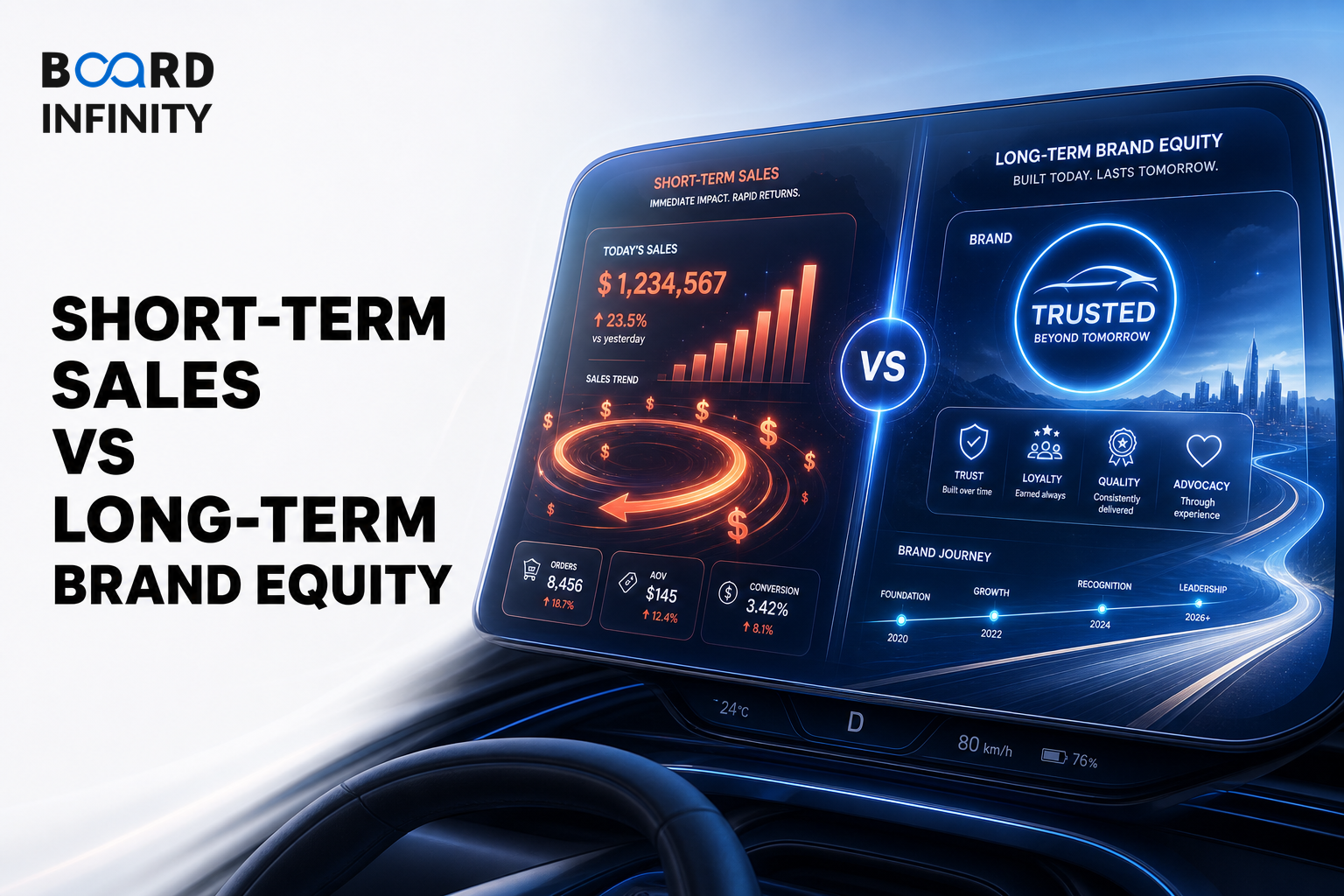
After learning how to allocate marketing budget across channels, the next interview question is how far a brand should push discounts for sales today. Discounting drives volume but destroys brand equity over time. This trade-off matters because interviewers want to see whether you can balance immediate revenue with long-term trust, pricing power, and premium perception.
- Discounting drives volume but destroys brand equity over time.
- Marketing decisions are rarely 'do X or Y' - they're 'given these constraints, what's the best allocation of limited resources?'
- Festive season sale: Tiered: loyal customers get early access + 20%; mass gets 10%.
- Competitor price war: Hold price + bundle value (free shipping, loyalty points).
- New market entry: Introductory offer (time-limited) then raise to target price.
- Clearing old inventory: Private sale to loyalty members; avoid public deep discounts.
- Discounting builds transactions, not brand equity or loyalty.
Big Picture: Revenue Today vs Equity Tomorrow
Performance marketing delivers measurable, short-term results (clicks, conversions). Brand building creates long-term demand, pricing power, and loyalty - but is harder to measure. Every marketing leader faces this trade-off.
Performance = measurable, short-term, diminishing returns. Brand = hard to measure, long-term, compound returns.
Brand equity is the financial and psychological premium consumers place on a brand over an unbranded equivalent.
How to Think About the Trade-Off
The core tension is simple: the short-term play can create a volume spike, but the long-term play protects value communication, quality perception, and brand image. The best approach typically uses constraints rather than blanket discounting - limited access, bundling, time limits, or private sales.
In a festive season sale, deep discounts of 40-50% off can drive a volume spike, but a limited-edition product with a modest discount of 10-15% protects the brand better. The best approach is tiered: loyal customers get early access + 20%; mass gets 10%.
In a competitor price war, the short-term play is to match competitor pricing immediately. The long-term play is to hold price and invest in value communication. The best approach is to hold price + bundle value through free shipping and loyalty points.
In a new market entry, penetration pricing can grab share fast, while premium pricing can establish quality perception. The best approach is an introductory offer that is time-limited, then raise to target price.
In clearing old inventory, a flash sale on your own site may solve the immediate inventory issue, but donating or destroying can preserve brand image. The best approach is a private sale to loyalty members; avoid public deep discounts.
Pricing Discipline and Consumer Conditioning
Pricing strategy must align with consumer psychology and established brand identity. India equivalent: Snapdeal and Shopclues over-indexed on discounting, training buyers to wait for sales and stripping year-round brand value.
Flipkart managed this by making Big Billion Day a defined annual event - maintaining pricing discipline 355 days/year while creating a clear discount moment.
Why can't brands simply stop discount pricing once they've started? Because you are fighting anchoring bias, loss aversion, and years of consumer conditioning - not just changing a price point.
Case Study: Snapdeal - Brand Dilution Through Discount Dependency
Snapdeal was India's #2 e-commerce platform in 2014-15, backed by SoftBank, valued at $6.5B. It competed with Flipkart and Amazon through deep discounts and rapid seller onboarding. By 2017, it was near collapse - a Flipkart acquisition attempt failed. By 2018, valuation had fallen to < $1B. It survived as a niche value-commerce platform serving budget shoppers.
Deep discounting attracted price-sensitive buyers with zero brand loyalty. Any ₹10 difference drove them to a competitor.
Snapdeal could not articulate what made it different from Flipkart or Amazon other than discounts - no category ownership, no positioning clarity. Rapid, low-bar onboarding led to counterfeit product complaints, destroying consumer trust just as categories were commoditising.
Discounting builds transactions, not brand equity or loyalty. Long-term competitive advantage comes from differentiated positioning: Amazon India owns 'widest selection + reliable delivery'; Nykaa owns 'beauty expertise + trust'; Zepto owns 'speed'. Snapdeal never owned a single dimension in the consumer's mind.
Structuring a Short Interview Answer
"When does discounting destroy long-term value?"
Do not say the answer is always to match discounts or always to avoid them. Diagnose: pricing war vs tactical promo? Decide based on margin and lifetime value impact.
The most frequent error is treating discounting as a harmless sales lever. It can train buyers to wait for sales, strip year-round brand value, and attract price-sensitive buyers with zero brand loyalty.
Conclusion
Short-term sales can create quick volume, but long-term brand equity depends on pricing discipline, differentiated positioning, and trust. The best answer is not discount or do not discount - it is choosing the right discount structure for the scenario while protecting the brand's future pricing power.