
Performance Marketing vs Brand Building: The 60/40 Budget Trade-off
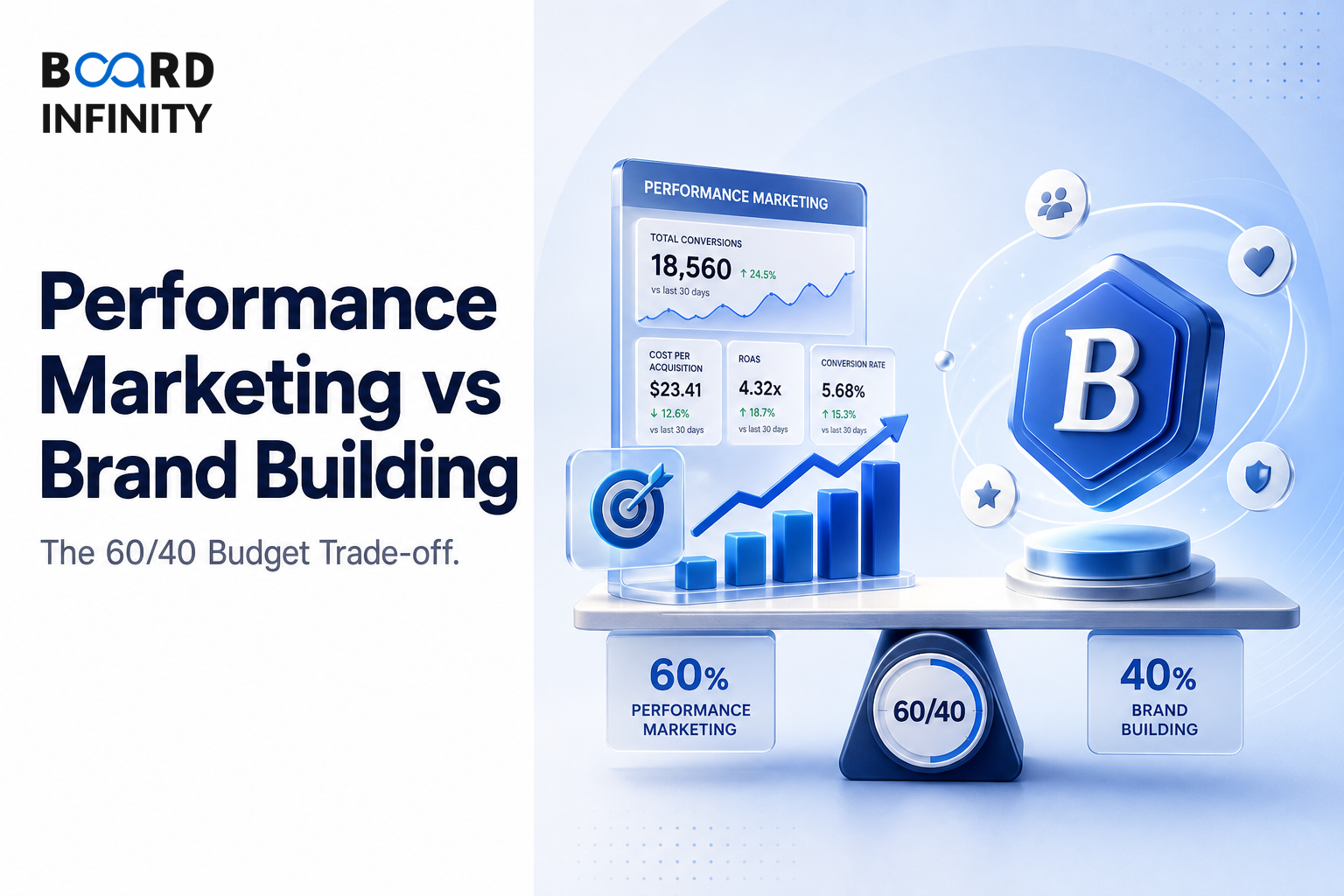
Marketing decisions are rarely 'do X or Y' - they're 'given these constraints, what's the best allocation of limited resources?' Performance marketing vs brand building is one of the clearest examples of that trade-off because it asks whether a brand should chase measurable short-term growth or invest in long-term demand creation. In interviews, this matters because every marketing leader faces this trade-off.
- Performance marketing delivers measurable, short-term results such as clicks, conversions, and ROAS - Return on Ad Spend.
- Brand building creates long-term demand, pricing power, and loyalty - but is harder to measure.
- The key tension is that performance marketing is highly measurable, while brand building is harder to measure directly through brand recall, NPS - Net Promoter Score, and salience.
- Performance marketing hits ceiling quickly - CPA rises as you scale. Brand building compounds over time - brand = moat.
- The 60/40 Rule recommends allocating roughly 60% of budget to brand building and 40% to performance/activation for optimal long-term growth.
- For new/unknown brands, temporarily shift to 70% performance / 30% brand - you need to build the base first.
- Meesho spending ₹200 Cr+ on Meta ads for app installs shows the performance side, while Amul's topical ads - zero media spend, massive brand equity - show the brand-building side.
Performance Marketing vs Brand Building: The Core Trade-off
Performance marketing delivers measurable, short-term results such as clicks, conversions, and ROAS. Brand building creates long-term demand, pricing power, and loyalty - but is harder to measure.
The big picture is a budgeting decision: performance marketing is immediate and measurable, while brand building is slower, harder to justify in board meetings, and potentially compounding over time.
The Binet & Field Framework
Research by Les Binet and Peter Field - the most cited work in marketing effectiveness - recommends using the 60/40 Rule as the decision anchor for long-term growth.
Allocate roughly 60% of budget to brand building and 40% to performance/activation for optimal long-term growth. For B2B, the ratio shifts to approximately 50/50. For new/unknown brands, temporarily shift to 70% performance / 30% brand - you need to build the base first.
When to Deviate from 60/40
The 60/40 Rule is the anchor, not a fixed answer for every business. The right split depends on stage, category position, product type, and funding context.
India Examples: Meesho and Amul
Meesho spending ₹200 Cr+ on Meta ads for app installs illustrates performance marketing: measurable, short-term, and suited to performance-driven goals and lower funnel growth. Amul's topical ads - zero media spend, massive brand equity - illustrate brand building: harder to measure directly, but capable of building long-term demand, pricing power, and loyalty.
The contrast is useful in interviews because it shows why a single answer like "spend more on ads" or "build the brand first" is incomplete. The stronger answer is to frame the budget split around time horizon, measurability, diminishing returns, risk, and business stage.
Structuring a Performance Marketing vs Brand Building Interview Answer
"How would you allocate a marketing budget between performance marketing and brand building for a D2C startup versus a category leader?"
The best answers do not treat 60/40 as a rule to apply blindly. They use it as the anchor, then deviate based on startup phase, category leadership, commodity product dynamics, or venture-funded D2C stage.
The most frequent error is framing this as performance marketing versus brand building, instead of asking what the best allocation of limited resources should be. That costs points because every marketing leader faces this trade-off, and the answer must balance short-term measurable results with long-term demand, pricing power, and loyalty.
Conclusion
Performance marketing gives immediate, measurable growth, while brand building creates long-term demand, pricing power, and loyalty. Use the 60/40 Rule as the decision anchor, then adjust the split based on stage, category position, product type, and funding context.