
India-Specific Marketing Trade-offs: Urban Metros vs Bharat
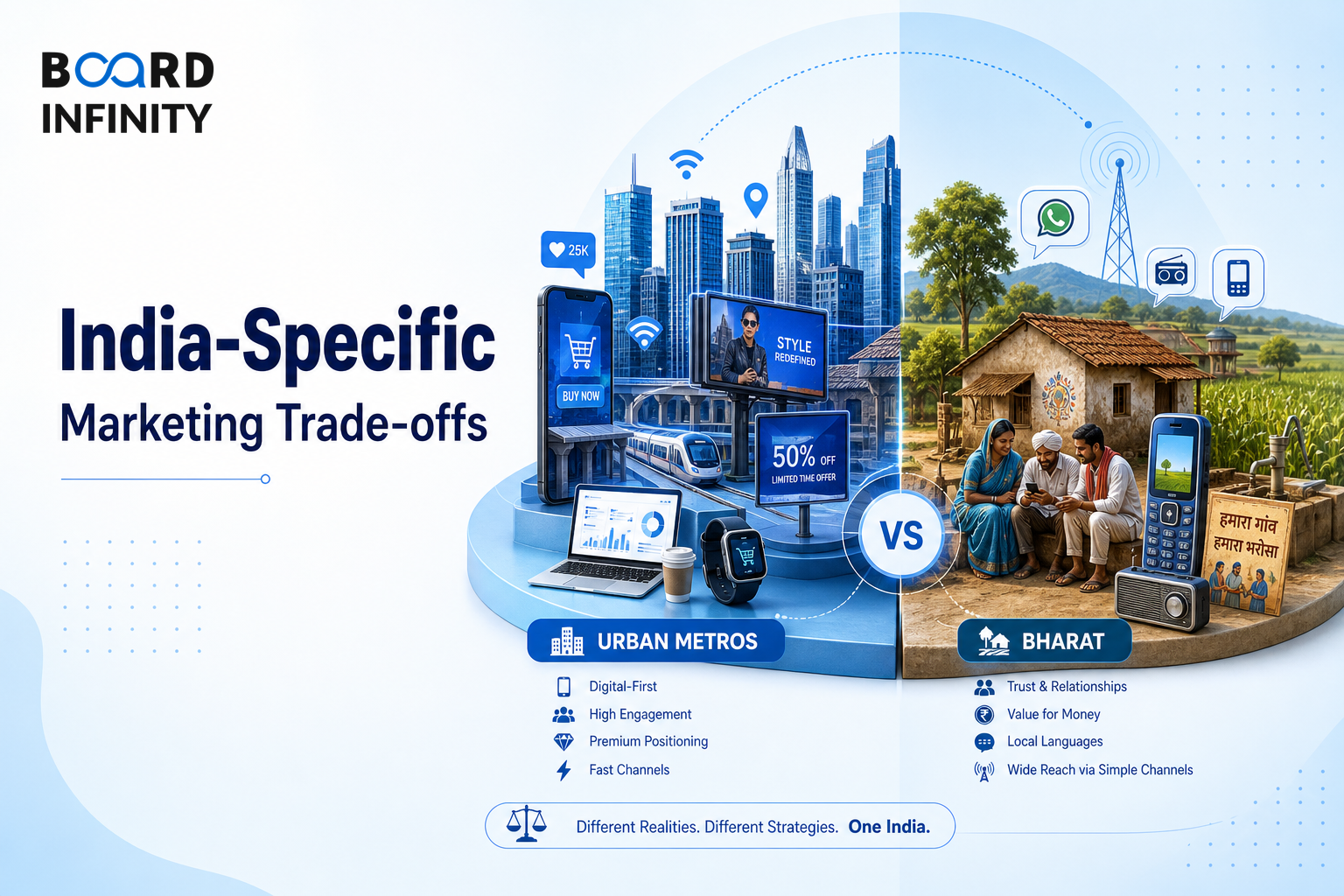
After deciding whether marketing should sit in-house, with an agency, or in a hybrid team, the next interview question is where the strategy will actually play out. In India, that often means clarifying whether the plan is for urban metros or Bharat. This matters in interviews because channel mix, language, pricing, trust, and distribution choices change dramatically by market.
- The India market is not one market - it is at least two: Urban Metros (Top 8) and Bharat (Tier 2-3+).
- Urban Metros show 85%+ smartphone penetration and 60% English-comfortable audiences, while Bharat shows 65% smartphone penetration and 90%+ vernacular preference.
- Discovery channels differ sharply: Instagram, YouTube, Google Search in Urban Metros versus WhatsApp forwards, YouTube Shorts, TV, and local influencers in Bharat.
- Purchase behavior changes from online-first, D2C comfortable, UPI native in metros to kirana-first, COD preference, and trust-building needed in Bharat.
- Price sensitivity differs: metros are premium-willing for differentiated products, while Bharat is value-oriented and ₹10-50 price points are critical.
- Interview Wisdom: When asked "how would you market X", always clarify: "For metros or Bharat?"
Urban Metros vs. Bharat: The Big Picture
The core trade-off is between Urban Metros (Top 8) and Bharat (Tier 2-3+). A strategy that works in Bangalore may completely fail in Lucknow because digital penetration, discovery channels, purchase behavior, price sensitivity, media costs, and strategy implication are different.
The India market is not one market - it is at least two. When asked "how would you market X", always clarify: "For metros or Bharat?"
How the Trade-off Changes the Marketing Decision
In Urban Metros, the audience is 85%+ smartphone and 60% English-comfortable. In Bharat, the audience is 65% smartphone and 90%+ vernacular preference. This makes language and format a core marketing decision rather than a cosmetic adaptation.
Discovery also shifts. Urban Metros rely on Instagram, YouTube, and Google Search. Bharat discovery happens through WhatsApp forwards, YouTube Shorts, TV, and local influencers.
Purchase behavior is another major split. Urban Metros are online-first, direct-to-consumer (D2C) comfortable, and Unified Payments Interface (UPI) native. Bharat is kirana-first, shows cash on delivery (COD) preference, and needs trust-building.
Pricing and media economics create further trade-offs. Urban Metros are premium-willing for differentiated products, with high cost per mille (CPM) of ₹150-300 on Meta. Bharat is value-oriented, where ₹10-50 price points are critical, and media costs are lower at ₹50-100 CPM but lower conversion rates.
Strategy Implication
For Urban Metros, the strategy implication is digital-led: performance + brand mix. For Bharat, the strategy implication is TV + hyperlocal digital, where distribution = marketing.
This is why the same marketing plan should not be applied mechanically across markets. The market choice changes the role of media, trust, price points, and the channel through which the product becomes believable and accessible.
Bangalore vs. Lucknow Application
A useful interview application is the Bangalore versus Lucknow contrast. A strategy that works in Bangalore may completely fail in Lucknow because the underlying market assumptions are different.
The situation is simple: the interviewer asks how you would market X. The problem is that "India" is too broad as a market definition. The framework is to clarify Urban Metros versus Bharat, then adjust discovery channels, purchase behavior, price sensitivity, media costs, and strategy implication accordingly. The outcome is that showing awareness of this split instantly signals depth.
Structuring a India Interview Answer
"How would you market X?"
The fastest way to show depth is to ask whether the market is Urban Metros or Bharat before choosing channels, pricing, and distribution.
The most frequent error is treating India as one market. A strategy that works in Bangalore may completely fail in Lucknow, so skipping the Urban Metros versus Bharat clarification can make the answer look generic and shallow.
Conclusion
India-specific marketing trade-offs start with one core question: Urban Metros or Bharat? Once that is clear, the right channel mix, language, pricing, trust-building, media spend, and distribution choices become far sharper.