
The Kraljic Matrix: Supply Positioning Explained
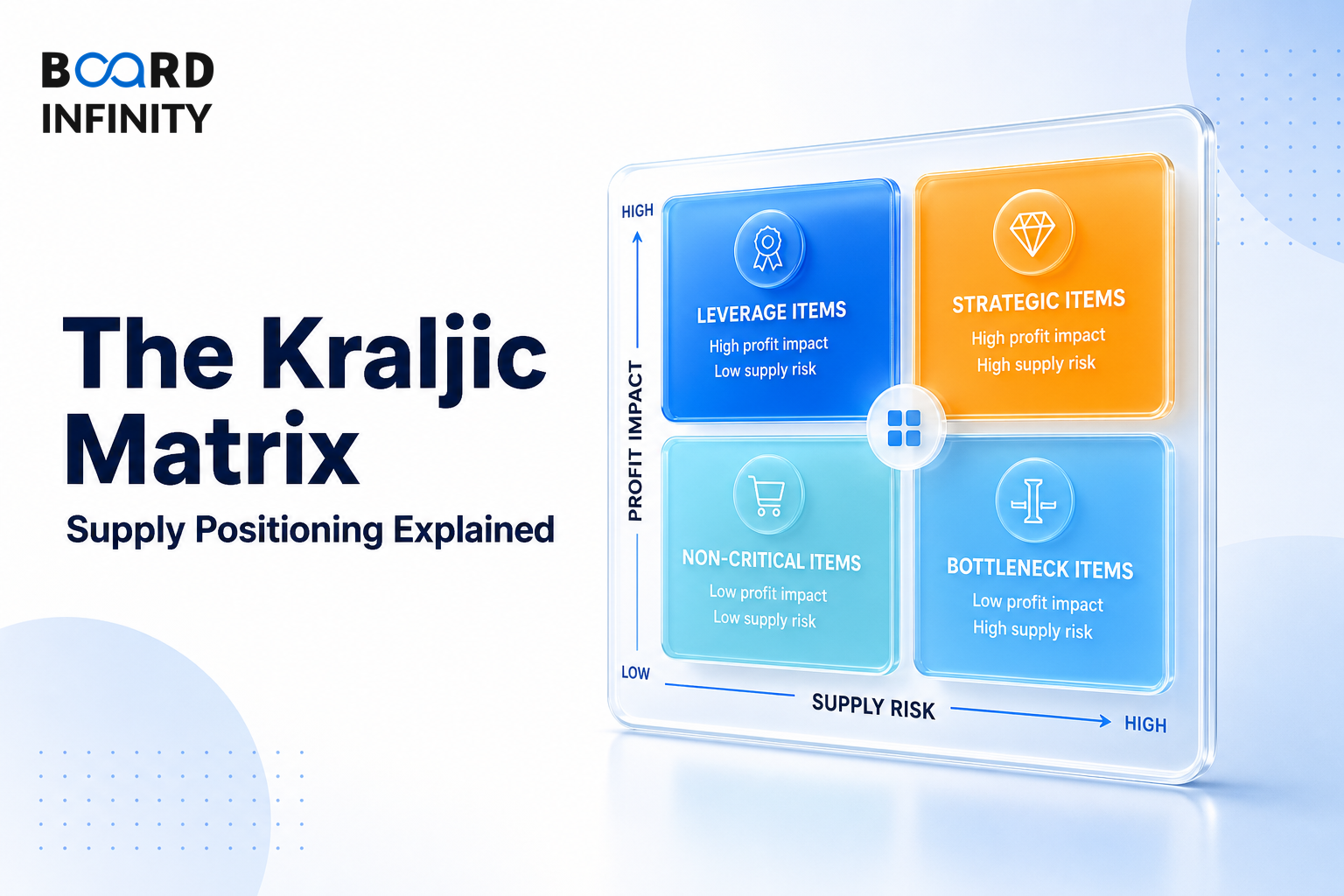
After understanding the Strategic Procurement Process, the next interview question is how to position what an organisation buys. The Kraljic Matrix answers this by matching sourcing strategy to two variables: supply risk and profit impact. In interviews, it matters because each quadrant needs a different sourcing strategy, and examples make the answer practical.
- The Kraljic Matrix (1983) segments purchased items into four categories based on supply risk and profit impact, guiding differentiated sourcing strategies.
- Kraljic classifies purchases on 2 axes: Supply Risk (x) and Profit Impact (y).
- Strategic items are high profit impact and high supply risk, with partnership, JV, long-term contracts.
- Leverage items are high profit impact and low supply risk, with maximise value - competitive bidding.
- Bottleneck items are low profit impact and high supply risk, with secure supply, find alternatives.
- Non-Critical items are low profit impact and low supply risk, with simplify, automate, e-procure.
- Indian examples include FMCG company buying packaging, pharma - unique API from single source, and office supplies via Government e-Marketplace (GeM).
The Big Picture: Supply Risk and Profit Impact
The Kraljic Matrix works by placing purchased items into four quadrants. The two axes are Supply Risk and Profit Impact, and the output is a differentiated sourcing strategy for each quadrant.
The Kraljic Matrix (1983) segments purchased items into four categories based on supply risk and profit impact, guiding differentiated sourcing strategies.
Quadrant-Wise Strategy and Supplier Relationship
The matrix is useful because it does not recommend one procurement approach for every purchase. Strategic, Leverage, Bottleneck, and Non-Critical purchases each need a different strategy, supplier relationship, and example set.
Strategic Items
Strategic items sit in the high profit impact and high supply risk quadrant. The sourcing strategy is partnership, JV, long-term contracts.
The supplier relationship is strategic partnership / JV. Examples include semiconductors, specialty chemicals, and Auto OEM + semiconductor supplier.
Leverage Items
Leverage items sit in the high profit impact and low supply risk quadrant. The sourcing strategy is maximise value - competitive bidding.
The supplier relationship is competitive, multiple suppliers. Examples include packaging, standard steel, logistics, and FMCG company buying packaging.
Bottleneck Items
Bottleneck items sit in the low profit impact and high supply risk quadrant. The sourcing strategy is secure supply, find alternatives.
The supplier relationship focuses on ensuring reliability. Examples include single-source machined parts and Pharma - unique API from single source.
Non-Critical Items
Non-Critical items sit in the low profit impact and low supply risk quadrant. The sourcing strategy is simplify, automate, e-procure.
The supplier relationship is transactional, minimal effort. Examples include office supplies, stationery, MRO, and office supplies via Government e-Marketplace (GeM).
Structuring a The Kraljic Matrix Interview Answer
"Explain the Kraljic Matrix with examples."
Do not stop at naming the 4 quadrants. Each quadrant needs a different sourcing strategy, so always connect the quadrant to the action.
The most frequent error is treating the Kraljic Matrix as only a classification chart. It costs points because the matrix is meant to guide differentiated sourcing strategies, not just label purchases.
Conclusion
The Kraljic Matrix is a practical procurement tool for matching sourcing strategy to supply risk and profit impact. The final takeaway is simple: classify the item, identify the quadrant, and choose the sourcing strategy that fits that quadrant.