
Outsourcing Models: 3PL vs 4PL Explained
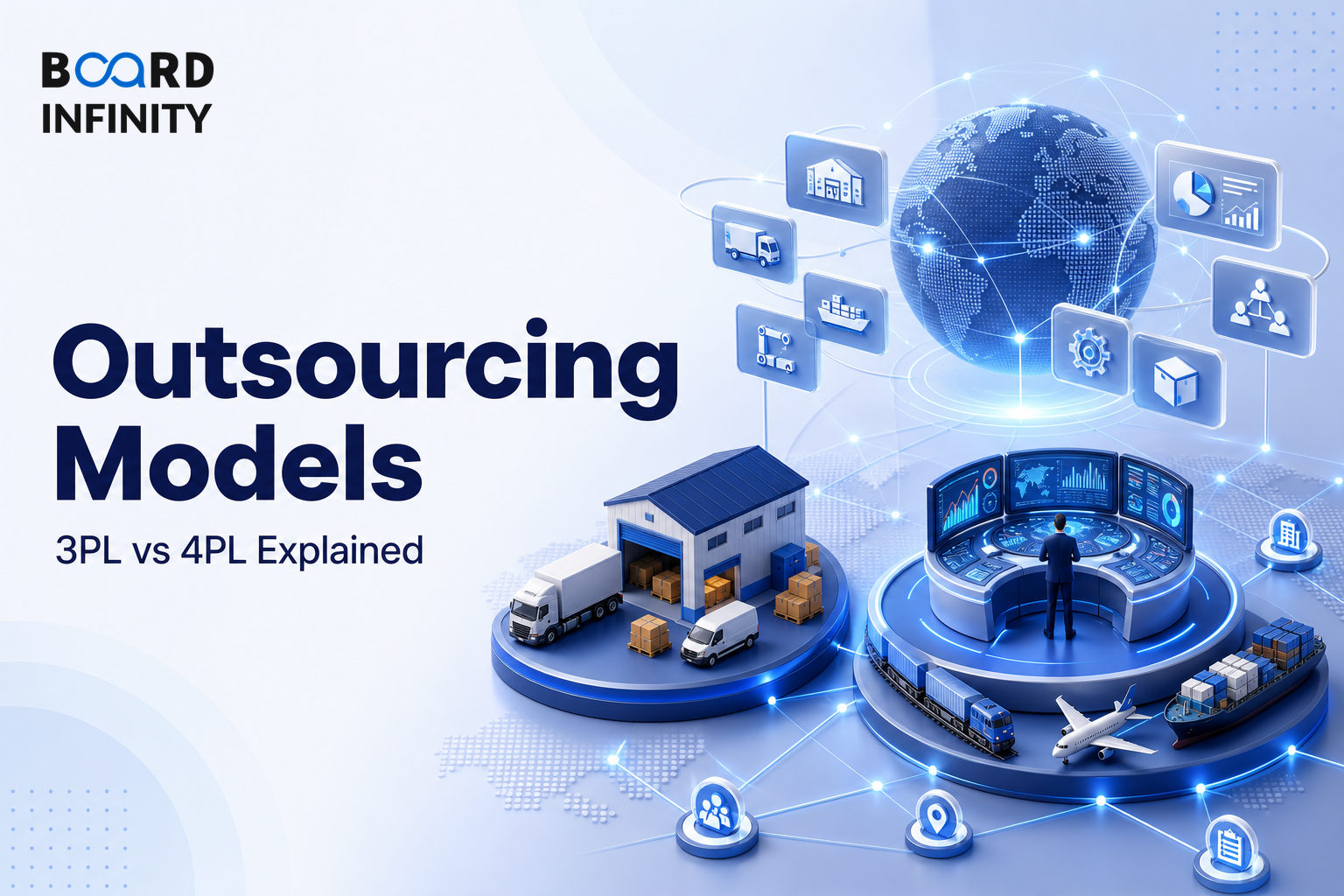
After Supplier Evaluation & Scorecards, the next question is how much logistics control a company should keep inside and how much it should outsource. Outsourcing models answer that control-versus-cost decision, moving from self-managed In-House (1PL) logistics to 4PL strategic oversight. In interviews, this matters because candidates are expected to separate outsourced operations from outsourced strategy + operations.
- In-House (1PL): Company manages own logistics, with Full control, High fixed cost, and the Indian example of Flipkart's Ekart logistics.
- 2PL: Asset-based carrier (trucking, shipping), with Moderate control level, Variable cost, and Indian examples TCI Freight, VRL Logistics.
- 3PL: End-to-end logistics management, with Outsourced operations, Variable cost, and Indian examples Delhivery, DHL Supply Chain India.
- 4PL: Supply chain orchestrator - manages 3PLs, with Strategic oversight, Premium cost, and Indian examples Accenture SCM, DHL Lead Logistics.
- 3PL (Third-Party Logistics) operates logistics on your behalf - warehousing, transport, fulfillment.
- 4PL (Lead Logistics Provider) manages your entire supply chain including multiple 3PLs - they're the orchestrator.
- 3PL = outsourced operations, 4PL = outsourced strategy + operations.
The Big Picture: From Full Control to Strategic Oversight
The outsourcing ladder moves from a company managing its own logistics to a supply chain orchestrator managing 3PLs. The control level shifts from Full control to Moderate, then Outsourced operations, and finally Strategic oversight; the cost logic shifts from High fixed cost to Variable and Premium.
How to Read the Outsourcing Model Ladder
In-House (1PL) means the company manages own logistics. The control level is Full control, the cost is High fixed cost, and the Indian example is Flipkart's Ekart logistics.
2PL means an asset-based carrier for trucking, shipping. The control level is Moderate, the cost is Variable, and the Indian examples are TCI Freight, VRL Logistics.
3PL means end-to-end logistics management. The control level is Outsourced operations, the cost is Variable, and the Indian examples are Delhivery, DHL Supply Chain India.
4PL means supply chain orchestrator - manages 3PLs. The control level is Strategic oversight, the cost is Premium, and the Indian examples are Accenture SCM, DHL Lead Logistics.
3PL vs 4PL: The Core Distinction
3PL (Third-Party Logistics) operates logistics on your behalf - warehousing, transport, fulfillment. It is the model for outsourced operations.
4PL (Lead Logistics Provider) manages your entire supply chain including multiple 3PLs - they're the orchestrator. It is the model for outsourced strategy + operations.
The clean interview line is: 3PL = outsourced operations, 4PL = outsourced strategy + operations. Example: Delhivery is 3PL, Accenture SCM is 4PL.
Control and Cost Logic
The practical decision is about control level and cost. In-House (1PL) gives Full control but comes with High fixed cost, while 3PL shifts the control level to Outsourced operations with Variable cost.
4PL is different because it is not just a logistics operator. It is a supply chain orchestrator - manages 3PLs, with Strategic oversight and Premium cost.
Indian Examples to Anchor the Answer
Use named Indian examples to make the answer concrete. Flipkart's Ekart logistics represents In-House (1PL), TCI Freight and VRL Logistics represent 2PL, Delhivery and DHL Supply Chain India represent 3PL, and Accenture SCM and DHL Lead Logistics represent 4PL.
Structuring a Outsourcing Models Interview Answer
"What is the difference between 3PL and 4PL?"
The strongest answers do not stop at saying both are outsourcing models. Separate operations from strategy + operations, then anchor the answer with Delhivery as 3PL and Accenture SCM as 4PL.
The most frequent error is treating 3PL and 4PL as the same kind of logistics vendor. That loses points because 3PL is outsourced operations, while 4PL is outsourced strategy + operations and manages multiple 3PLs.
Conclusion
Outsourcing models are best understood as a control-versus-cost ladder: In-House (1PL) gives Full control, 3PL gives outsourced operations, and 4PL gives Strategic oversight as a supply chain orchestrator. For interviews, remember the crisp distinction: Delhivery is 3PL, Accenture SCM is 4PL.