
Supplier Evaluation & Scorecards Explained
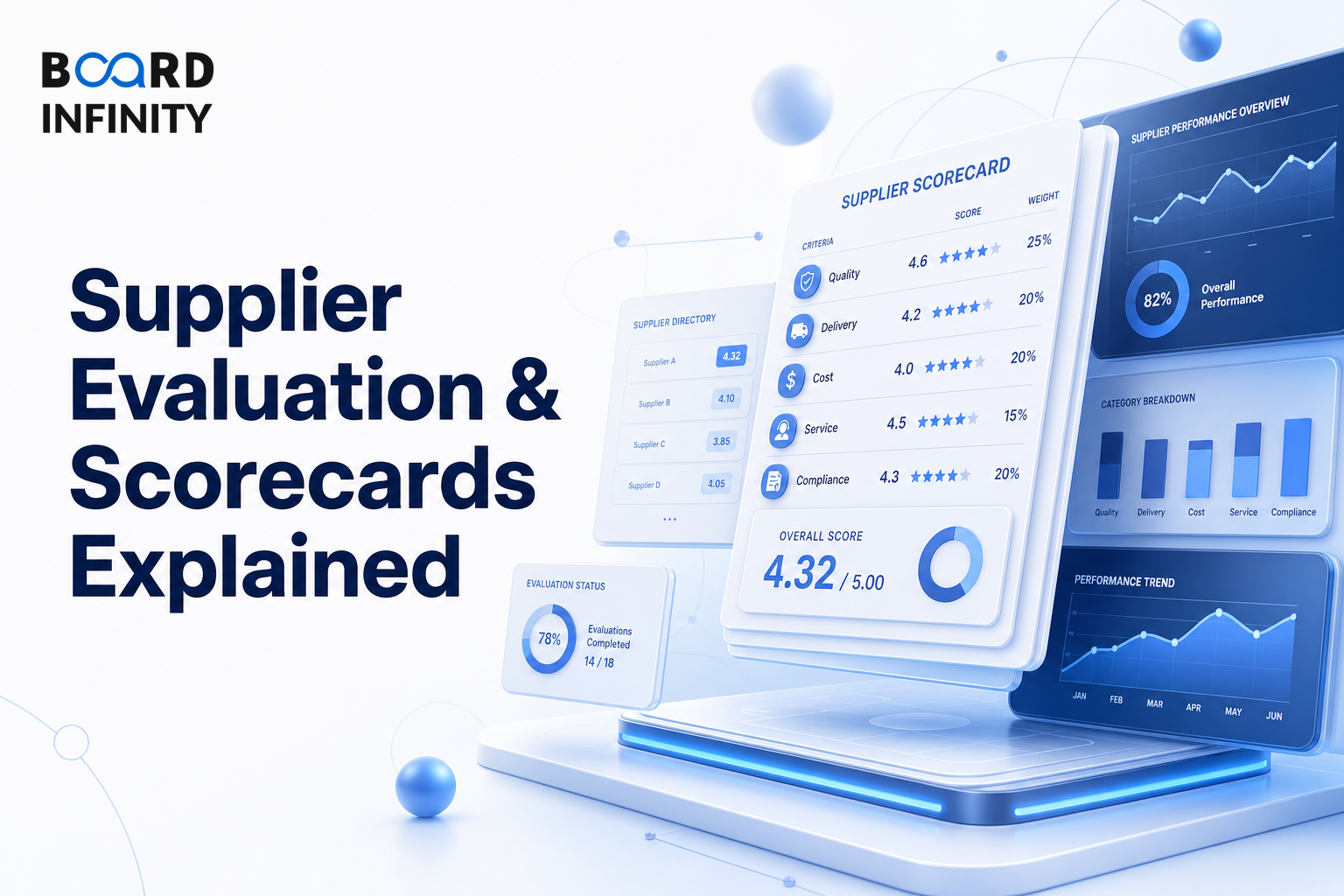
The Kraljic Matrix segments purchased items based on supply risk and profit impact, guiding differentiated sourcing strategies. Supplier evaluation answers the next question: once suppliers are shortlisted, how do you compare them objectively across quality, delivery, cost, innovation, sustainability, and responsiveness? In interviews, this matters because it shows that supplier choice is not only price-based - it is a weighted decision linked to the supplier relationship spectrum.
- Supplier evaluation uses a weighted scorecard to compare suppliers across multiple dimensions instead of relying only on price.
- The core dimensions are Quality, Delivery, Cost, Innovation, Sustainability, and Responsiveness.
- PPM means Parts Per Million defect rate, and OTIF means On-Time In-Full.
- In the scorecard, Quality has the highest weight at 30%, followed by Delivery at 25% and Cost at 20%.
- Supplier A has a Weighted Total of 87.75, while Supplier B has a Weighted Total of 83.25.
- The supplier relationship spectrum moves from Arm's Length buying to Preferred Supplier, Partnership, Strategic Alliance, and Vertical Integration.
Big Picture: From Supplier Metrics to Supplier Ranking
A supplier scorecard converts different performance dimensions into a weighted total. It compares suppliers using common metrics such as PPM, OTIF %, year-over-year cost reduction, value engineering suggestions/year, ESG compliance, green practices, and communication or issue resolution time.
The big idea is simple: a supplier may lead on one dimension, but the final decision depends on the weighted total across all dimensions.
Supplier Relationship Spectrum
The scorecard can also be linked to the type of supplier relationship. A supplier relationship can range from price-based transactional buying to ownership and full control.
How the Weighted Scorecard Works
The scorecard assigns a weight to each dimension and scores each supplier on that dimension. The weights total 100%, so the final Weighted Total becomes an objective comparison across suppliers.
In this scorecard, Supplier B performs better on Cost and Innovation. Supplier A performs better on Quality, Delivery, Sustainability, and Responsiveness. Because Quality and Delivery carry higher weights, Supplier A has the higher Weighted Total: 87.75 versus 83.25.
Worked Example: Supplier A vs Supplier B
The situation is a supplier comparison where both suppliers are assessed across Quality, Delivery, Cost, Innovation, Sustainability, and Responsiveness. The problem is that Supplier B has stronger cost reduction and more value engineering suggestions, while Supplier A has better PPM, OTIF %, ESG compliance, and response time.
The framework is the weighted scorecard. Quality is weighted at 30%, Delivery at 25%, Cost at 20%, Innovation at 10%, Sustainability at 10%, and Responsiveness at 5%. The decision follows the Weighted Total: Supplier A scores 87.75, while Supplier B scores 83.25.
The learning is that the best supplier is not necessarily the lowest-cost supplier. The objective ranking depends on how quality, delivery, cost, innovation, sustainability, and responsiveness combine in the weighted total.
Structuring a Supplier Evaluation & Scorecards Explained Interview Answer
"How would you evaluate and rank two suppliers using a supplier scorecard?"
Do not stop at cost reduction. In this scorecard, Supplier B has 5% cost reduction versus Supplier A's 3%, but Supplier A still has the higher Weighted Total because quality, delivery, sustainability, and responsiveness also matter.
The most frequent error is treating supplier evaluation as a price comparison. That costs points because the scorecard is weighted across Quality, Delivery, Cost, Innovation, Sustainability, and Responsiveness, and the final ranking comes from the Weighted Total.
Conclusion
Supplier evaluation is a weighted scorecard approach that converts supplier performance into an objective ranking. The strongest answer links the metrics to the final Weighted Total and then connects the supplier choice to the relationship spectrum from Arm's Length buying to Vertical Integration.